



Open prompts
sample 01 AI Image Prompt
sample 01, its complete AI image prompt, and the Typography & Posters · Watercolor · 3D · 240 style are free to view and copy.
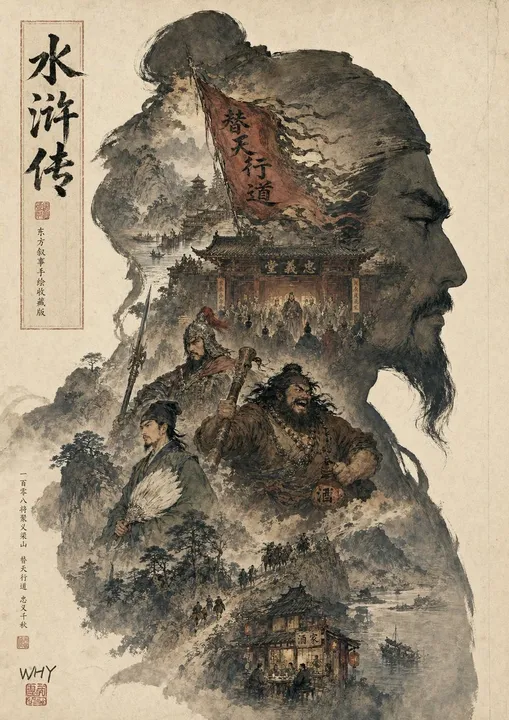
Complete AI image prompt
Distill the theme’s central meaning into a monumental side-facing contour with overwhelming visual weight, a calm and continuously recognizable outer profile that doubles as a translucent narrative mask. Let the theme generate every symbolic actor, decisive action, setting cue, artifact, and attachment inside it: anchor the interior with a mid-scale key episode, then nest several tiers of miniature scenes through overlap, frames within frames, scale recession, and pale atmospheric ink. Establish a three-step hierarchy between the immense carrier, the central episode, and the tiny narrative world. The eye should meet the complete contour first, travel in a relaxed serpentine descent through theme-derived paths and directional attachments, and end at restrained marginal information. Balance the richly occupied interior against a broad uninterrupted paper field; keep one quiet recognition plane continuous while the opposite side carries intricate storytelling, producing asymmetric dynamic equilibrium. Allow one semantically motivated attachment to cross the contour and stitch the inner world to the surrounding emptiness, while all other fragments reinforce perceptual closure. Build the image on warm ivory, uncoated xuan paper. Lay in the large tonal mass with dilute ink, define essential forms with pressure-modulated charcoal and deep umber lines, and combine gongbi-like descriptive precision with transparent mineral-pigment glazing and freehand ink wash. Confine soft absorption blooms, dry-brush tapers, and translucent layered washes to dispersing scene boundaries, landscape-like transition bands, and places where the carrier dissolves into paper; keep the theme’s highest-recognition surface finely resolved and continuous, with paper fibers visible only through open fields and thin washes. Let paper tone dominate the area, use ink black and smoky brown for the value skeleton, and derive a muted supporting family from the theme to separate story levels. Repeat a very small amount of cinnabar-warm red, or an equally intense theme-native accent, across the directional attachment, pivotal costume or material details, organic connector motifs, and compact seal-like marks. Give the key inner episode a gentle local lift in luminosity, compressing distant layers into progressively paler ink. Set the theme name or essential phrase as large expressive lettering whose stroke weight follows pressure, whose ink transitions feel materially continuous, and whose glyph topology remains unmistakable; position it in a comparatively open margin so it acts as a light counterweight to the dense carrier. Reduce supporting copy to slender marginal columns and a few square seal-like information nodes. For any target writing system, preserve valid stroke anatomy, counters, terminals, joins, spacing rhythm, orthographic recognition, and natural reading direction, allowing lettering to pace the image while preserving the main form’s continuity. Sustain the hush, poetry, and theatrical tension of a classical narrative scroll while letting story content, symbolism, palette source, and ornamental density respond to the theme; the invariant signature is a monumental contour containing a multi-scale world, breathable paper emptiness governing density, and exact linework merging into expressive ink.
More open images in the “Typography & Posters · Watercolor · 3D · 240” style