



Open prompts
sample 01 AI Image Prompt
sample 01, its complete AI image prompt, and the Infographics & Visual Guides · 3D · Paper Texture · 151 style are free to view and copy.
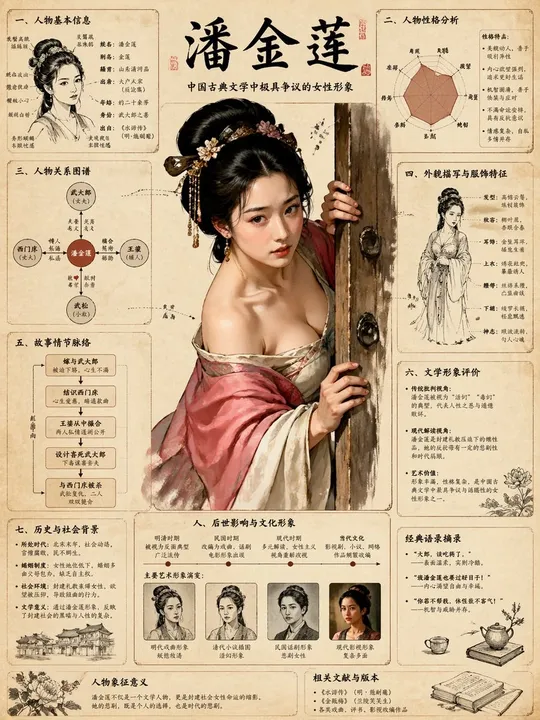
Complete AI image prompt
Build a dense editorial knowledge plate on warm fibrous parchment, organized as a stable but slightly irregular archive grid around one commanding axial subject. The central subject must carry the greatest visual weight, beginning beneath the headline and extending deep into the lower field; render it with finely modeled, near-real painted volume, soft directional light, tactile surface detail, and a restrained theme-derived palette richer than the surrounding ink work. Let a hand, edge, appendage, or defining component cross nearby rules and engage a narrow vertical structural element through overlap, grip, support, or concealment, so dimensional reality appears to break into the flat document. Reserve a concentrated pocket of space above for a broad display headline made of forceful hand-drawn strokes, with abrupt weight shifts, sharp terminals, slight dry-brush breakup, and compact explanatory copy below. Rebuild all visible wording from the new theme while preserving a clearly readable hierarchy of headline, numbered section heads, labels, notes, and captions. Pack the side and lower zones with thin brown-ink rounded panels containing evidence cards, relational diagrams, radial metrics, step sequences, feature notes, timelines, quotations, and source-like entries; keep the flanks information-heavy and the center comparatively open. Route the eye from headline to hero subject, down both panel columns, then into a horizontal synthesis band. Use arrows, dotted connectors, oxblood nodes, and small diagram marks both as navigation and as visual evidence pointing back toward the subject. Repeat the theme object in selected modules as delicate black-ink studies, cropped details, and small evolutionary variants, allowing analytical line art to corroborate the dimensional centerpiece. Limit the ground to parchment cream, ink black, deep brown, muted brick red, dusty rose, and low-chroma colors sampled from the theme; avoid luminous digital gradients. Unify fine contour drawing, pale ink wash, watercolor blooms, opaque paint scuffs, subtle paper mottling, gentle bleed, imperfect registration, and minute hand-drawn rule wobble. Keep aging quiet and material, never decorative; let a few painted edges dissolve into the sheet while diagrams remain light, precise, and handmade. The finished image should read at once as a dramatic subject-centered portrait of an idea and as a disciplined, collectible archival infographic, balancing editorial clarity, scholarly density, and authentic printed irregularity.
More open images in the “Infographics & Visual Guides · 3D · Paper Texture · 151” style