



Open prompts
sample 01 AI Image Prompt
sample 01, its complete AI image prompt, and the Travel, Cities & Architecture · Printmaking · Watercolor · 065 style are free to view and copy.
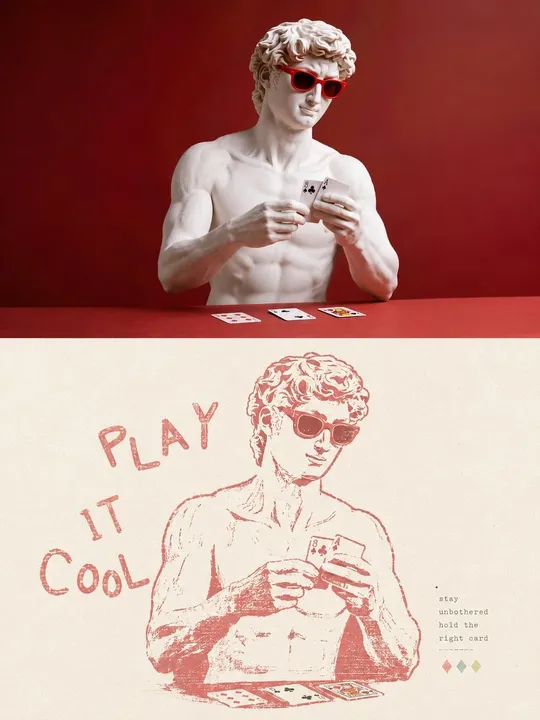
Complete AI image prompt
Reduce the theme’s most recognizable subject, action, or scene into a calm editorial illustration with an immediately legible silhouette and one dominant visual mass. Let a few supporting forms follow the subject’s gesture, gaze, or environmental direction to create a quiet reading loop, balanced across generous pale negative space by one title group; step the remaining information down through a short caption, tiny notations, fine rules, and one or two theme-derived symbols at the margins. Build the imagery from two interlocking rendering grammars. Give the focal subject’s expression, pose, organic detail, folds, and intricate contours the character of a hand-cut relief print: breathing variations in contour weight, directional hatching separated by open paper, and solid ink whose small interruptions remain confined to the carved areas where fibrous stock absorbs the impression, with detail thinning outward from the perceptual center. Carry architecture, sky, ground, vessels, and broad environmental planes with rounded simplified shapes, flat color, restrained soft shadows, and crisp continuous edges, so the handmade focal mark sits inside a light, orderly field. When a large setting or still life carries the theme, let clean geometric planes hold most of the mass and reserve the printed marks for decisive contours, lettering, and selected textures; when character and intimate gesture carry it, increase the carved-line density while keeping faces, hands, and the narrative object unmistakable. Derive three to five low- or medium-chroma spot colors from the theme’s emotional temperature and material associations over a warm paper-white field: one structural dark, one or two broad subject and environment colors, and a brighter warm accent restricted to the emotional hinge. Use unequal color areas for extension contrast, let paper white participate in modeling, and allow slight local registration drift only where printed color meets the focal linework. Set the headline in restrained, approachable editorial lettering selected from a narrow sans, an unpretentious serif, or a typewriter-like construction according to the theme; preserve valid target-script anatomy, open counters, relaxed line spacing, and a decisive scale jump. Place it in the negative space released by the subject, sharing the illustration palette and echoing its contour rhythm. Reduce the background to the layers needed for place, scale, and atmosphere, compress distant contrast and detail, and use one small foreground form or fine linear element as a scale anchor. Keep the narrative specific, the spatial hierarchy airy, the focal recognition strong, and the overall mood warm, observant, quietly humorous, and gently restorative.
More open images in the “Travel, Cities & Architecture · Printmaking · Watercolor · 065” style