



Open prompts
sample 02 AI Image Prompt
sample 02, its complete AI image prompt, and the Good Morning & Daily Greetings · Good Morning · 3D · 182 style are free to view and copy.
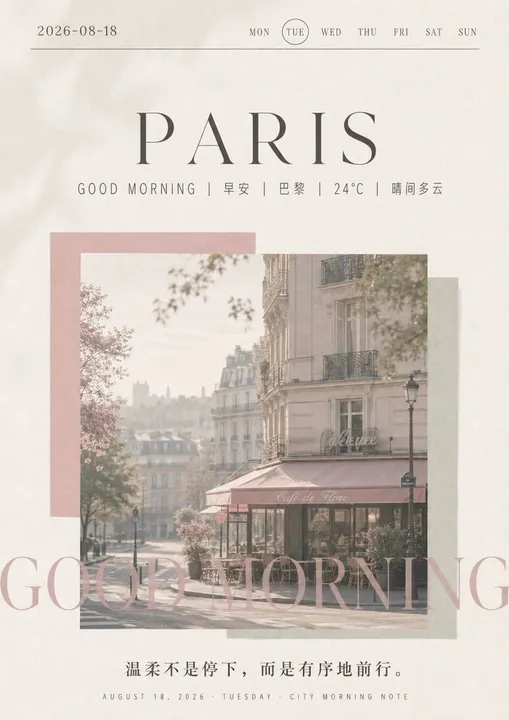
Complete AI image prompt
Build the first read around a tactile calendar sheet holding a physical photograph while one oversized greeting crosses the photograph’s boundary. Translate any subject into its most recognizable scene, object, or abstract idea and let it inhabit a documentary-style image with convincing depth, a clear focal hierarchy, and a broad white instant-photo border; give this print a slight rotation, a soft contact shadow, and a small strip of translucent tape on a warm matte off-white paper field. As a bounded mounting variation, square the photograph into a clean rectangular crop and offset two muted translucent color-paper blocks behind it, but keep the image unmistakably dominant. Govern the page with a calm single-axis editorial grid that coordinates a date, weekday, large subject name, short salutation, compact status or weather line, brief reflective copy, and a minute footer. Create a decisive scale jump between image and supporting information, align small type on shared baselines with generous tracking, and use broad intervals of empty paper to separate layers. Lead the eye from the date and display name into the photograph, through the boundary-crossing greeting, then down to the closing line; let the print and greeting break the grid in a controlled way so unequal masses remain poised. Set the display name in an elegant high-contrast serif structure with tall firm stems, hairline cross strokes, open counters, sharp terminals, and spacious letter rhythm. Use narrow fine-line lettering for metadata, with wide tracking and restrained optical weight; keep any target writing system anatomically correct, highly legible, and coordinated by visual weight rather than nominal size. Turn the shortest emotional salutation into a subject-derived graphic mark: either stretch very large translucent serif glyphs across the lower image edge and surrounding paper, or use authentic brush lettering with visible pressure changes, decisive entries and exits, and dry-brush gaps confined to the strokes as it overlaps one corner of the print. In both modes, the lettering must physically intersect the photograph and remain orthographically recognizable. Let the subject determine imagery, symbols, copy, material associations, and hue family. Preserve a luminous warm-white majority field, deep ink for information, the photograph as the main color source, and a single low-chroma misted accent sampled from the subject for backing paper, brushwork, or a pale painted echo. Keep the overall value key bright with low-to-moderate contrast. Within the pictured world, oblique morning light should make soft elongated shadows, gentle atmospheric depth, and a quiet lived-in warmth. Render fine cotton-pulp fibers only across the background sheet and white print border while the photographic area stays naturally clear; make the print edge substantial, the tape translucent, contact shadows delicate, and printed ink even. Outside the image, allow only a faint subject-derived contour drawing, botanical-like directional motif, distant silhouette, or diluted watercolor wash to recede through the empty margins as an environmental echo. Maintain the information cadence of date anchor, subject identity, image core, emotional greeting, and concise closing thought, producing an orderly, touchable editorial diary page illuminated by morning calm.
More open images in the “Good Morning & Daily Greetings · Good Morning · 3D · 182” style