



Open prompts
sample 02 AI Image Prompt
sample 02, its complete AI image prompt, and the Infographics & Visual Guides · Calming · 132 style are free to view and copy.
Complete AI image prompt
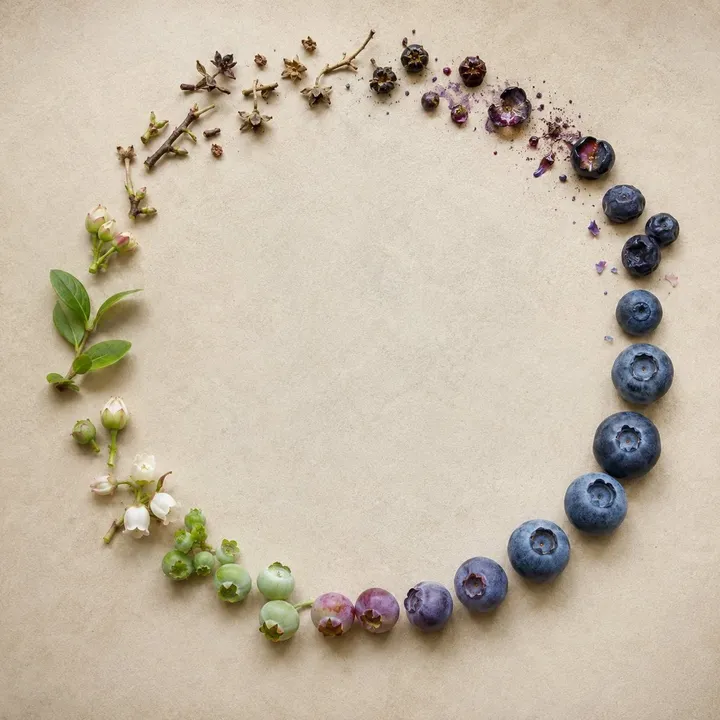
Build the subject into an almost closed circular sequence with a deliberate breathing gap, using its own recognizable whole forms, developmental variants, internal components, attachments, and residual traces. Give one arc a few large, full, complete carriers that establish visual weight, then guide the eye in one continuous direction through smaller emerging forms, cut or separated states, scattered fragments, slender connectors, and finally germinating or dissolving traces, so a cycle of formation, maturity, disassembly, and renewal is understood entirely through physical transformation. Let the subject redefine every object, silhouette, material, symbol, attachment, and color source while preserving the progression from whole to fragmentary, heavy to light, explicit to residual. Use radial continuity and perceptual closure as the spatial skeleton: the object band occupies the outer field while an uninterrupted central void remains far broader than the band; the opening and sparse passages release tension. Distribute weight asymmetrically, balancing the densest cluster with a longer, lighter counter-sequence and controlled spacing; enter through the largest, most chromatic form and travel around the ring through scale reduction, density shifts, and state changes. Avoid a uniform bead rhythm by clustering complete forms, allowing theme-derived stems, filaments, branches, or structural links to carry the curve, then progressively separating slices, shells, cores, components, and minute remnants. Reveal the process at one or two transitions through a cut, opening, fracture, or small spill, keeping even the tiniest pieces crisply legible and intentionally spaced. Photograph the arrangement directly from above on one continuous pale warm-neutral matte surface whose restrained natural tonal variation supports organic materials and preserves the calm central field. Concentrate subject color in the complete forms, then develop a controlled stage-linked shift in saturation, value, depth, or material freshness around the circle; keep the warm neutral ground overwhelmingly dominant and reserve complementary accents for tiny theme-equivalent nodes such as exposed interiors, seeds, droplets, or reproductive details. Shape volume with broad soft natural light from an oblique upper side, rounded highlights, and short directional shadows that remain close to each object; larger forms carry slightly deeper contact shadows while fragments cast only light impressions. Render truthful scale, skin, fibers, translucent edges, exposed interiors, moisture, and dry matter according to each stage. The first read must remain the union of the silent central void, open lifecycle ring, continuous transformation, and materially credible still-life observation, precise and restrained yet quietly poetic.
More open images in the “Infographics & Visual Guides · Calming · 132” style