



Open prompts
sample 03 AI Image Prompt
sample 03, its complete AI image prompt, and the Presentations & Courseware · Paper Texture · Bright · 295 style are free to view and copy.
Complete AI image prompt
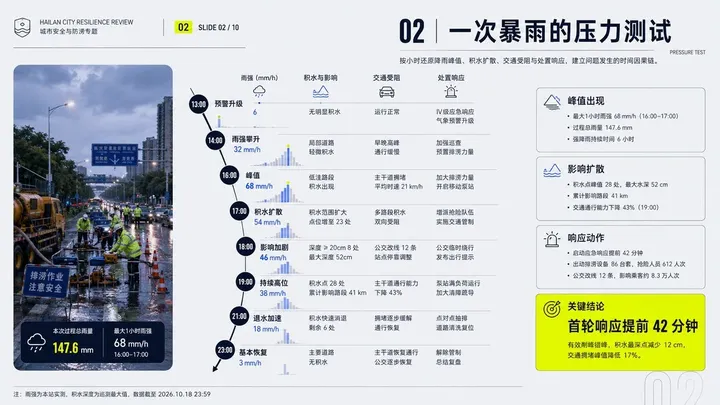
Make the first read a conversion of verifiable field evidence into an unambiguous decision: let the subject generate documentary photography with environmental depth, visible action, and natural light, then derive its data, nodes, relationships, phases, findings, and recommended actions into one disciplined editorial information system. Govern the space with an asymmetric modular grid: a dominant evidence field occupies roughly two thirds of the area while a narrow side rail, header navigation, and marginal notes provide a light counterweight. On cover-like compositions, balance a large rounded photographic field against a nearly equal mass of tightly set display type; on analytical compositions, give the map, timeline, process, or principal chart the largest visual territory and attach compact cards around its edges. Lead the eye from an oversized section number and headline through the core evidence, then arrest it at one highlighted conclusion. Build a dramatic hierarchy with very heavy, condensed, deep-navy display lettering and key numerals, using square terminals, tall narrow proportions, and clearly opened counters while preserving valid anatomy in the chosen writing system; set supporting multilingual copy in restrained sans serif forms with generous leading, exact baselines, and fast scanning rhythms created by weight and blue emphasis across figures, units, and short labels. Connect information with hairline gray rules, thin outlined rounded cards, capsule indices, concise arrows, and theme-derived monoline icons sharing one stroke weight and open contours. Layer complex evidence through pale base diagrams, translucent categorical regions, nodes, markers, miniature bar and line charts, and brief annotations; embed small documentary images inside selected cards as factual and scale anchors. Leave broad fields of cool bright paper white, use navy for authority and hierarchy, gray-blue for diagrams and infrastructure, and permit limited blue, cyan, violet, and orange as subject-driven data codes. Reserve high-energy fluorescent yellow-green for page-number chips, short key rules, and a single action-conclusion panel so it repeats as the decision signal across the system. Keep the background evenly matte, edges crisp, and shadows extremely shallow; resolve dense passages through grouping, alignment, spacing, and line-weight contrast. Carry the same identity header, numbering logic, title scale, corner radius, and footer-note rhythm across the set, while allowing the central evidence structure to vary within bounds among photography, spatial diagrams, chronological paths, matrices, gauges, profile records, and phased processes according to the subject, sustaining a calm, credible, action-oriented research-report character.
More open images in the “Presentations & Courseware · Paper Texture · Bright · 295” style