



Open prompts
sample 03 AI Image Prompt
sample 03, its complete AI image prompt, and the Traditional Culture · Paper Texture · Bright · 045 style are free to view and copy.
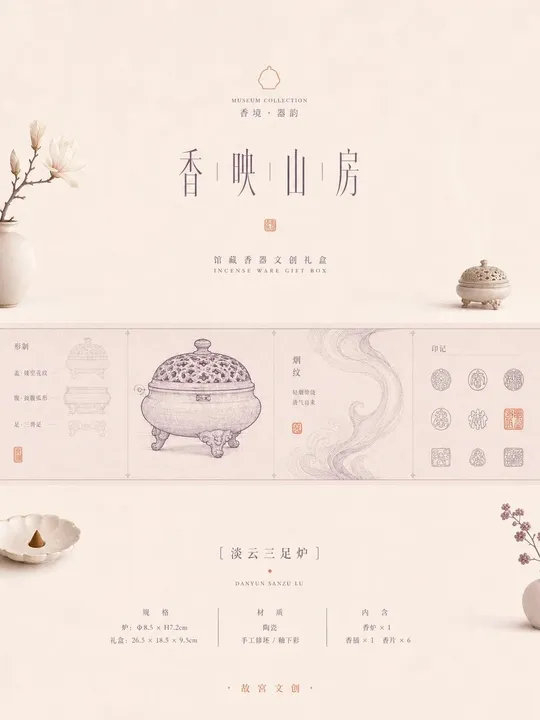
Complete AI image prompt
Split a broad, quiet field of negative space with one narrow archival spine that runs continuously through the composition. Compress the densest material into this strip: enlarged theme-derived forms, fine documentary drawings, marginal notes, proportional marks, and small seals. Keep only a restrained title hierarchy, dates, captions, and a few subject-generated artifacts outside it, so the eye enters through the spine, travels along its segmented evidence, and resolves at a peripheral object or information node. Build asymmetrical equilibrium from an overwhelmingly open field and two unequal anchors, the slender spine and the display title; align the smaller blocks to disciplined columns and baselines with generous intervals, then let one physical carrier touch an edge or cross a module as the sole controlled break. Recast any subject as three mutually confirming forms: a recognizable physical carrier rendered under soft studio illumination with a shallow contact shadow; monochrome contour studies, cross-sections, pattern fragments, measured diagrams, and annotated details distilled from that carrier; and compact seals, emblems, symbols, plus one small supporting object derived from the subject's meaning to create pause, scale, and ceremony. Use tall, fine display lettering native to the requested writing system, with clear stroke contrast, open spacing, valid glyph topology, and either columnar stacking or widely separated word groups. Reduce supporting text to delicate short columns, numbering, hairline rules, and spacious leading; letters and numerals serve only chronology and catalogue rank. Derive a controlled two-color family from the subject's history, material associations, and emotional temperature: a large low-chroma dark field or warm paper-white field, a narrow band in the opposing value, linework and type in a related dark tone, and extremely limited mineral-warm, metallic, or vermilion seal accents. Maintain restrained saturation, a crisp value hierarchy, and a narrow color gamut. Render the outer field as an even matte paper plane or flat color field; confine fine paper fibers, shallow impressions, and naturally varied ink absorption to the archival spine while the surrounding emptiness remains continuous and soft. Keep physical objects clearly edged without brittle sharpness, drawings precise with stable hairlines and selective engraved hatching, and seals small and concentrated. The result should unite the authority of a curated historical folio, the clarity of contemporary museum display, and the hush of a formal ritual: subject matter may change completely, while the continuous archival spine, evidentiary sequence, expansive pauses, exact type-image hierarchy, and dialogue between object and diagram remain invariant.
More open images in the “Traditional Culture · Paper Texture · Bright · 045” style