



Open prompts
sample 03 AI Image Prompt
sample 03, its complete AI image prompt, and the Portraits, Weddings & Photography · Glass · Bright · 093 style are free to view and copy.
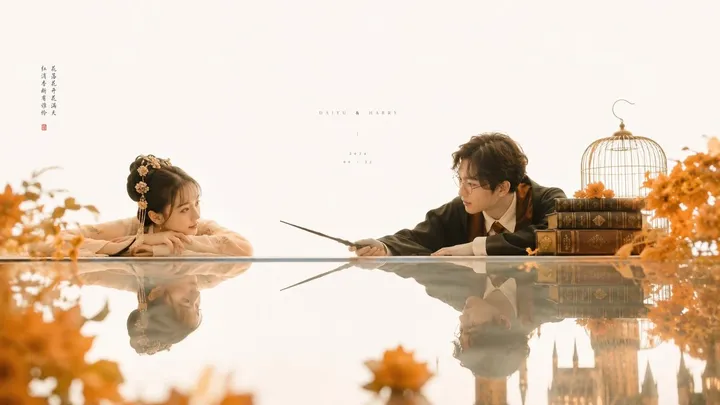
Complete AI image prompt
Build the first read around two theme-derived primary forms in a quiet visual dialogue, connected by exchanged gazes, directional gestures, or one delicate bridging action, then hinge the visible world to its reflection along a low horizontal mirror plane. Keep each form close to that seam and continue its silhouette, posture, and theme-specific attachments downward in a clearly corresponding inverted image; let the reflection remain complete near contact, slightly softer and darker, then gently dissolve with distance so intimacy and vertical reversal register at once. Govern the space with a stable horizontal axis and dynamic balance across a generous central interval: the opposing masses may be near-equal or deliberately unequal, but their orientation and extensions must create an invisible line through the emptiness. Let the paired forms and reflections carry the lower visual weight while an expansive luminous field above isolates them. Suspend restrained micro-typography near the optical axis as a breathing point, using very small high-contrast letterforms, wide tracking, sparse line spacing, and valid anatomy for the chosen writing system; wording, language, names, and date derive from the theme. Use enveloping high-key illumination, an airy transition from luminous off-white into the palest tint supplied by the subject, and soft backlight around contours while preserving precise faces, material cues, and meaningful ornaments. Derive the palette from the theme's emotional temperature and material associations: a broad low-chroma light field supports deep structural forms, while one memorable accent family is concentrated in surfaces, garments, botanical or object attachments; its temperature may move from cool violet or ice blue to warm red or amber, but the light-field, dark-skeleton, limited-accent proportion remains fixed. Establish scale and narrative only through distant low-contrast silhouettes, reflected architectural or natural extensions, and a few theme-native props near the outer edges, leaving the central air open. Allow a restrained layer of related foliage, crystalline bokeh, or softened thematic shapes to enter out of focus from the lower and side edges, creating foreground framing and depth. The theme determines the identity, materials, symbolism, relationship, interaction, attachments, and environmental cues of the paired carriers, with every detail drawn from one coherent narrative source. Render with delicate photographic realism, soft cinematic diffusion, a continuous glass- or water-like mirror surface, legible contact edges, clear luminous highlights, and a unified hierarchy of real layer, reflected layer, abundant negative space, and miniature information, producing a serene, romantic, ceremonial atmosphere.
More open images in the “Portraits, Weddings & Photography · Glass · Bright · 093” style