



Open prompts
sample 03 AI Image Prompt
sample 03, its complete AI image prompt, and the Infographics & Visual Guides · Solar Terms · 3D · 155 style are free to view and copy.
Complete AI image prompt
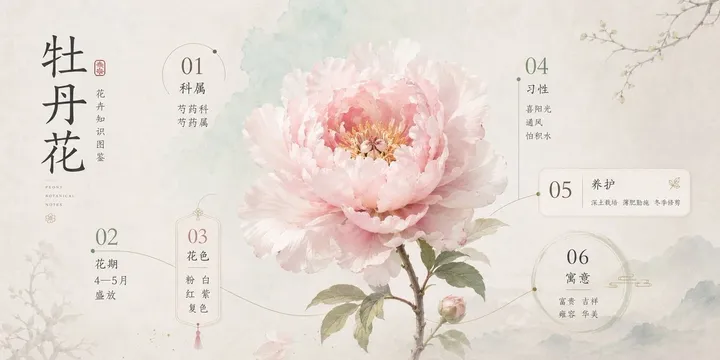
Build the first read around one greatly enlarged, specimen-like expression of the subject’s most recognizable form, rendered with precise natural structure and translucent watercolor softness; keep its silhouette coherent while allowing selected contours or attachments to cross the information grid. Let the subject generate its own symbolism, secondary details, narrative cues, and a restrained pastel family, supported by ivory paper white, misty neutrals, and quiet organic hues, with only a small warmer or deeper concentration inside the focal form. Organize the image as an elegant East Asian knowledge atlas: the main form carries several times the visual weight of all supporting elements, a large column of vertically set Chinese display lettering acts as a calm calligraphic anchor, and roughly six compact knowledge nodes orbit the remaining open space. Each node uses a tall serif numeral, a short heading, and two or three concise lines in a clear three-level hierarchy; hairline stems, short elbow leaders, dots, and fine arcs follow the subject’s perimeter, with a few connections passing behind the focal form or spanning open paper as controlled breaks in the editorial grid. Construct the Chinese title with a high-contrast Ming/Song-derived skeleton, strong upright verticals, fine horizontals, crisp restrained terminals, valid glyph anatomy, and generous spacing; use smaller, lighter Chinese print text for annotations and a minute, widely tracked Latin taxonomic line only as a density counterpoint. Set everything on a luminous, warm, uncoated-paper field. Near the outer margins, allow very pale subject-derived watercolor veils, distant silhouettes, or botanical-like contour motifs to diffuse into the paper and recede around the focal object, joining the negative space through cool-warm atmospheric transitions while preserving its readable edge. Use enveloping high-key illumination with milky translucent highlights, feather-light shadows, and shallow focus limited to subordinate attachments; retain fine detail at the center of attention. Bound decorative variation to a few thin rings, framed labels, narrow hanging plaques, seal-like micro-marks, and tiny subject symbols, all drawn with hairline strokes, ample internal padding, and quiet precision so every annotation belongs to the same refined atlas sheet. Maintain asymmetric dynamic equilibrium among the dominant specimen, the vertical title mass, and the numbered notes: the eye lands on the subject, receives its tone from the title, then travels slowly through leaders and numbers, while broad untouched intervals create pauses. The finish is soft, bright, contemplative, and quietly scholarly, with an even clean paper surface, continuously gentle edges, stable dark-gray ink, and sharply legible type.
More open images in the “Infographics & Visual Guides · Solar Terms · 3D · 155” style