



Open prompts
sample 06 AI Image Prompt
sample 06, its complete AI image prompt, and the Typography & Posters · X Archive · 236 style are free to view and copy.
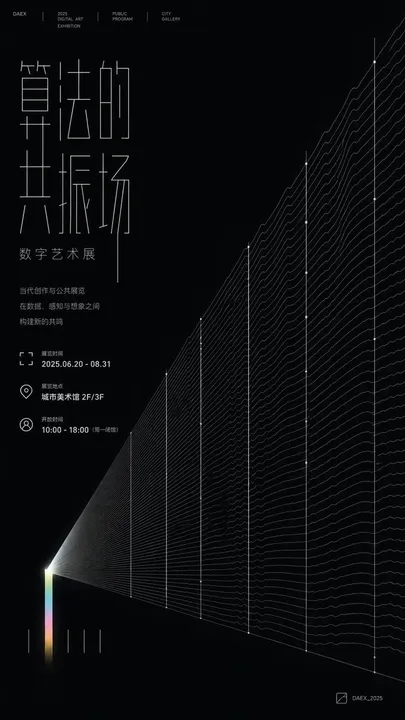
Complete AI image prompt
Build the first read around an immense theme-derived headline or iconic semantic form that carries more than two thirds of the visual weight, spans across an environmental image or abstract spatial system, and occasionally crosses the grid, meets a frame edge, or passes behind a foreground plane so type, subject, and space become one visual landscape. Govern the remaining content with an asymmetric editorial grid: grouped captions recede into narrow columns, stacked cards, numerals, hairline rules, and widely spaced peripheral microcopy; lead the eye from the dominant form through one thematic focal point and a compact functional sequence, then release it into sparse identity and action information. Keep repeated modules precisely aligned and evenly paced, with only one deliberate structural breach. Let the subject determine imagery, symbols, materials, and narrative, choosing a depth-rich photographic environment or translating its defining behavior into a geometric light field with radial or single-point convergence, layered planes, luminous filaments, fine dot matrices, and disciplined line arrays; preserve distinct foreground, middle, and distant layers plus a broad quiet field that isolates the focal event. Construct display lettering through valid anatomy for the chosen writing system: retain recognizable glyph topology and component balance while stretching proportions, sharpening stroke contrast, enlarging counters, extending selected strokes, or embedding a single system of lines and dots. Set supporting copy small, widely tracked, baseline-true, and separated by abrupt scale jumps; balance multiple scripts by optical weight rather than nominal size. Derive color from the subject as one restrained low-chroma field, structural lights and darks, and one concentrated warm accent or cool emission reserved for a headline fragment, divider, node, or focal light. The luminous mode uses airy high-key diffusion and transparent depth; the dark mode uses a deep field, cool emitted light, and sparse warm reflections, both with controlled chroma and a decisive focal contrast. Render real materials with credible reflection, transmission, and contact shadows, while graphic layers use continuous light threads, uniform fine lines, and sharply resolved points. Use thin frames, restrained icons, indexing numbers, code-like information blocks, and short rules only as measures of scale and order. Keep card corners exact, shadows shallow but layered, linework crisp, and photographic-to-graphic transitions precise, producing calm executive hierarchy, engineered detail, and understated luxury.
More open images in the “Typography & Posters · X Archive · 236” style