

Open prompts
en sample 01 AI Image Prompt
en sample 01, its complete AI image prompt, and the XXD Panel 030 · Nature Unbound style are free to view and copy.
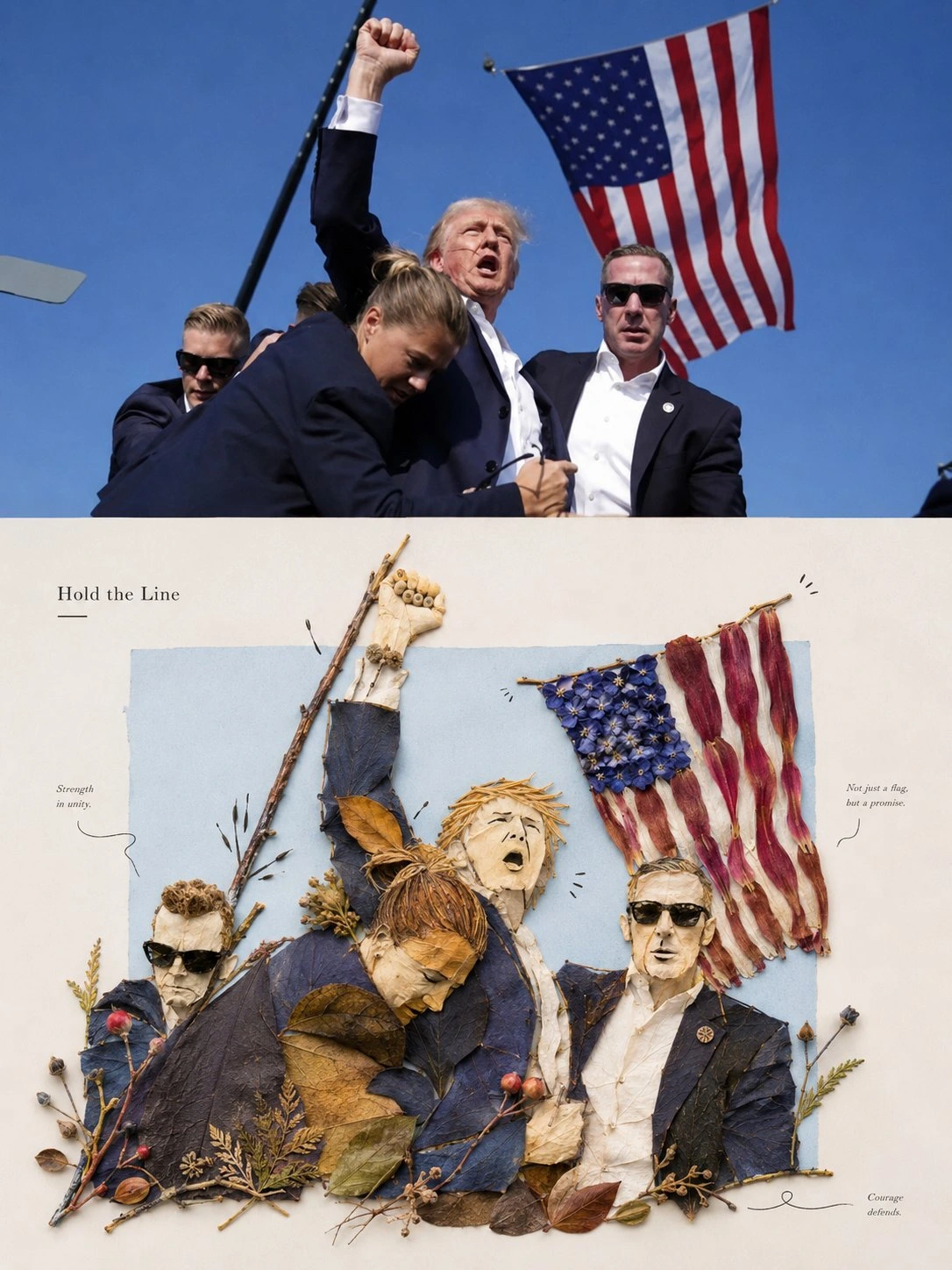
Complete AI image prompt
Please make every photo I upload into its own standalone high-end design poster; no multi-image collages, each photo output separately. The overall composition uses a 3:4 vertical format, with the upper and lower zones strictly 1:1 in height, each taking up 50% of the frame.

The upper half keeps the original photo, preserving the subject's structure, real texture, natural light and shadow, and original color atmosphere, applying only a slight high-end photographic color grade so that it carries the texture of art magazines, independent publications, and exhibition photography. To fit the frame, the sky, ground, or environmental background may be extended naturally, but the subject must not be stretched, distorted, or altered.

The lower half extracts the most recognizable **subject, outline, pose, and narrative relationships** from the photo and reconstructs them into an editorial illustration assembled from real natural materials. Use clearly identifiable leaves, petals, twigs, fruits, seeds, grass stems, bark, or dried leaves, directly employing their original shapes, textures, color variations, and irregular edges to compose the subject. Do not cut the plant matter into overly precise geometric shapes, and do not enclose it within illustrated outlines; let viewers both recognize the original subject and clearly see that it has been ingeniously assembled from real natural elements.

The composition establishes order with a simple rectangular color field or paper area, but does not deliberately draw a complete border. Maintain a natural inside-outside relationship between the subject and the rectangle: most of the subject lies within the color field, while a small number of its most directional parts extend naturally beyond the boundary, giving the image a relaxed sense of crossing the edge—as though the plants simply happened to grow out of the layout, rather than being deliberately posed to “break the frame.” Retain large areas of negative space, a clear visual center of gravity, and incomplete symmetry, allowing the chance qualities of natural materials to coexist with the order of editorial design.

Black lines appear only as **an extremely limited supporting language**, and do not outline the entire subject. They may be used for eyes, mouths, minimal expressions, hints of tiny movements, local connections, short strokes, handwritten traces, or a subtle visual rhythm within the layout. Keep the lines fine, relaxed, and slightly hand-drawn, letting the plants themselves carry the subject's form and outline.

Extract the most vital and recognizable color character from the photo above, then reinterpret it through the colors of the natural plant matter itself. Preserve the real composite color variations of leaves, petals, fruits, and dried branches without over-unifying them through dyeing; use a light or softly mixed background color coordinated with the original image so that the natural materials become the visual center of the image, with the overall result fresh, restrained, full of vitality, and uncluttered.

Keep text to an absolute minimum and use it as a lightweight element in the editorial design. From the photo's mood, action, relationship, or metaphor, distill a short title and a small number of micro-annotations, which may sit close to the edge of the rectangular color field, float within the negative space, or align ingeniously with the direction of a twig or leaf. It must not overpower the subject or become a conventional poster title.

The overall result presents the visual relationship of **real natural materials × subtle black hand-drawn marks × geometric color field × natural boundary crossing**, maintaining a handmade, clever, relaxed, poetic, high-end editorial feel. Avoid complete black outlines, plants cut into regular color blocks, children's leaf collages, deliberate boundary crossing, cartoon collages, and template-based compositions.
Original style prompt
Please make every photo I upload into its own standalone high-end design poster; no multi-image collages, each photo output separately. The overall composition uses a 3:4 vertical format, with the upper and lower zones strictly 1:1 in height, each taking up 50% of the frame.

The upper half keeps the original photo, preserving the subject's structure, real texture, natural light and shadow, and original color atmosphere, applying only a slight high-end photographic color grade so that it carries the texture of art magazines, independent publications, and exhibition photography. To fit the frame, the sky, ground, or environmental background may be extended naturally, but the subject must not be stretched, distorted, or altered.

The lower half extracts the most recognizable **subject, outline, pose, and narrative relationships** from the photo and reconstructs them into an editorial illustration assembled from real natural materials. Use clearly identifiable leaves, petals, twigs, fruits, seeds, grass stems, bark, or dried leaves, directly employing their original shapes, textures, color variations, and irregular edges to compose the subject. Do not cut the plant matter into overly precise geometric shapes, and do not enclose it within illustrated outlines; let viewers both recognize the original subject and clearly see that it has been ingeniously assembled from real natural elements.

The composition establishes order with a simple rectangular color field or paper area, but does not deliberately draw a complete border. Maintain a natural inside-outside relationship between the subject and the rectangle: most of the subject lies within the color field, while a small number of its most directional parts extend naturally beyond the boundary, giving the image a relaxed sense of crossing the edge—as though the plants simply happened to grow out of the layout, rather than being deliberately posed to “break the frame.” Retain large areas of negative space, a clear visual center of gravity, and incomplete symmetry, allowing the chance qualities of natural materials to coexist with the order of editorial design.

Black lines appear only as **an extremely limited supporting language**, and do not outline the entire subject. They may be used for eyes, mouths, minimal expressions, hints of tiny movements, local connections, short strokes, handwritten traces, or a subtle visual rhythm within the layout. Keep the lines fine, relaxed, and slightly hand-drawn, letting the plants themselves carry the subject's form and outline.

Extract the most vital and recognizable color character from the photo above, then reinterpret it through the colors of the natural plant matter itself. Preserve the real composite color variations of leaves, petals, fruits, and dried branches without over-unifying them through dyeing; use a light or softly mixed background color coordinated with the original image so that the natural materials become the visual center of the image, with the overall result fresh, restrained, full of vitality, and uncluttered.

Keep text to an absolute minimum and use it as a lightweight element in the editorial design. From the photo's mood, action, relationship, or metaphor, distill a short title and a small number of micro-annotations, which may sit close to the edge of the rectangular color field, float within the negative space, or align ingeniously with the direction of a twig or leaf. It must not overpower the subject or become a conventional poster title.

The overall result presents the visual relationship of **real natural materials × subtle black hand-drawn marks × geometric color field × natural boundary crossing**, maintaining a handmade, clever, relaxed, poetic, high-end editorial feel. Avoid complete black outlines, plants cut into regular color blocks, children's leaf collages, deliberate boundary crossing, cartoon collages, and template-based compositions.
More open images in the “XXD Panel 030 · Nature Unbound” style