



Open prompts
en sample 03 AI Image Prompt
en sample 03, its complete AI image prompt, and the XXD Panel 041 · Isometric Lab style are free to view and copy.
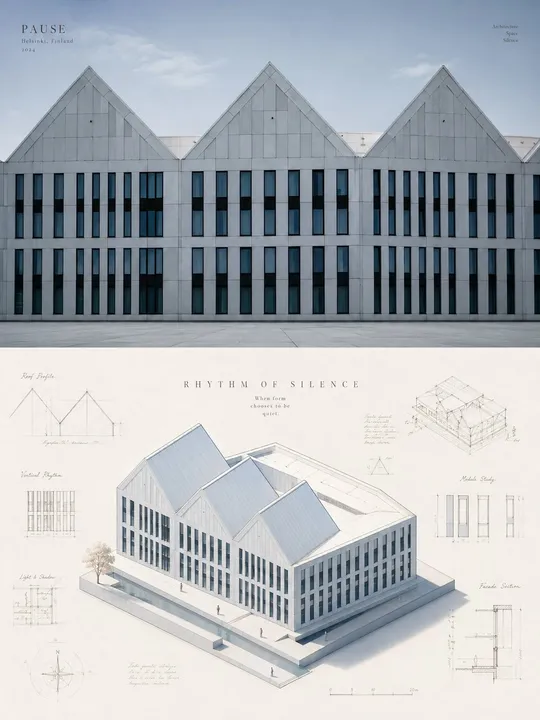
Complete AI image prompt
Please make every photo I upload into its own standalone high-end design poster; no multi-image collages, each photo output separately. The overall composition uses a 3:4 vertical format, with the upper and lower zones strictly 1:1 in height, each taking up 50% of the frame.

The upper half keeps the original photo, preserving the subject's structure, real texture, natural light and shadow, and original color atmosphere, applying only a slight high-end photographic color grade so that it carries the texture of art magazines, independent publications, and exhibition photography. To fit the frame, the sky, ground, or environmental background may be extended naturally, but the subject must not be stretched, distorted, or altered.

The lower half extracts the most recognizable **subject, outline, pose, and narrative relationships** from the photo and **reconstructs them with isometric spatial logic**. This does not mean simply turning the original object into a 3D model, but rather breaking the subject down into clear masses, levels, facets, and spatial relationships and recombining them along unified isometric axes, giving it both the structural order of an architectural model and the visual distillation of an editorial illustration. The viewing angle, proportions, and local structure may be appropriately adjusted to better display the subject's most representative form, but its identifying characteristics must remain recognizable at a glance.

At the same time, distill a **thematic image** from the photo's core content, action, structure, or symbolic relationships, geometrize and symbolize it, and integrate it into the isometric composition. The thematic image may become a base, facet, spatial opening, path, enclosing structure, or negative shape, causing the subject to pass through, interlock with, float within, be cut by, be supported by, or sit on staggered levels with it. In this way, the theme is not an added decoration but a compositional mechanism that determines how the subject exists in space.

The composition adapts to the subject's visual center of gravity, contour direction, and spatial characteristics, establishing professional order through isometric axes, mass proportions, staggered levels, scale contrasts, partial cropping, and extensive negative space. The subject need not be mechanically centered; it may be offset, suspended, or extended, allowing the isometric structure and thematic image together to form the sole visual center.

The subject uses a **high-key, translucent, soft Japanese color palette and delicate matte materials**. Extract from the photo above the most vital colors that best represent the subject's spirit and remix them, using soft white, cream white, or an extremely pale warm color as the base. Transform the core colors into clean, bright, gentle color planes, distinguishing different masses through lighter and darker shades of the same hue and a small number of accent colors. Light and shadow are soft yet definite, using slight tonal variation to help the structure read; avoid heavy 3D shadows, plastic materials, and dull, dirty tones.

Maintain extensive negative space in the background and add **creative research traces in the style of Leonardo da Vinci's manuscripts**: subject-related contour sketches, structural breakdowns, enlarged details, proportion lines, measurement lines, arrows, geometric deductions, natural-observation line drawings, and miniature annotations, distributed faintly around the subject in extremely pale pencil, ocher ink lines, or a faded manuscript texture. The manuscript elements should resemble trails of thought left by the design process, contrasting a “rational finished work with a perceptual research process” against the precise isometric subject, without forming a second visual center.

The text is likewise organized around the theme and spatial structure. Distill a short title from the photo's subject identity, action, emotion, or symbolic significance, paired with a minimal amount of location information, state words, or miniature annotations. Text may be arranged along isometric axes, thematic-image boundaries, structural facets, or manuscript guide lines—horizontally, vertically, offset, interwoven, or hidden within negative shapes—making it an information layer like those in design drawings and high-end art publications rather than a title pasted on afterward.

The whole presents the visual temperament of **thematic metaphor × isometric spatial order × Leonardo-style research manuscript × translucent Japanese colors × Eastern negative space × high-end editorial design**. Whether the subject is a person, animal, plant, building, object, food, vehicle, or natural landscape, its own structure should determine the most suitable isometric reconstruction method. Avoid ordinary 3D models, a game-scene feel, an axonometric engineering-drawing feel, cartoon low-poly forms, mechanical centering, an e-commerce display feel, and a template feel.
More open images in the “XXD Panel 041 · Isometric Lab” style