

Open prompts
en sample 03 AI Image Prompt
en sample 03, its complete AI image prompt, and the XXD Panel 011 · Meditative Line Poem style are free to view and copy.
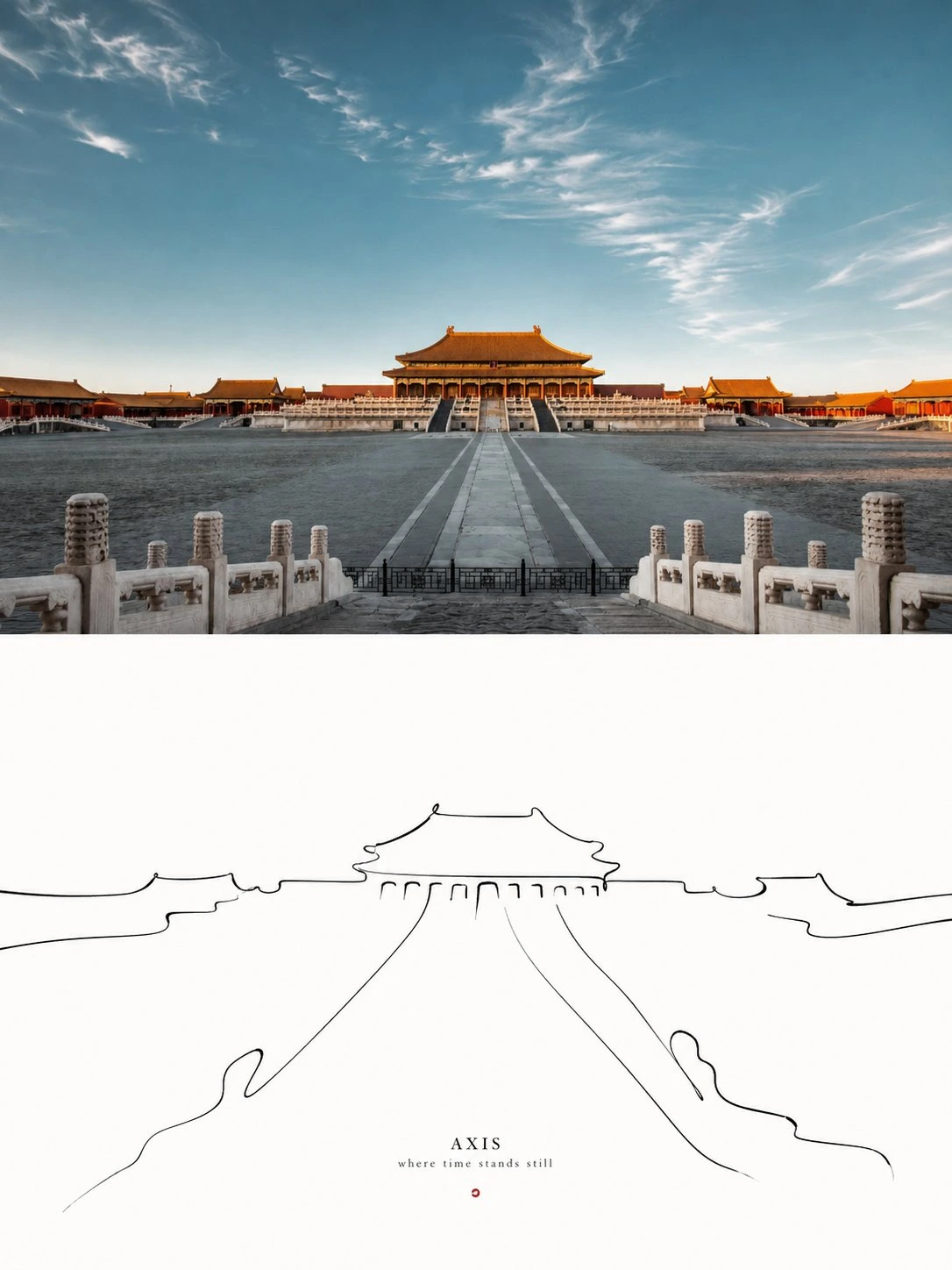
Complete AI image prompt
Please make every photo I upload into its own standalone high-end design poster; no multi-image collages, each photo output separately. The overall composition uses a 3:4 vertical format, with the upper and lower zones strictly 1:1 in height, each taking up 50% of the frame.

The upper half keeps the original photo, preserving the subject's identity, structure, pose, real texture, natural light and shadow, and original color atmosphere, applying only a slight high-end photographic color grade so that it carries the texture of art magazines, independent publications, and exhibition photography. To fit the frame, the sky, ground, or environmental background may be extended naturally, but the subject must not be stretched, distorted, or altered.

The lower half extracts the most recognizable **subject, outline, pose, and narrative relationships** from the photo, further distills their most meaningful emotional tension, spatial relationships, direction of movement, or metaphor, and reconstructs them as a highly restrained minimal philosophical line work. Do not mechanically trace the photo or completely reproduce its details; instead, remove redundancies and compress information, condensing the complex image into one core visual proposition so that the original subject remains recognizable while conveying a spiritual expression quieter and more implicit than the original image.

The lower half of the image centers on a **white or warm paper-white background, continuous black lines, and extensive negative space**. The lines are fine, flowing, and natural, with pauses, breathing room, variations in density, and rhythm. The subject may be reorganized by omitting parts of its outline, locally connecting, displacing, extending, overlapping, or leaving forms unfinished. For people, retain primarily pose and relationships; for animals, movement and signs of life; for objects, the most critical structure; for architecture and spaces, proportions, boundaries, and spatial rhythm; and for natural landscapes, the horizon, directional flow, outlines, and sense of distance. Regardless of the original image's content, avoid complex depiction and let a small number of lines carry the main narrative.

The composition emphasizes **one core image, one set of relationships, and a large expanse of silent space**. The subject may be very small, offset, partially cropped, or suspended in negative space, with emotion formed through the distance, proximity, separation, crossing, pauses, and direction between lines. Negative space is not a background but an important part of the image, used to express time, distance, loneliness, intimacy, waiting, flow, or a sense of incompletion. Avoid filling the frame, mechanical centering, decorative accumulation, and meaningless complex lines.

The whole is primarily black and white, allowing only an **extremely small amount of meaningful accent color**. The accent color should be distilled from the color in the upper photo with the greatest emotional value or narrative significance and may land on one tiny object, node, line segment, point of light, or focal point of a relationship, like a memory deliberately preserved in the image. Color is not decoration, is not distributed evenly, and does not exceed the minimum area required by the visual focal point.

The text likewise undergoes “spiritual distillation.” Do not simply write the place or object name; instead, generate an extremely short title in the user's specified target language from the photo's **emotion, relationships, movement, time, distance, state, or metaphor**, accompanied by a small amount of microtext, a number, or one restrained philosophical sentence. The text should feel like an annotation in an art book, not a poster advertising slogan.

The text must share the composition with the lines: it may extend along a line's direction, stop at the end of a line, hide in broad negative space, align with the subject's outline, be crossed or divided by a line, or even let a line naturally become the text's baseline, guide line, or visual connection. Keep only **one short title + 1–2 groups of tiny supporting text**; use a light font weight, wide letterspacing, small caps, vertical arrangement, or asymmetrical placement to establish a quiet, high-end editorial feel.

The whole presents **quiet, contemplation, subtlety, poetry, a philosophical quality, a meditative quality, and a collectible quality**. Every line, every area of negative space, every text position, and every touch of accent color must have meaning. The final result is not to “turn the photo into a line drawing,” but to distill and elevate the photo visually, like a minimal work of imagistic art that can be contemplated repeatedly and understood slowly.

Avoid realistic line drawings, complex outlines, cartoon illustrations, smooth vector icons, meaningless abstract curves, large color blocks, commercial poster typography, decorative textual clutter, and a template feel.
Original style prompt
Please make every photo I upload into its own standalone high-end design poster; no multi-image collages, each photo output separately. The overall composition uses a 3:4 vertical format, with the upper and lower zones strictly 1:1 in height, each taking up 50% of the frame.

The upper half keeps the original photo, preserving the subject's identity, structure, pose, real texture, natural light and shadow, and original color atmosphere, applying only a slight high-end photographic color grade so that it carries the texture of art magazines, independent publications, and exhibition photography. To fit the frame, the sky, ground, or environmental background may be extended naturally, but the subject must not be stretched, distorted, or altered.

The lower half extracts the most recognizable **subject, outline, pose, and narrative relationships** from the photo, further distills their most meaningful emotional tension, spatial relationships, direction of movement, or metaphor, and reconstructs them as a highly restrained minimal philosophical line work. Do not mechanically trace the photo or completely reproduce its details; instead, remove redundancies and compress information, condensing the complex image into one core visual proposition so that the original subject remains recognizable while conveying a spiritual expression quieter and more implicit than the original image.

The lower half of the image centers on a **white or warm paper-white background, continuous black lines, and extensive negative space**. The lines are fine, flowing, and natural, with pauses, breathing room, variations in density, and rhythm. The subject may be reorganized by omitting parts of its outline, locally connecting, displacing, extending, overlapping, or leaving forms unfinished. For people, retain primarily pose and relationships; for animals, movement and signs of life; for objects, the most critical structure; for architecture and spaces, proportions, boundaries, and spatial rhythm; and for natural landscapes, the horizon, directional flow, outlines, and sense of distance. Regardless of the original image's content, avoid complex depiction and let a small number of lines carry the main narrative.

The composition emphasizes **one core image, one set of relationships, and a large expanse of silent space**. The subject may be very small, offset, partially cropped, or suspended in negative space, with emotion formed through the distance, proximity, separation, crossing, pauses, and direction between lines. Negative space is not a background but an important part of the image, used to express time, distance, loneliness, intimacy, waiting, flow, or a sense of incompletion. Avoid filling the frame, mechanical centering, decorative accumulation, and meaningless complex lines.

The whole is primarily black and white, allowing only an **extremely small amount of meaningful accent color**. The accent color should be distilled from the color in the upper photo with the greatest emotional value or narrative significance and may land on one tiny object, node, line segment, point of light, or focal point of a relationship, like a memory deliberately preserved in the image. Color is not decoration, is not distributed evenly, and does not exceed the minimum area required by the visual focal point.

The text likewise undergoes “spiritual distillation.” Do not simply write the place or object name; instead, generate an extremely short title in the user's specified target language from the photo's **emotion, relationships, movement, time, distance, state, or metaphor**, accompanied by a small amount of microtext, a number, or one restrained philosophical sentence. The text should feel like an annotation in an art book, not a poster advertising slogan.

The text must share the composition with the lines: it may extend along a line's direction, stop at the end of a line, hide in broad negative space, align with the subject's outline, be crossed or divided by a line, or even let a line naturally become the text's baseline, guide line, or visual connection. Keep only **one short title + 1–2 groups of tiny supporting text**; use a light font weight, wide letterspacing, small caps, vertical arrangement, or asymmetrical placement to establish a quiet, high-end editorial feel.

The whole presents **quiet, contemplation, subtlety, poetry, a philosophical quality, a meditative quality, and a collectible quality**. Every line, every area of negative space, every text position, and every touch of accent color must have meaning. The final result is not to “turn the photo into a line drawing,” but to distill and elevate the photo visually, like a minimal work of imagistic art that can be contemplated repeatedly and understood slowly.

Avoid realistic line drawings, complex outlines, cartoon illustrations, smooth vector icons, meaningless abstract curves, large color blocks, commercial poster typography, decorative textual clutter, and a template feel.
More open images in the “XXD Panel 011 · Meditative Line Poem” style