

Open prompts
en sample 04 AI Image Prompt
en sample 04, its complete AI image prompt, and the XXD Panel 014 · Paper Relief Journal style are free to view and copy.
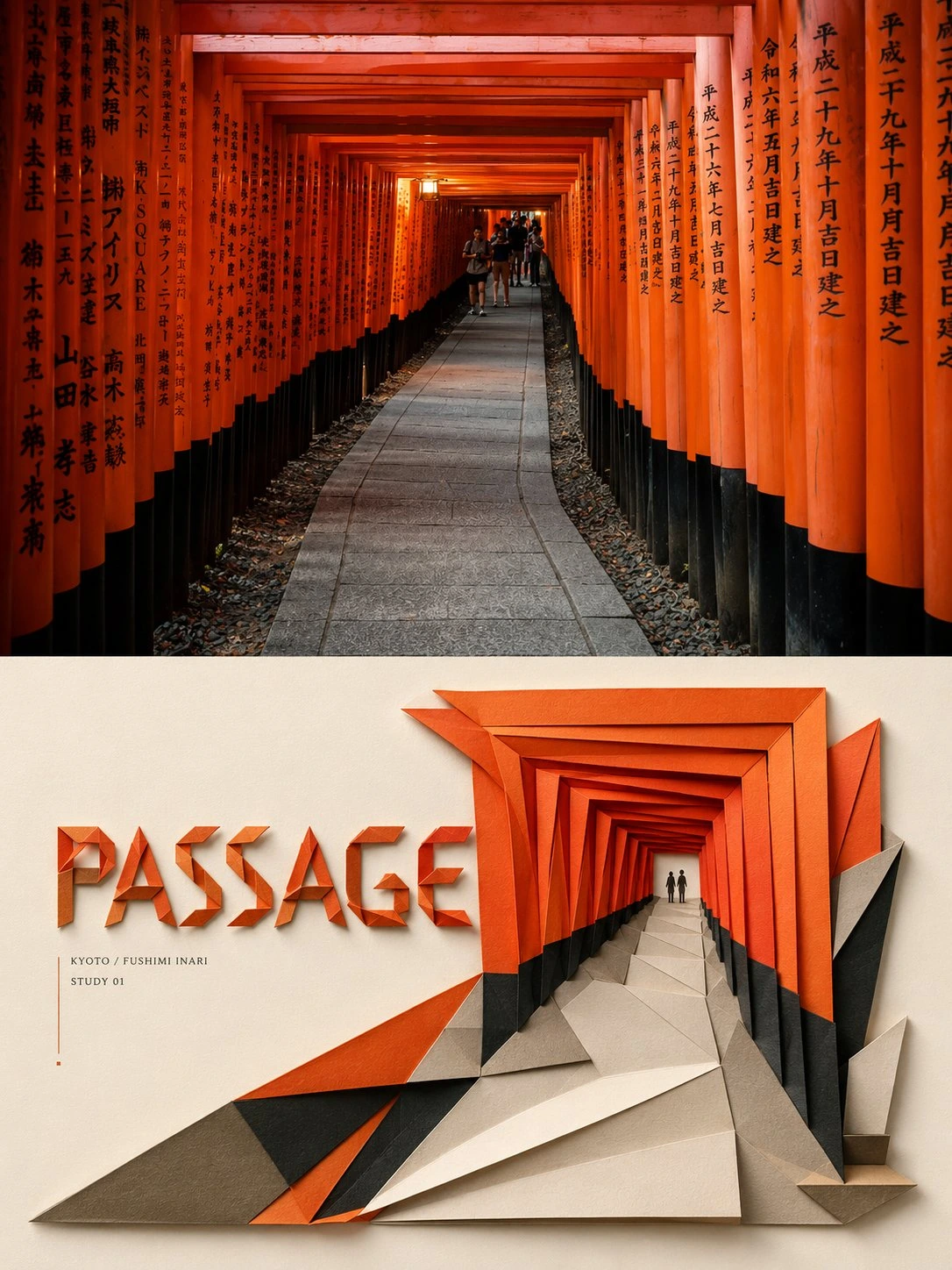
Complete AI image prompt
Please make every photo I upload into its own standalone high-end design poster; no multi-image collages, each photo output separately. The overall composition uses a 3:4 vertical format, with the upper and lower zones strictly 1:1 in height, each taking up 50% of the frame.

The upper half keeps the original photo, preserving the subject's structure, real texture, natural light and shadow, and original color atmosphere, applying only a slight high-end photographic color grade so that it carries the texture of art magazines, independent publications, and exhibition photography. To fit the frame, the sky, ground, or environmental background may be extended naturally, but the subject must not be stretched, distorted, or altered.

The lower half extracts the most recognizable subject, outline, pose, and narrative relationships from the photo and reconstructs them into an exquisite three-dimensional origami and paper-sculpture collage. Do not mechanically replicate the photo's details; instead, reconceive the subject through folding, faceting, layering, nesting, and the assembly of paper pieces, allowing it to retain instantly recognizable identifying features while possessing a clear geometric structure and the authentic feel of a handmade object.

The composition is reorganized according to the subject's own visual center of gravity, contour direction, volumetric proportions, and direction of movement, rather than being fixed at the center. Use primary and secondary hierarchy, scale contrast, axial relationships, triangular stability, diagonal tension, front-to-back occlusion, and positive-negative shape control to manage the image's rhythm; the subject may be moderately off-center, partially cropped, or extended in one direction, creating room to breathe through large areas of negative space, so that the paper-art form has sculptural volume while maintaining the restraint and balance of modern editorial design. Supporting paper pieces and geometric elements are used only to support the subject and do not form a second visual center.

Extract the most recognizable and vibrant colors from the photo above and translate them into a harmonious yet vivid set of paper colors, distinguishing folded planes and spatial layers through light and dark variations of the same hue, analogous colors, and a small amount of contrasting color. The background uses off-white, light gray, soft pastels, or a pale color coordinated with the original image, with large areas of negative space and only a small amount of paper texture and abstract geometric detail. Use soft diffused light to render paper fibers, creases, cut edges, thickness, and natural shadows; keep the overall effect clean, realistic, and refined, avoiding plastic-like 3D, smooth CG, and a cheap cardstock feel.

Text is likewise transformed into a paper-art structure and a component of the composition. Distill a short word or title from the subject's identity, theme, action, emotion, or symbolic meaning in the photo, pairing it with a very small amount of numbering, place information, status words, or miniature annotations. The main text may be composed of folded paper pieces; according to the subject's structure, choose relationships such as arcing around it, extending along an axis, conforming to the outline, supporting it above and below, interweaving and overlapping, or suspending within negative space, so that the text is both legible and part of the image's spatial structure. Keep supporting small text extremely minimal, using restrained high-end editorial typography to balance the handmade warmth of the paper art.

The overall emphasis is on paper material, geometric precision, spatial layering, compositional order, and handmade warmth, presenting a visual temperament that combines contemporary paper sculpture with high-end editorial design. Whether the subject is a person, animal, plant, building, object, vehicle, or natural landscape, maintain a clear and ingenious visual correspondence between the real photograph and the paper-art reconstruction, avoiding cartoon origami, a children's-craft feel, uniform symmetry, complex accumulation, an e-commerce display feel, and a template feel.
Original style prompt
Please make every photo I upload into its own standalone high-end design poster; no multi-image collages, each photo output separately. The overall composition uses a 3:4 vertical format, with the upper and lower zones strictly 1:1 in height, each taking up 50% of the frame.

The upper half keeps the original photo, preserving the subject's structure, real texture, natural light and shadow, and original color atmosphere, applying only a slight high-end photographic color grade so that it carries the texture of art magazines, independent publications, and exhibition photography. To fit the frame, the sky, ground, or environmental background may be extended naturally, but the subject must not be stretched, distorted, or altered.

The lower half extracts the most recognizable subject, outline, pose, and narrative relationships from the photo and reconstructs them into an exquisite three-dimensional origami and paper-sculpture collage. Do not mechanically replicate the photo's details; instead, reconceive the subject through folding, faceting, layering, nesting, and the assembly of paper pieces, allowing it to retain instantly recognizable identifying features while possessing a clear geometric structure and the authentic feel of a handmade object.

The composition is reorganized according to the subject's own visual center of gravity, contour direction, volumetric proportions, and direction of movement, rather than being fixed at the center. Use primary and secondary hierarchy, scale contrast, axial relationships, triangular stability, diagonal tension, front-to-back occlusion, and positive-negative shape control to manage the image's rhythm; the subject may be moderately off-center, partially cropped, or extended in one direction, creating room to breathe through large areas of negative space, so that the paper-art form has sculptural volume while maintaining the restraint and balance of modern editorial design. Supporting paper pieces and geometric elements are used only to support the subject and do not form a second visual center.

Extract the most recognizable and vibrant colors from the photo above and translate them into a harmonious yet vivid set of paper colors, distinguishing folded planes and spatial layers through light and dark variations of the same hue, analogous colors, and a small amount of contrasting color. The background uses off-white, light gray, soft pastels, or a pale color coordinated with the original image, with large areas of negative space and only a small amount of paper texture and abstract geometric detail. Use soft diffused light to render paper fibers, creases, cut edges, thickness, and natural shadows; keep the overall effect clean, realistic, and refined, avoiding plastic-like 3D, smooth CG, and a cheap cardstock feel.

Text is likewise transformed into a paper-art structure and a component of the composition. Distill a short word or title from the subject's identity, theme, action, emotion, or symbolic meaning in the photo, pairing it with a very small amount of numbering, place information, status words, or miniature annotations. The main text may be composed of folded paper pieces; according to the subject's structure, choose relationships such as arcing around it, extending along an axis, conforming to the outline, supporting it above and below, interweaving and overlapping, or suspending within negative space, so that the text is both legible and part of the image's spatial structure. Keep supporting small text extremely minimal, using restrained high-end editorial typography to balance the handmade warmth of the paper art.

The overall emphasis is on paper material, geometric precision, spatial layering, compositional order, and handmade warmth, presenting a visual temperament that combines contemporary paper sculpture with high-end editorial design. Whether the subject is a person, animal, plant, building, object, vehicle, or natural landscape, maintain a clear and ingenious visual correspondence between the real photograph and the paper-art reconstruction, avoiding cartoon origami, a children's-craft feel, uniform symmetry, complex accumulation, an e-commerce display feel, and a template feel.
More open images in the “XXD Panel 014 · Paper Relief Journal” style