

Open prompts
en sample 05 AI Image Prompt
en sample 05, its complete AI image prompt, and the XXD Panel 022 · Color-Dot Trespass style are free to view and copy.
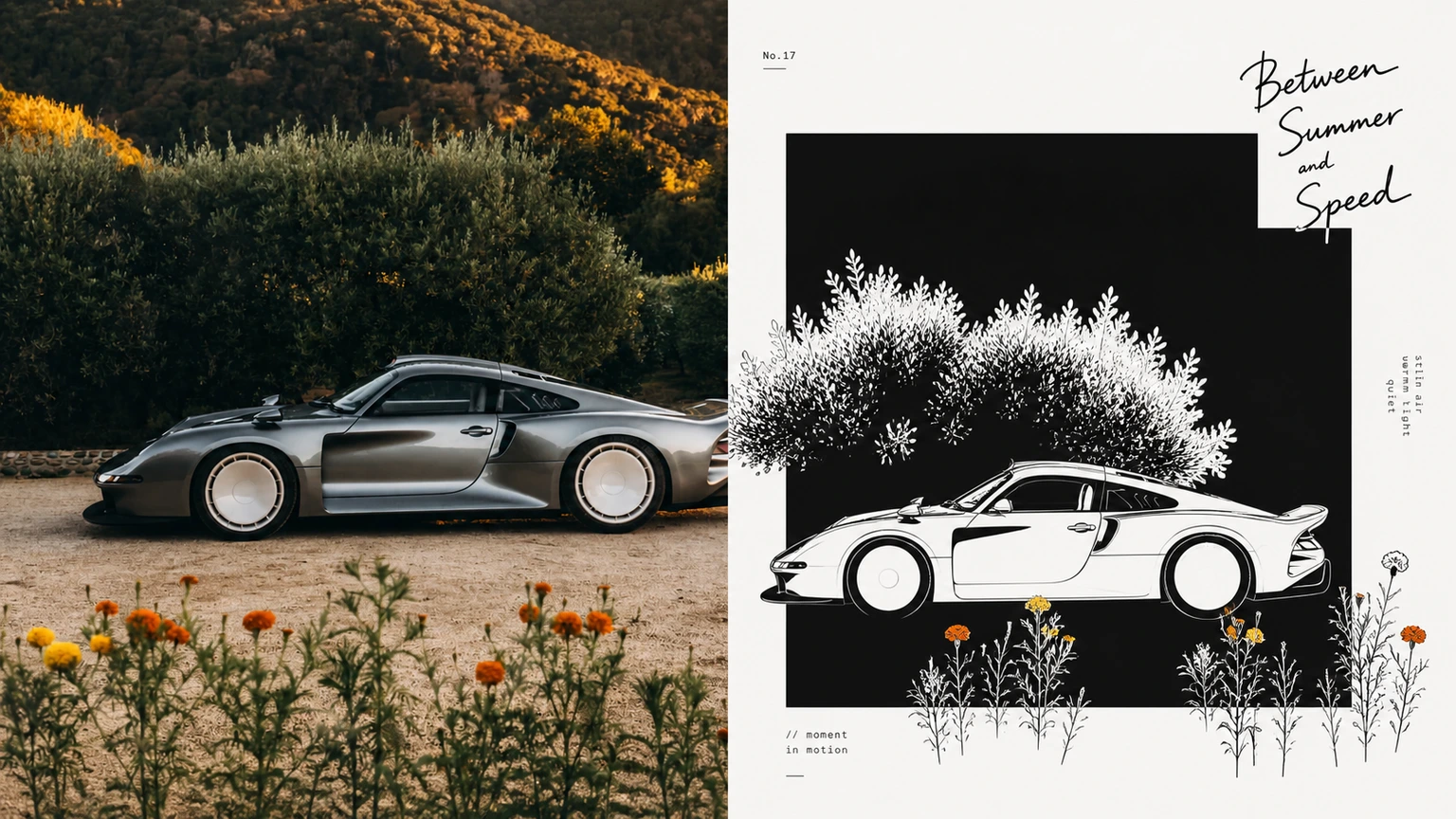
Complete AI image prompt
Please make every photo I upload into its own standalone high-end design poster; no multi-image collages, each photo output separately. The overall composition uses a 3:4 vertical format, with the upper and lower zones strictly 1:1 in height, each taking up 50% of the frame.

The upper half keeps the original photo, preserving the subject's structure, real texture, natural light and shadow, and original color atmosphere, applying only a slight high-end photographic color grade so that it carries the texture of art magazines, independent publications, and exhibition photography. To fit the frame, the environmental background may be extended naturally, but the subject must not be stretched, distorted, or altered.

The lower half extracts the most recognizable subject, outline, pose, and narrative relationships from the photo and reconstructs them into a minimal black-and-white hand-drawn editorial illustration. Use a horizontal or vertical solid-black rectangular color field as the primary visual field, with most of the subject contained inside the rectangle, while allowing the most recognizable head, upper contour, branches and leaves, roof, limbs, edges of objects, or other key structures to naturally break beyond the rectangle's boundary, creating a clear “boundary-crossing” relationship. The subject is not pasted onto the black rectangle, but appears to emerge from, pass through, or grow out of the black space, making the rectangle both a background and part of the composition.

Retain only the subject's most essential outer contour, pose, and key structures, expressed through fluid black hand-drawn lines + white negative shapes + a small number of gray color planes. The lines should be concise, smooth, and steady, with natural hand-drawn elasticity and rhythm. A slight handmade quality is allowed, but avoid excessive wobbling, repeated tracing, scratchy noise, or deliberately affected childishness; the overall effect should be closer to a clean, crisp illustrator's line drawing than to rough, casual doodling. Keep internal details extremely minimal, using only a small number of structural lines, expression lines, and localized shadows to establish recognizability.

The overall palette is primarily black, white, and gray, but one core localized color accent may be added when necessary as a finishing touch. This color may appear only in the most crucial, narratively significant, or memorable detail, such as one part of the subject, a small object, a key surface, the focus of an action, or an emotional signal. The accent color must occupy a very small area, be precisely positioned, and serve a clear purpose, like the only illuminated part of the image, used to enhance memorability and emotional tension rather than disrupt the overall black-and-white order. Extract the single most representative highlight color from the original photo and moderately purify it.

The composition emphasizes the conflict between the geometric order of the black rectangle and the subject's free contour. The rectangle provides a stable, weighty visual base, while the subject creates vitality through asymmetrical positioning, partial cropping, and boundary crossing; a large expanse of blank white paper surrounds the black area, allowing black, white, and gray to form a strong yet restrained relationship of areas. Supporting structures may be transformed into a very small number of straight lines, slanted planes, platforms, edges, or geometric slices, but must not form a second subject.

The text establishes a light black-and-white editorial micro-typographic system. Distill a short title from the photo's action, emotion, state, or metaphor, and pair it with 1–3 sets of tiny annotations, numbers, state words, or short phrases. Text may sit close to the edge of the black rectangle, hide within negative shapes, follow the direction of the boundary crossing, or align and misalign with the subject's contour; use black handwriting, a thin sans-serif, or a restrained serif typeface, maintaining a small scale so the text feels like an illustrator's annotations and editorial marks rather than a commercial headline.

The overall image presents a visual temperament of pure white paper × black geometric color field × fluid hand-drawn lines × subject crossing the boundary × a single-point color accent: restrained, intelligent, light, humorous, modern, and imbued with the feel of art publishing. Avoid colorful cartoons, complex scenes, smooth vector outlines, realistic light and shade, 3D texture, solid-black silhouettes, rough chaotic lines, and template-like centered compositions.
Original style prompt
Please make every photo I upload into its own standalone high-end design poster; no multi-image collages, each photo output separately. The overall composition uses a 3:4 vertical format, with the upper and lower zones strictly 1:1 in height, each taking up 50% of the frame.

The upper half keeps the original photo, preserving the subject's structure, real texture, natural light and shadow, and original color atmosphere, applying only a slight high-end photographic color grade so that it carries the texture of art magazines, independent publications, and exhibition photography. To fit the frame, the environmental background may be extended naturally, but the subject must not be stretched, distorted, or altered.

The lower half extracts the most recognizable subject, outline, pose, and narrative relationships from the photo and reconstructs them into a minimal black-and-white hand-drawn editorial illustration. Use a horizontal or vertical solid-black rectangular color field as the primary visual field, with most of the subject contained inside the rectangle, while allowing the most recognizable head, upper contour, branches and leaves, roof, limbs, edges of objects, or other key structures to naturally break beyond the rectangle's boundary, creating a clear “boundary-crossing” relationship. The subject is not pasted onto the black rectangle, but appears to emerge from, pass through, or grow out of the black space, making the rectangle both a background and part of the composition.

Retain only the subject's most essential outer contour, pose, and key structures, expressed through fluid black hand-drawn lines + white negative shapes + a small number of gray color planes. The lines should be concise, smooth, and steady, with natural hand-drawn elasticity and rhythm. A slight handmade quality is allowed, but avoid excessive wobbling, repeated tracing, scratchy noise, or deliberately affected childishness; the overall effect should be closer to a clean, crisp illustrator's line drawing than to rough, casual doodling. Keep internal details extremely minimal, using only a small number of structural lines, expression lines, and localized shadows to establish recognizability.

The overall palette is primarily black, white, and gray, but one core localized color accent may be added when necessary as a finishing touch. This color may appear only in the most crucial, narratively significant, or memorable detail, such as one part of the subject, a small object, a key surface, the focus of an action, or an emotional signal. The accent color must occupy a very small area, be precisely positioned, and serve a clear purpose, like the only illuminated part of the image, used to enhance memorability and emotional tension rather than disrupt the overall black-and-white order. Extract the single most representative highlight color from the original photo and moderately purify it.

The composition emphasizes the conflict between the geometric order of the black rectangle and the subject's free contour. The rectangle provides a stable, weighty visual base, while the subject creates vitality through asymmetrical positioning, partial cropping, and boundary crossing; a large expanse of blank white paper surrounds the black area, allowing black, white, and gray to form a strong yet restrained relationship of areas. Supporting structures may be transformed into a very small number of straight lines, slanted planes, platforms, edges, or geometric slices, but must not form a second subject.

The text establishes a light black-and-white editorial micro-typographic system. Distill a short title from the photo's action, emotion, state, or metaphor, and pair it with 1–3 sets of tiny annotations, numbers, state words, or short phrases. Text may sit close to the edge of the black rectangle, hide within negative shapes, follow the direction of the boundary crossing, or align and misalign with the subject's contour; use black handwriting, a thin sans-serif, or a restrained serif typeface, maintaining a small scale so the text feels like an illustrator's annotations and editorial marks rather than a commercial headline.

The overall image presents a visual temperament of pure white paper × black geometric color field × fluid hand-drawn lines × subject crossing the boundary × a single-point color accent: restrained, intelligent, light, humorous, modern, and imbued with the feel of art publishing. Avoid colorful cartoons, complex scenes, smooth vector outlines, realistic light and shade, 3D texture, solid-black silhouettes, rough chaotic lines, and template-like centered compositions.
More open images in the “XXD Panel 022 · Color-Dot Trespass” style