

Open prompts
en sample 05 AI Image Prompt
en sample 05, its complete AI image prompt, and the XXD Panel 043 · White Foam style are free to view and copy.
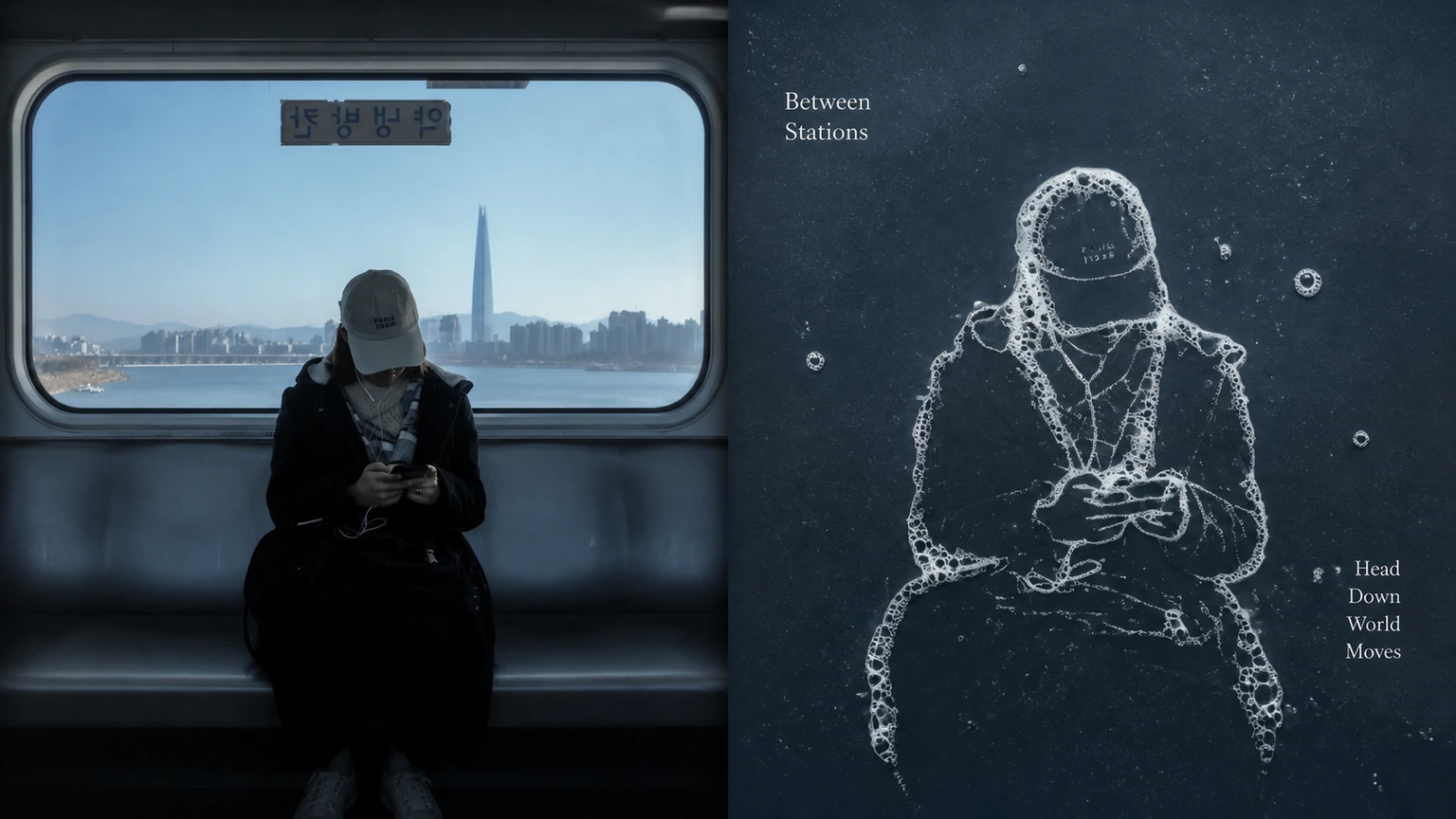
Complete AI image prompt
Please make every photo I upload into its own standalone high-end design poster; no multi-image collages, each photo output separately. The overall composition uses a 3:4 vertical format, with the upper and lower zones strictly 1:1 in height, each taking up 50% of the frame.

The upper half keeps the original photo, preserving the subject's structure, real texture, natural light and shadow, and original color atmosphere, applying only a slight high-end photographic color grade so that it carries the texture of art magazines, independent publications, and exhibition photography. To fit the frame, the sky, ground, or environmental background may be extended naturally, but the subject must not be stretched, distorted, or altered.

The lower half extracts the most recognizable **subject, outline, pose, and narrative relationships** from the photo and reconstructs them as a real soap-foam graphic on a flat surface. It is not a 3D sculpture or a three-dimensional foam model; instead, the subject is formed directly on a flat surface from white soap suds, fine dense bubbles, bubble films, and wet traces. Retain only the most crucial outer contour, proportions, movement, and structural transitions, redescribing the subject through the accumulation, dispersal, rupture, and residue of real foam so that it is recognizable at a glance as the same object shown above.

The composition follows a **front-facing, eye-level, distortion-free flat-photography logic**: the camera faces the supporting plane directly, with accurate horizontal and vertical relationships, and no wide-angle view, tilted perspective, exaggerated near-large/far-small scaling, or edge deformation. The subject is laid out naturally according to its own visual center of gravity, contour flow, and direction of movement; it may be centered or slightly offset. Keep only a small number of scattered bubbles, water marks, and soap-suds remnants around it, giving the image the trace-like feeling that something truly happened there while preserving abundant quiet space.

The background uses a **dark, low-reflective flat surface with a slightly wet texture**; its color is not fixed. First determine from the upper photo the core hue most suitable for use as a dark background, then deepen, purify, and translate it into a more refined register. If the original image contains no suitable dark color, actively choose the most harmonious dark color based on the subject's color temperature, mood, and overall character. The background should be deep yet clean, rich but not muddy, creating a clear and restrained light-dark contrast with the white foam while maintaining a subtle color connection with the upper photo.

The foam retains realistic layers of white, milky white, and translucency, composed of fine dense bubbles of varying sizes, transparent bubble films, wet edges, locally burst bubbles, and slight soap-solution residue. Avoid the material feel of cream, cotton, clouds, plastic, or CG. Extremely subtle water droplets, reflections, seams, or surface textures may remain, but they must not disrupt the purity of the flat composition.

Typography intervenes ingeniously as part of the composition: distill an extremely short title from the subject's identity, movement, emotion, or metaphor in the photo, accompanied by a small number of status words or micro-annotations. Text may be arranged along the subject's contour, the image axis, foam edges, or background structure, and may also be partially obscured or crossed by foam or set into negative shapes, so that it feels like an editorial mark that has always existed on this plane rather than a title pasted on afterward.

The overall visual character is **real object × white flat foam × dark emotional ground × minimalist order × high-end editorial photography**. Whether the subject is a person, animal, plant, building, object, food, vehicle, or natural landscape, the realistic, restrained, and ingenious foam reconstruction should begin from the most recognizable form in the original image. Avoid 3D masses, lens distortion, exaggerated perspective, pale low-contrast backgrounds, cartoon bubbles, a bathroom-advertising feel, and a template-like feel.
Original style prompt
Please make every photo I upload into its own standalone high-end design poster; no multi-image collages, each photo output separately. The overall composition uses a 3:4 vertical format, with the upper and lower zones strictly 1:1 in height, each taking up 50% of the frame.

The upper half keeps the original photo, preserving the subject's structure, real texture, natural light and shadow, and original color atmosphere, applying only a slight high-end photographic color grade so that it carries the texture of art magazines, independent publications, and exhibition photography. To fit the frame, the sky, ground, or environmental background may be extended naturally, but the subject must not be stretched, distorted, or altered.

The lower half extracts the most recognizable **subject, outline, pose, and narrative relationships** from the photo and reconstructs them as a real soap-foam graphic on a flat surface. It is not a 3D sculpture or a three-dimensional foam model; instead, the subject is formed directly on a flat surface from white soap suds, fine dense bubbles, bubble films, and wet traces. Retain only the most crucial outer contour, proportions, movement, and structural transitions, redescribing the subject through the accumulation, dispersal, rupture, and residue of real foam so that it is recognizable at a glance as the same object shown above.

The composition follows a **front-facing, eye-level, distortion-free flat-photography logic**: the camera faces the supporting plane directly, with accurate horizontal and vertical relationships, and no wide-angle view, tilted perspective, exaggerated near-large/far-small scaling, or edge deformation. The subject is laid out naturally according to its own visual center of gravity, contour flow, and direction of movement; it may be centered or slightly offset. Keep only a small number of scattered bubbles, water marks, and soap-suds remnants around it, giving the image the trace-like feeling that something truly happened there while preserving abundant quiet space.

The background uses a **dark, low-reflective flat surface with a slightly wet texture**; its color is not fixed. First determine from the upper photo the core hue most suitable for use as a dark background, then deepen, purify, and translate it into a more refined register. If the original image contains no suitable dark color, actively choose the most harmonious dark color based on the subject's color temperature, mood, and overall character. The background should be deep yet clean, rich but not muddy, creating a clear and restrained light-dark contrast with the white foam while maintaining a subtle color connection with the upper photo.

The foam retains realistic layers of white, milky white, and translucency, composed of fine dense bubbles of varying sizes, transparent bubble films, wet edges, locally burst bubbles, and slight soap-solution residue. Avoid the material feel of cream, cotton, clouds, plastic, or CG. Extremely subtle water droplets, reflections, seams, or surface textures may remain, but they must not disrupt the purity of the flat composition.

Typography intervenes ingeniously as part of the composition: distill an extremely short title from the subject's identity, movement, emotion, or metaphor in the photo, accompanied by a small number of status words or micro-annotations. Text may be arranged along the subject's contour, the image axis, foam edges, or background structure, and may also be partially obscured or crossed by foam or set into negative shapes, so that it feels like an editorial mark that has always existed on this plane rather than a title pasted on afterward.

The overall visual character is **real object × white flat foam × dark emotional ground × minimalist order × high-end editorial photography**. Whether the subject is a person, animal, plant, building, object, food, vehicle, or natural landscape, the realistic, restrained, and ingenious foam reconstruction should begin from the most recognizable form in the original image. Avoid 3D masses, lens distortion, exaggerated perspective, pale low-contrast backgrounds, cartoon bubbles, a bathroom-advertising feel, and a template-like feel.