

Open prompts
en sample 05 AI Image Prompt
en sample 05, its complete AI image prompt, and the XXD Panel 082 · Watercolor Off the Page style are free to view and copy.
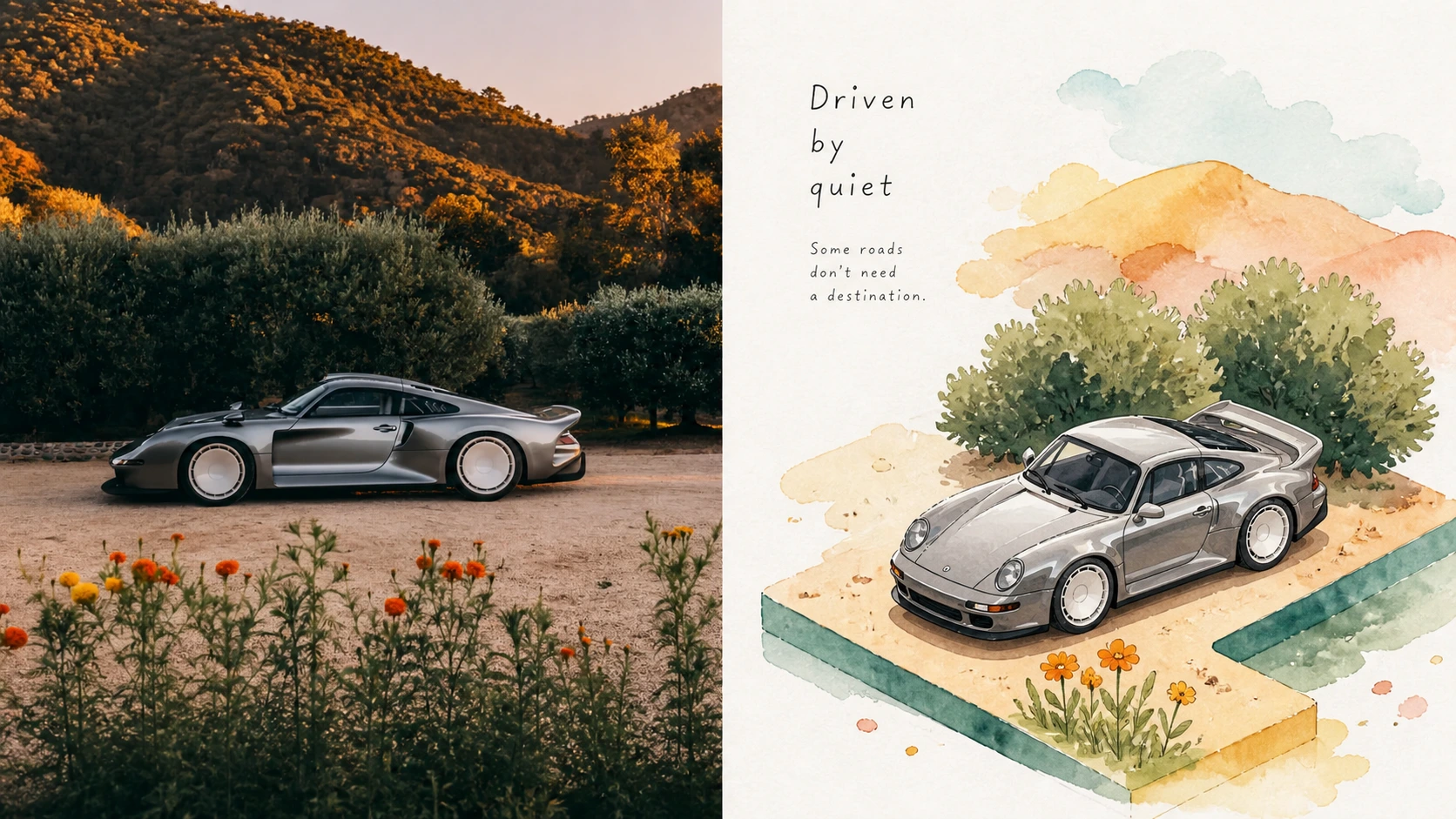
Complete AI image prompt
Turn each photograph I upload into a separate premium design poster. Do not combine multiple images; output each photograph separately. Use an overall 3:4 portrait composition, with the upper and lower regions kept at a strict 1:1 height ratio, each occupying 50% of the image.

Retain the original photograph in the upper half, preserving the subject's identity, structure, pose, authentic texture, natural light and shadow, and original colour atmosphere. Apply only subtle, premium colour grading to give it the quality of an art magazine, independent publication, or exhibition image. The surrounding environment may be extended naturally to fit the aspect ratio, but the subject must not be stretched, distorted, or altered.

In the lower half, extract the photograph's most recognisable **subject, silhouette, structure, pose, and narrative relationships**, and reconstruct them in a fusion of **Naïve Watercolor + Wonky + Isometric** styles. Do not depict the photograph in full. Retain only the most important identity traits and visual metaphors, compressing the complex scene into a few watercolour fields and one clear central character. The original should remain instantly recognisable while gaining a redesigned sense of playfulness, space, and artistry.

First establish the base composition with **large irregular watercolour fields**. These fields should show natural tide marks, grain, variations in concentration, paper showing through, and slight misregistration, like freely spread soft terrain or an abstract stage. The central subject should then “leap out” of the colour fields through **Isometric / 2.5D geometric spatial logic**, using axonometric perspective, layered planes, geometric facets, foreground–background occlusion, and slight height differences to create volume. Parts of the subject may extend beyond the colour-field boundaries, letting two-dimensional watercolour and three-dimensional illusion interweave naturally and creating the visual relationship of “flat colour fields supporting a small three-dimensional world.”

Keep the subject's form **Naïve + Wonky**: proportions may be moderately exaggerated, structures slightly asymmetrical and marked by handmade error, and contours loose, uneven in weight, and gently trembling. However, the basic Isometric viewpoint, structural directions, and spatial relationships must remain clear; do not let the wonkiness collapse into illogical cartooning. The result should present a contrast in which **geometric order and innocent hand drawing coexist**.

The composition should prioritise **subject placement, field proportions, spatial direction, positive and negative shapes, and expansive negative space**. The subject need not be mechanically centred; it may be offset, raised, lowered, or partially cropped according to the original photograph's direction. The watercolour fields serve not only as background but also as terrain, air, shadow, or narrative space. Actively remove complex environmental detail, keeping only a few forms that strengthen the central theme so that the subject truly becomes the single visual focus.

Extract and retune **the brightest, most vivid, and most life-filled colours** from the upper photograph rather than sampling colour evenly. Translate the original palette into lively yet soft watercolour relationships such as clear blue, aqua, tender green, warm yellow, coral orange, peach pink, and gentle violet, with abundant clean warm white or an extremely pale ground coordinated with the photograph's overall colour temperature as breathing space. The watercolour base may remain soft and transparent, while the three-dimensional subject's key colour fields should be slightly more solid and vivid so the protagonist rises naturally from the background. Avoid muddy greys, gloom, excessive Morandi-style muting, fluorescent colour, and a cheap candy-like look.

Let a small amount of text enter freely, generating concise wording from the photograph's subject, action, place, emotion, or metaphor without restricting the language. Use a **slender, rounded editorial typeface with slight handwritten drift and loosened composition**, combining the friendliness of a picture book with the restraint of an independent art publication. Text may sit naturally along watercolour-field edges, Isometric axes, near the subject, or in broad negative space, forming a shared image–text rhythm with the two-dimensional fields and three-dimensional protagonist.

The overall result should have the premium picture-book-poster character created by **expansive negative space, irregular watercolour fields, naïve hand-drawn contours, an Isometric three-dimensional protagonist, and a vivid healing palette**. The central subject should appear to gain space, stand up, or suddenly leap from the soft watercolour plane; it must be neither a purely flat children's illustration nor a realistic 3D model.
Original style prompt
Turn each photograph I upload into a separate premium design poster. Do not combine multiple images; output each photograph separately. Use an overall 3:4 portrait composition, with the upper and lower regions kept at a strict 1:1 height ratio, each occupying 50% of the image.

Retain the original photograph in the upper half, preserving the subject's identity, structure, pose, authentic texture, natural light and shadow, and original colour atmosphere. Apply only subtle, premium colour grading to give it the quality of an art magazine, independent publication, or exhibition image. The surrounding environment may be extended naturally to fit the aspect ratio, but the subject must not be stretched, distorted, or altered.

In the lower half, extract the photograph's most recognisable **subject, silhouette, structure, pose, and narrative relationships**, and reconstruct them in a fusion of **Naïve Watercolor + Wonky + Isometric** styles. Do not depict the photograph in full. Retain only the most important identity traits and visual metaphors, compressing the complex scene into a few watercolour fields and one clear central character. The original should remain instantly recognisable while gaining a redesigned sense of playfulness, space, and artistry.

First establish the base composition with **large irregular watercolour fields**. These fields should show natural tide marks, grain, variations in concentration, paper showing through, and slight misregistration, like freely spread soft terrain or an abstract stage. The central subject should then “leap out” of the colour fields through **Isometric / 2.5D geometric spatial logic**, using axonometric perspective, layered planes, geometric facets, foreground–background occlusion, and slight height differences to create volume. Parts of the subject may extend beyond the colour-field boundaries, letting two-dimensional watercolour and three-dimensional illusion interweave naturally and creating the visual relationship of “flat colour fields supporting a small three-dimensional world.”

Keep the subject's form **Naïve + Wonky**: proportions may be moderately exaggerated, structures slightly asymmetrical and marked by handmade error, and contours loose, uneven in weight, and gently trembling. However, the basic Isometric viewpoint, structural directions, and spatial relationships must remain clear; do not let the wonkiness collapse into illogical cartooning. The result should present a contrast in which **geometric order and innocent hand drawing coexist**.

The composition should prioritise **subject placement, field proportions, spatial direction, positive and negative shapes, and expansive negative space**. The subject need not be mechanically centred; it may be offset, raised, lowered, or partially cropped according to the original photograph's direction. The watercolour fields serve not only as background but also as terrain, air, shadow, or narrative space. Actively remove complex environmental detail, keeping only a few forms that strengthen the central theme so that the subject truly becomes the single visual focus.

Extract and retune **the brightest, most vivid, and most life-filled colours** from the upper photograph rather than sampling colour evenly. Translate the original palette into lively yet soft watercolour relationships such as clear blue, aqua, tender green, warm yellow, coral orange, peach pink, and gentle violet, with abundant clean warm white or an extremely pale ground coordinated with the photograph's overall colour temperature as breathing space. The watercolour base may remain soft and transparent, while the three-dimensional subject's key colour fields should be slightly more solid and vivid so the protagonist rises naturally from the background. Avoid muddy greys, gloom, excessive Morandi-style muting, fluorescent colour, and a cheap candy-like look.

Let a small amount of text enter freely, generating concise wording from the photograph's subject, action, place, emotion, or metaphor without restricting the language. Use a **slender, rounded editorial typeface with slight handwritten drift and loosened composition**, combining the friendliness of a picture book with the restraint of an independent art publication. Text may sit naturally along watercolour-field edges, Isometric axes, near the subject, or in broad negative space, forming a shared image–text rhythm with the two-dimensional fields and three-dimensional protagonist.

The overall result should have the premium picture-book-poster character created by **expansive negative space, irregular watercolour fields, naïve hand-drawn contours, an Isometric three-dimensional protagonist, and a vivid healing palette**. The central subject should appear to gain space, stand up, or suddenly leap from the soft watercolour plane; it must be neither a purely flat children's illustration nor a realistic 3D model.
More open images in the “XXD Panel 082 · Watercolor Off the Page” style