

Open prompts
en sample 06 AI Image Prompt
en sample 06, its complete AI image prompt, and the XXD Panel 058 · Poetic Conceptual Scene style are free to view and copy.
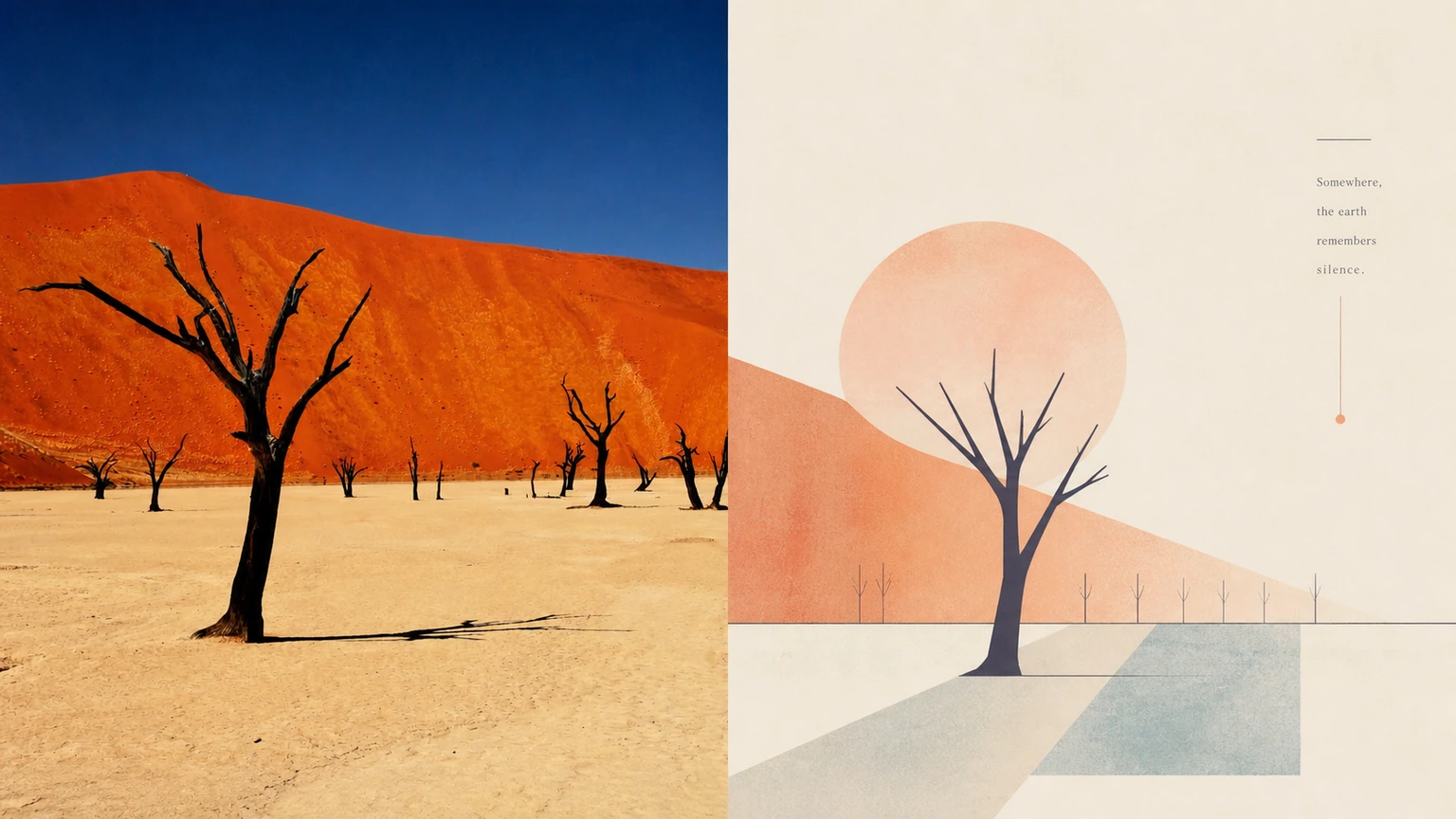
Complete AI image prompt
Please make every photo I upload into its own standalone high-end design poster; no multi-image collages, and output each photo separately. The overall composition uses a 3:4 vertical format and continues the two-layer upper-and-lower logic: the upper half is real photography, and the lower half is an artistic reconstruction based on subtext and symbolism;

The upper half retains the original photo, preserving the subject's identity, structure, pose, real texture, natural light and shadow, and original color atmosphere, applying only a slight high-end photographic color grade so that it has the texture of an art magazine, independent publication, and exhibition photography. To fit the frame, the environmental background may be extended naturally, but the subject must not be stretched, distorted, or altered.

The lower half extracts the most recognizable **subject, outline, pose, narrative relationships, and emotional metaphors** from the photo. It should not merely reproduce “what is seen,” but also understand “what the original image is implying, what it symbolizes, and what it calls to mind,” and then reconstruct these into a graphic scene that is **geometrically minimal, poetic and romantic, yet structurally rigorous**. Do not depict the original scene in full, and do not directly copy realistic details. Instead, retain only the core theme and visual logic that best embody the spirit of the original image, translating complex information into a small number of clear and meaningful forms, paths, landforms, architectural elements, spatial layers, or symbolic objects, so that viewers immediately sense that it shares the same origin as the original image while also feeling its elevated allegorical quality and poetry.

The composition should be founded on **geometric order and rational structure**, with a Da Vinci-like rigor: emphasize proportion, axes, perspective, primary-secondary hierarchy, relationships between planes, directional paths, and spatial balance. The subject may be transformed into a simplified mountain form, architectural form, object form, human form, road, platform, dome, arch, disc, tree-like form, or another symbolic geometric shape, using a small number of key elements to construct a quiet and romantic “conceptual landscape.” The lower half should contain extensive pale negative space and breathing room. Proactively remove complex backgrounds, retaining only the necessary setting that supports the theme and symbolism, allowing emptiness, distance, and order themselves to participate in the narrative.

The visual language uses **geometric flat graphics + a soft handmade texture**: forms are clearly distilled, edges restrained, and details simplified. A slight paper, powdery, or printmaking texture is allowed, but avoid a sticker-like feel, 3D feel, realism, and excessive decoration. The image as a whole should have both the simplicity of modern graphic design and the poetry of romantic narrative illustration, like a dream map, remembered landscape, or allegorical diagram disciplined by rational structure.

The color palette continues the current logic: overall, use a **soft, translucent, slightly desaturated high-end color system**, with a very pale, clean, near-white background serving as a large breathing field. Use **pale pink-blue, mist blue, sky blue, and airy cool blue** to establish the main atmosphere, balanced with **ivory white, cream white, pale beige, soft gray-green, and architectural neutrals**; a small amount of **blush pink, soft peach, dusty rose, or muted blush** may be added as a local accent to give the image a more soothing quality, poetry, and refined layering. Avoid dirty gray, overly strong contrast, highly saturated clashing colors, and a cheap retro feel.

Do not preset fixed titles, numbers, places, or languages for the text, and do not create menu-style information. Based on the photo's theme, emotion, symbolism, memory, or cultural context, freely generate a very small amount of genuinely meaningful characters, words, short sentences, or fragments, and integrate them naturally into the negative-space areas through high-end editorial typography. The text should be small, light, restrained, and refined, and may be arranged along an axis, edge, path, or around the subject, like a note, title slip, or observational phrase in an independent publication, forming a quiet and intelligent relationship with the geometric composition.

The overall temperament should resemble an independently published art travel journal or visual allegory handbook: **minimal, poetic, romantic, rational, restrained, with geometric order and conceptual beauty.** Avoid fully realistic landscapes, information overload, complex decoration, an overfilled subject, overly solid backgrounds, a templated poster feel, an e-commerce illustration feel, a cartoon feel, and a cheap collage feel.
Original style prompt
Please make every photo I upload into its own standalone high-end design poster; no multi-image collages, and output each photo separately. The overall composition uses a 3:4 vertical format and continues the two-layer upper-and-lower logic: the upper half is real photography, and the lower half is an artistic reconstruction based on subtext and symbolism;

The upper half retains the original photo, preserving the subject's identity, structure, pose, real texture, natural light and shadow, and original color atmosphere, applying only a slight high-end photographic color grade so that it has the texture of an art magazine, independent publication, and exhibition photography. To fit the frame, the environmental background may be extended naturally, but the subject must not be stretched, distorted, or altered.

The lower half extracts the most recognizable **subject, outline, pose, narrative relationships, and emotional metaphors** from the photo. It should not merely reproduce “what is seen,” but also understand “what the original image is implying, what it symbolizes, and what it calls to mind,” and then reconstruct these into a graphic scene that is **geometrically minimal, poetic and romantic, yet structurally rigorous**. Do not depict the original scene in full, and do not directly copy realistic details. Instead, retain only the core theme and visual logic that best embody the spirit of the original image, translating complex information into a small number of clear and meaningful forms, paths, landforms, architectural elements, spatial layers, or symbolic objects, so that viewers immediately sense that it shares the same origin as the original image while also feeling its elevated allegorical quality and poetry.

The composition should be founded on **geometric order and rational structure**, with a Da Vinci-like rigor: emphasize proportion, axes, perspective, primary-secondary hierarchy, relationships between planes, directional paths, and spatial balance. The subject may be transformed into a simplified mountain form, architectural form, object form, human form, road, platform, dome, arch, disc, tree-like form, or another symbolic geometric shape, using a small number of key elements to construct a quiet and romantic “conceptual landscape.” The lower half should contain extensive pale negative space and breathing room. Proactively remove complex backgrounds, retaining only the necessary setting that supports the theme and symbolism, allowing emptiness, distance, and order themselves to participate in the narrative.

The visual language uses **geometric flat graphics + a soft handmade texture**: forms are clearly distilled, edges restrained, and details simplified. A slight paper, powdery, or printmaking texture is allowed, but avoid a sticker-like feel, 3D feel, realism, and excessive decoration. The image as a whole should have both the simplicity of modern graphic design and the poetry of romantic narrative illustration, like a dream map, remembered landscape, or allegorical diagram disciplined by rational structure.

The color palette continues the current logic: overall, use a **soft, translucent, slightly desaturated high-end color system**, with a very pale, clean, near-white background serving as a large breathing field. Use **pale pink-blue, mist blue, sky blue, and airy cool blue** to establish the main atmosphere, balanced with **ivory white, cream white, pale beige, soft gray-green, and architectural neutrals**; a small amount of **blush pink, soft peach, dusty rose, or muted blush** may be added as a local accent to give the image a more soothing quality, poetry, and refined layering. Avoid dirty gray, overly strong contrast, highly saturated clashing colors, and a cheap retro feel.

Do not preset fixed titles, numbers, places, or languages for the text, and do not create menu-style information. Based on the photo's theme, emotion, symbolism, memory, or cultural context, freely generate a very small amount of genuinely meaningful characters, words, short sentences, or fragments, and integrate them naturally into the negative-space areas through high-end editorial typography. The text should be small, light, restrained, and refined, and may be arranged along an axis, edge, path, or around the subject, like a note, title slip, or observational phrase in an independent publication, forming a quiet and intelligent relationship with the geometric composition.

The overall temperament should resemble an independently published art travel journal or visual allegory handbook: **minimal, poetic, romantic, rational, restrained, with geometric order and conceptual beauty.** Avoid fully realistic landscapes, information overload, complex decoration, an overfilled subject, overly solid backgrounds, a templated poster feel, an e-commerce illustration feel, a cartoon feel, and a cheap collage feel.
More open images in the “XXD Panel 058 · Poetic Conceptual Scene” style