

Open prompts
en sample 06 AI Image Prompt
en sample 06, its complete AI image prompt, and the XXD Panel 012 · Geometry of Life style are free to view and copy.
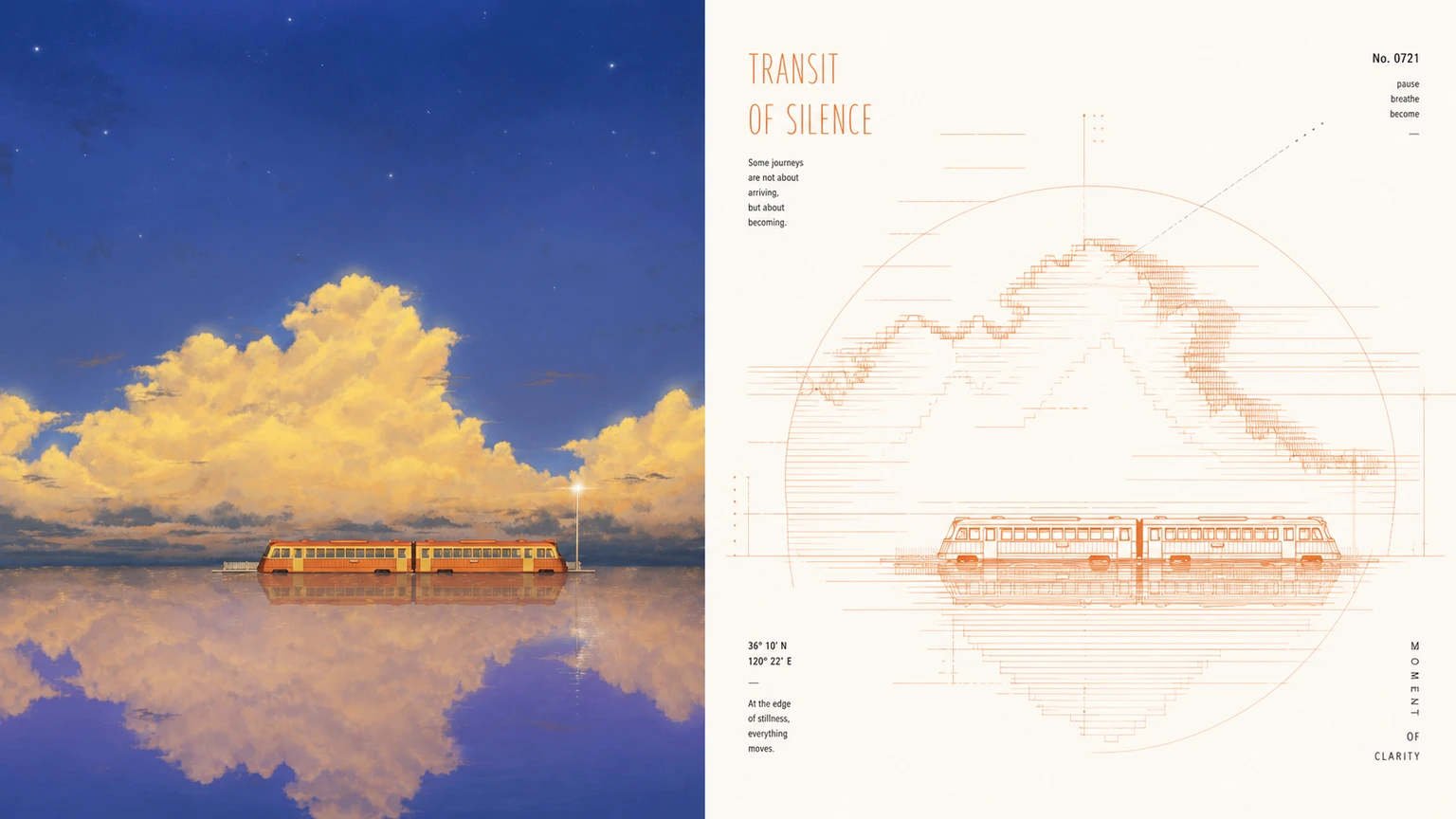
Complete AI image prompt
Please make every photo I upload into its own standalone high-end design poster; no multi-image collages, each photo output separately. The overall composition uses a 3:4 vertical format, with the upper and lower zones strictly 1:1 in height, each taking up 50% of the frame.

The upper half keeps the original photo, preserving the subject's structure, real texture, natural light and shadow, and original color atmosphere, applying only a slight high-end photographic color grade so that it carries the texture of art magazines, independent publications, and exhibition photography. To fit the frame, the sky, ground, or environmental background may be extended naturally, but the subject must not be stretched, distorted, or altered.

The lower half extracts the most recognizable **subject, outline, pose, and narrative relationships** from the photo and reconstructs them as a linear experimental poster with geometric order. The subject emerges through the aggregation of high-density repeated lines, offset tracing lines, short loops, and slightly trembling trajectories, retaining clearly recognizable edges while keeping the interior unstable and flowing. Outside it, lines from the same source, but finer, sparser, and lighter, spread outward, while horizontal, vertical, diagonal, arc, tangent, or implicit grid lines establish a rational structure, creating the visual tension of **high density at the center, low density at the periphery, with geometric order and free linearity coexisting**.

For the color scheme, extract from the upper photo **the color with the greatest vitality, the strongest recognizability, and the best ability to represent the subject's essential spirit** as the main line color. Do not sample colors evenly by area, and do not deliberately distress or mute them toward gray; the color may be purified, brightened, and corrected appropriately to make it cleaner, more vivid, and more modern. The whole uses a clean light-colored background, a single main line color, and black-gray microtypography, creating layers through line density, thickness, and overprinting. Avoid dirty colors, a gray haze, a fixed blue cast, mixed multiple colors, and digital gradients.

Text intervenes ingeniously as part of the composition. Distill an extremely short title from the photo's emotion, movement, time, state, or metaphor, accompanied by a small number, an apt philosophical memorable line, a state word, a scale, or a micro-annotation. Text may be arranged along geometric axes, the subject's outline, or the boundary of the line field; horizontally, vertically, rotated, interwoven, or offset. Use an extremely small type size, light font weight, wide letterspacing, and precise alignment to create a high-end editorial feel, letting rational typography hold down the agitation of the free lines.

Maintain extensive negative space, a single visual focal point, and clear geometric order throughout, presenting a visual temperament that is **clean, restrained, sharp, experimental, artistic, and full of vitality**. Avoid random doodling, directionless tangles of lines, dirty and worn retro styling, a cyber-tech feel, a commercial promotional feel, a cartoon feel, and a template feel.
Original style prompt
Please make every photo I upload into its own standalone high-end design poster; no multi-image collages, each photo output separately. The overall composition uses a 3:4 vertical format, with the upper and lower zones strictly 1:1 in height, each taking up 50% of the frame.

The upper half keeps the original photo, preserving the subject's structure, real texture, natural light and shadow, and original color atmosphere, applying only a slight high-end photographic color grade so that it carries the texture of art magazines, independent publications, and exhibition photography. To fit the frame, the sky, ground, or environmental background may be extended naturally, but the subject must not be stretched, distorted, or altered.

The lower half extracts the most recognizable **subject, outline, pose, and narrative relationships** from the photo and reconstructs them as a linear experimental poster with geometric order. The subject emerges through the aggregation of high-density repeated lines, offset tracing lines, short loops, and slightly trembling trajectories, retaining clearly recognizable edges while keeping the interior unstable and flowing. Outside it, lines from the same source, but finer, sparser, and lighter, spread outward, while horizontal, vertical, diagonal, arc, tangent, or implicit grid lines establish a rational structure, creating the visual tension of **high density at the center, low density at the periphery, with geometric order and free linearity coexisting**.

For the color scheme, extract from the upper photo **the color with the greatest vitality, the strongest recognizability, and the best ability to represent the subject's essential spirit** as the main line color. Do not sample colors evenly by area, and do not deliberately distress or mute them toward gray; the color may be purified, brightened, and corrected appropriately to make it cleaner, more vivid, and more modern. The whole uses a clean light-colored background, a single main line color, and black-gray microtypography, creating layers through line density, thickness, and overprinting. Avoid dirty colors, a gray haze, a fixed blue cast, mixed multiple colors, and digital gradients.

Text intervenes ingeniously as part of the composition. Distill an extremely short title from the photo's emotion, movement, time, state, or metaphor, accompanied by a small number, an apt philosophical memorable line, a state word, a scale, or a micro-annotation. Text may be arranged along geometric axes, the subject's outline, or the boundary of the line field; horizontally, vertically, rotated, interwoven, or offset. Use an extremely small type size, light font weight, wide letterspacing, and precise alignment to create a high-end editorial feel, letting rational typography hold down the agitation of the free lines.

Maintain extensive negative space, a single visual focal point, and clear geometric order throughout, presenting a visual temperament that is **clean, restrained, sharp, experimental, artistic, and full of vitality**. Avoid random doodling, directionless tangles of lines, dirty and worn retro styling, a cyber-tech feel, a commercial promotional feel, a cartoon feel, and a template feel.
More open images in the “XXD Panel 012 · Geometry of Life” style