

Open prompts
en sample 06 AI Image Prompt
en sample 06, its complete AI image prompt, and the XXD Panel 028 · Isometric Micro-Landscape style are free to view and copy.
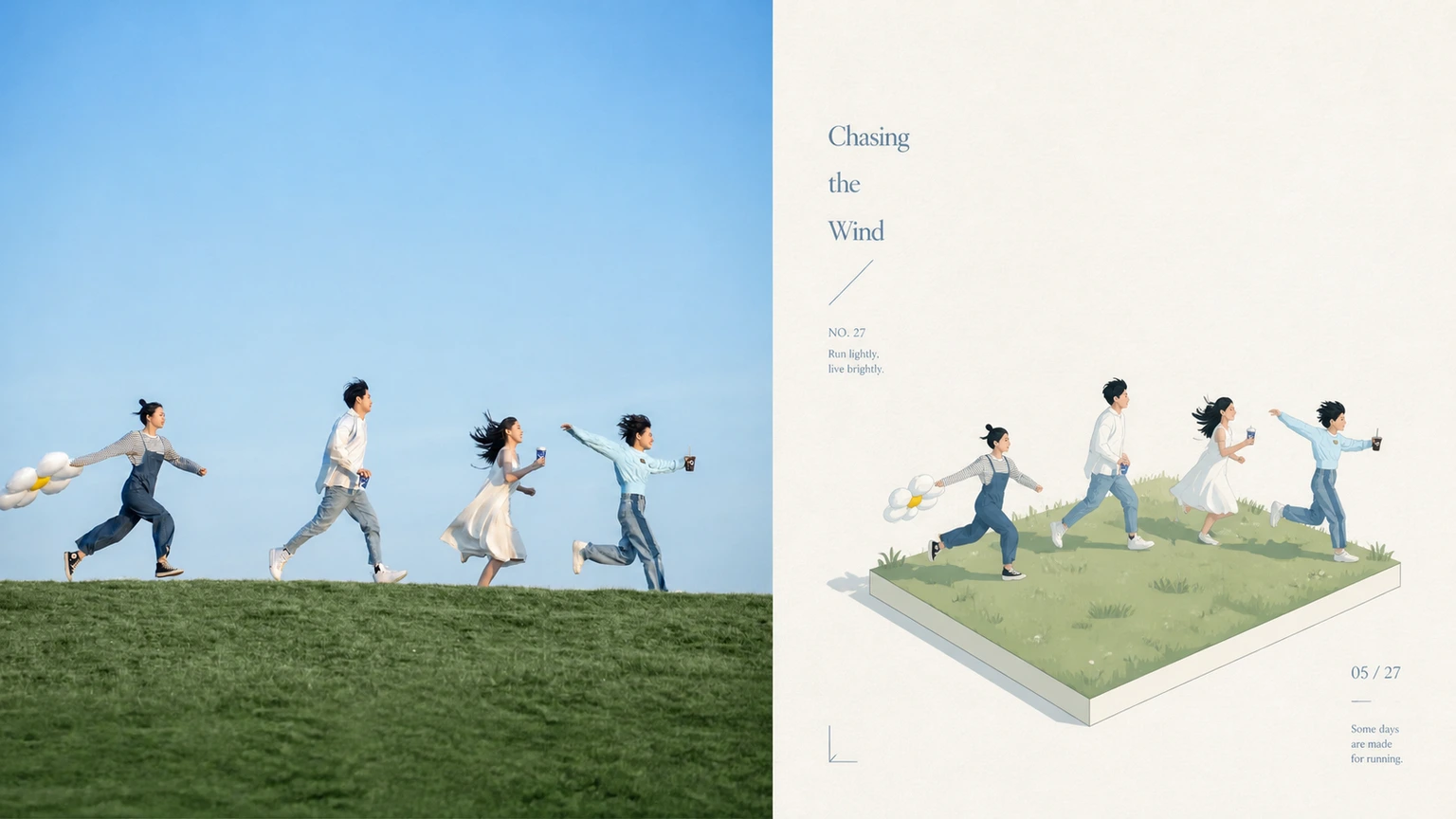
Complete AI image prompt
Please make every photo I upload into its own standalone high-end design poster; no multi-image collages, each photo output separately. The overall composition uses a 3:4 vertical format, with the upper and lower zones strictly 1:1 in height, each taking up 50% of the frame.

The upper half keeps the original photo, preserving the subject's structure, real texture, natural light and shadow, and original color atmosphere, applying only a slight high-end photographic color grade so that it carries the texture of art magazines, independent publications, and exhibition photography. To fit the frame, the sky, ground, or environmental background may be extended naturally, but the subject must not be stretched, distorted, or altered.

The lower half extracts the most recognizable **subject, outline, pose, and narrative relationships** from the photo and reconstructs them into a refined, minimal isometric illustration, like a miniature three-dimensional model or architectural scale model displayed on paper. Do not mechanically replicate the photo's details; instead, re-express the subject through simplified volumes, clear edges, concise layers, and miniature-scene relationships, preserving identity features recognizable at a glance while giving it the quiet, restrained, poetic quality of editorial illustration.

The overall composition follows the logic of **an isometric perspective, a miniature landscape, and the feel of a paper model**: the subject appears to have been cut out and placed on a small piece of paper or miniature base, with large areas of negative space retained around it; a sense of scale and solitude is established through contrasts in volume, cropped edges, subtle cast shadows, and a few tiny details. A very small number of supporting elements may be added to reinforce the subject, but they must not form a second visual center.

The color scheme is drawn entirely from the original photo above, prioritizing the colors that are most recognizable, most evocative, and most representative of the subject, then **summarizing, purifying, softening, and unifying the complex colors into a limited palette**. Preserve the original image's warm-cool relationships and color character, but reduce stray colors and visual noise so that the colors feel calmer, more restrained, softer, and more like an editorial illustration on paper; distinguish volumes through lighter and darker shades of the same color, analogous-color relationships, and small color differences, without introducing a fixed color scheme unrelated to the original image. Use fine ink lines, flat color planes, subtle shadows, and paper grain to convey structure and depth.

Text intervenes deftly as part of the composition. From the photo's theme, location, action, state, or mood, distill a short title in the target language specified by the user, accompanied by a very small number of numerals, short phrases, or micro-annotations. Keep the text slender, restrained, and modern-editorial in feel; it may be arranged along the edges of the negative space, the subject's base, a horizontal axis, or the isometric structure, forming a quiet and refined layout rhythm together with the graphics.

The overall reference is **minimal isometric illustration, miniature three-dimensional models, landscapes on paper, and high-end editorial design**, presenting a quiet, poetic, restrained, refined visual quality with a collectible feel. Avoid cartoonishness, high-saturation contrasting colors, fixed color schemes unrelated to the original image, a plastic 3D feel, accumulations of complex scenery, an e-commerce look, and a template-like feel.
Original style prompt
Please make every photo I upload into its own standalone high-end design poster; no multi-image collages, each photo output separately. The overall composition uses a 3:4 vertical format, with the upper and lower zones strictly 1:1 in height, each taking up 50% of the frame.

The upper half keeps the original photo, preserving the subject's structure, real texture, natural light and shadow, and original color atmosphere, applying only a slight high-end photographic color grade so that it carries the texture of art magazines, independent publications, and exhibition photography. To fit the frame, the sky, ground, or environmental background may be extended naturally, but the subject must not be stretched, distorted, or altered.

The lower half extracts the most recognizable **subject, outline, pose, and narrative relationships** from the photo and reconstructs them into a refined, minimal isometric illustration, like a miniature three-dimensional model or architectural scale model displayed on paper. Do not mechanically replicate the photo's details; instead, re-express the subject through simplified volumes, clear edges, concise layers, and miniature-scene relationships, preserving identity features recognizable at a glance while giving it the quiet, restrained, poetic quality of editorial illustration.

The overall composition follows the logic of **an isometric perspective, a miniature landscape, and the feel of a paper model**: the subject appears to have been cut out and placed on a small piece of paper or miniature base, with large areas of negative space retained around it; a sense of scale and solitude is established through contrasts in volume, cropped edges, subtle cast shadows, and a few tiny details. A very small number of supporting elements may be added to reinforce the subject, but they must not form a second visual center.

The color scheme is drawn entirely from the original photo above, prioritizing the colors that are most recognizable, most evocative, and most representative of the subject, then **summarizing, purifying, softening, and unifying the complex colors into a limited palette**. Preserve the original image's warm-cool relationships and color character, but reduce stray colors and visual noise so that the colors feel calmer, more restrained, softer, and more like an editorial illustration on paper; distinguish volumes through lighter and darker shades of the same color, analogous-color relationships, and small color differences, without introducing a fixed color scheme unrelated to the original image. Use fine ink lines, flat color planes, subtle shadows, and paper grain to convey structure and depth.

Text intervenes deftly as part of the composition. From the photo's theme, location, action, state, or mood, distill a short title in the target language specified by the user, accompanied by a very small number of numerals, short phrases, or micro-annotations. Keep the text slender, restrained, and modern-editorial in feel; it may be arranged along the edges of the negative space, the subject's base, a horizontal axis, or the isometric structure, forming a quiet and refined layout rhythm together with the graphics.

The overall reference is **minimal isometric illustration, miniature three-dimensional models, landscapes on paper, and high-end editorial design**, presenting a quiet, poetic, restrained, refined visual quality with a collectible feel. Avoid cartoonishness, high-saturation contrasting colors, fixed color schemes unrelated to the original image, a plastic 3D feel, accumulations of complex scenery, an e-commerce look, and a template-like feel.
More open images in the “XXD Panel 028 · Isometric Micro-Landscape” style