
Open prompts
en sample 06 AI Image Prompt
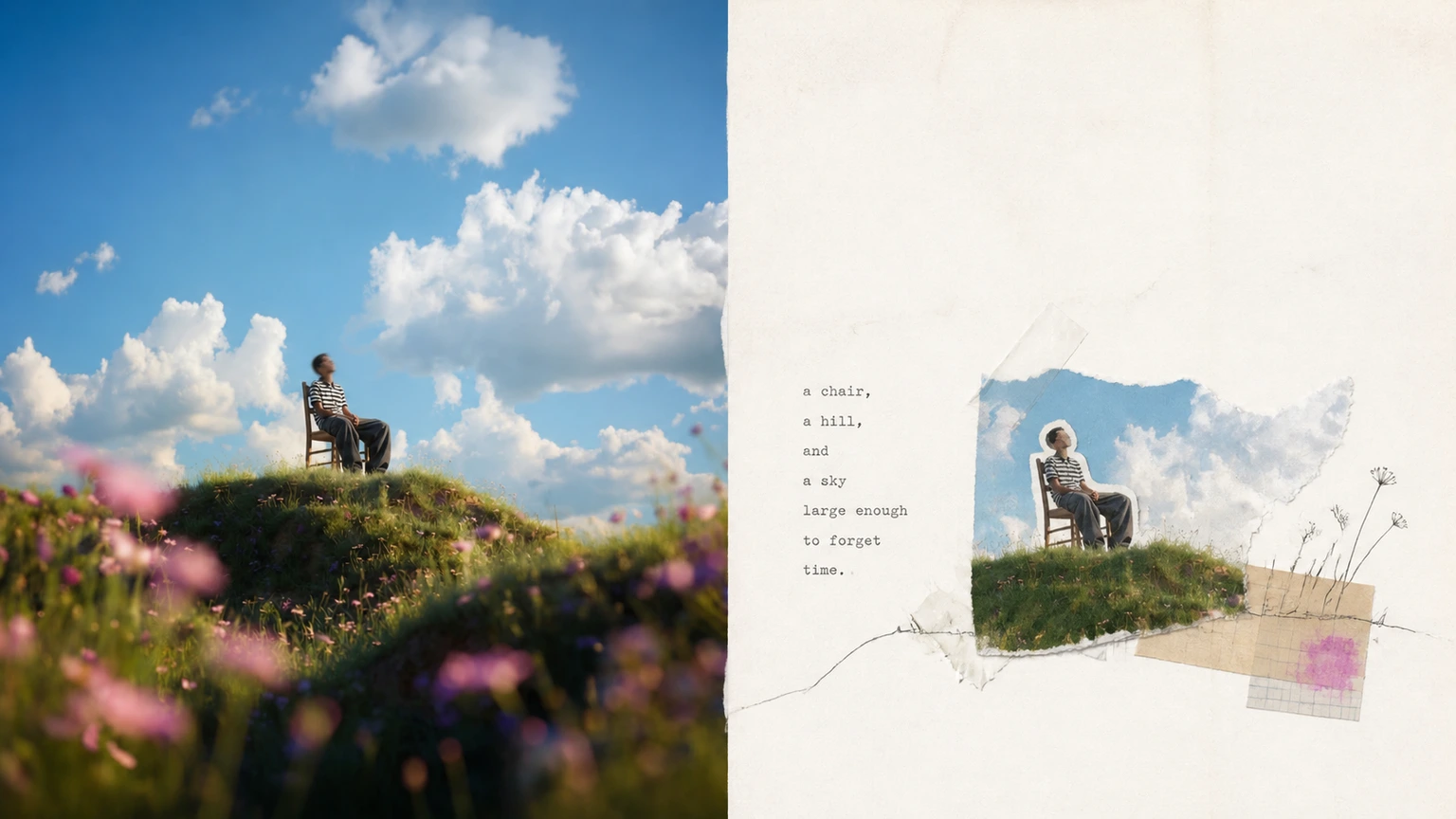
en sample 06, its complete AI image prompt, and the XXD Panel 064 · Indie Collage Page style are free to view and copy.
Complete AI image prompt
Please make each photo I upload into an independent high-end design poster. No splicing of multiple pictures, and each photo will be output separately. The overall composition adopts a 3:4 vertical layout, with the upper and lower areas strictly cut in a 50:50 ratio, each accounting for 50% of the screen.

The upper part retains the original photo, maintaining the main structure, real texture, natural light and shadow, and original color atmosphere. It only undergoes slight advanced photography color grading to give it the texture of art magazines, independent publications, and exhibition photography. The sky, ground, or environmental background can be naturally expanded to fit the frame, but the subject must not be stretched, distorted, or altered.

The lower part extracts the most identifiable ** subject, outline, posture and narrative relationship ** in the photo. After understanding the most worthy emotions, metaphors and narrative core of the original picture, it reconstructs it into a collage-style hand-painted picture with the texture of blank art and mixed graphics and text. Don’t completely copy the photo, keep only a small amount of the most critical information so that people can recognize the original object at a glance, and at the same time form a more condensed and meaningful visual expression.

The style refers to ** old paper collage, hand-torn paper edges, pencil/ink line drawing, slight archival feel and poetic editing design **. The main body can be composed of torn-off stickers, old paper textures, faded text fragments, slight sketch lines and partial splicing structures, retaining manual errors, incomplete edges, dislocation and incompleteness. The lines should be thin, light, and restrained, with slight manual pauses and hesitations. No smooth vectors, no thick black borders, and no complete illustration-style coloring.

The background uses **, a very light, almost white paper background color **, with a slight natural paper grain and old texture, but the overall color remains clean, quiet, and transparent. White space must become an important part of the composition, responsible for a sense of air, time, silence, distance or memory. The main body does not have to be centered, but can be offset, reduced, suspended or partially cropped, and a more professional layout order can be formed through blank space, direction, density and local auxiliary elements.

The overall color is restrained, based on the original color of the paper, light gray, light brown, and old ink. **The two most memorable colors 1–2** can be extracted from the photo above as a very small amount of accent color, used for local collages, symbols, paper strips, traces, or narrative highlights. The color is limited to the point without covering a large area.

The text is freely generated based on the photo itself, with no fixed title, location, number, year or language preset. A very small number of meaningful words, words, phrases or fragments can be extracted from the subject, action, time, memory, emotion or metaphor, and combined with the image to compose the composition. The ** text uses the small, restrained, slightly mechanical error typewriter font **. It can be arranged horizontally, vertically, scattered, welted, expanded along the main direction, or form a clever relationship with collage elements, white space and image edges, presenting a quiet, restrained, archive-like texture of mixed graphics and text.

The overall presentation is **'s independent publication temperament with ample white space, restrained composition, delicate sense of collage, high-level relationship between picture and text, quiet and deep **. Avoid complete scene reproduction, background filling, dense decoration, cartoon feel, smooth vectors, heavy coloring, 3D texture, commercial template feel and meaningless pseudo-text.
Original style prompt
Please make each photo I upload into an independent high-end design poster. No splicing of multiple pictures, and each photo will be output separately. The overall composition adopts a 3:4 vertical layout, with the upper and lower areas strictly cut in a 50:50 ratio, each accounting for 50% of the screen.

The upper part retains the original photo, maintaining the main structure, real texture, natural light and shadow, and original color atmosphere. It only undergoes slight advanced photography color grading to give it the texture of art magazines, independent publications, and exhibition photography. The sky, ground, or environmental background can be naturally expanded to fit the frame, but the subject must not be stretched, distorted, or altered.

The lower part extracts the most identifiable ** subject, outline, posture and narrative relationship ** in the photo. After understanding the most worthy emotions, metaphors and narrative core of the original picture, it reconstructs it into a collage-style hand-painted picture with the texture of blank art and mixed graphics and text. Don’t completely copy the photo, keep only a small amount of the most critical information so that people can recognize the original object at a glance, and at the same time form a more condensed and meaningful visual expression.

The style refers to ** old paper collage, hand-torn paper edges, pencil/ink line drawing, slight archival feel and poetic editing design **. The main body can be composed of torn-off stickers, old paper textures, faded text fragments, slight sketch lines and partial splicing structures, retaining manual errors, incomplete edges, dislocation and incompleteness. The lines should be thin, light, and restrained, with slight manual pauses and hesitations. No smooth vectors, no thick black borders, and no complete illustration-style coloring.

The background uses **, a very light, almost white paper background color **, with a slight natural paper grain and old texture, but the overall color remains clean, quiet, and transparent. White space must become an important part of the composition, responsible for a sense of air, time, silence, distance or memory. The main body does not have to be centered, but can be offset, reduced, suspended or partially cropped, and a more professional layout order can be formed through blank space, direction, density and local auxiliary elements.

The overall color is restrained, based on the original color of the paper, light gray, light brown, and old ink. **The two most memorable colors 1–2** can be extracted from the photo above as a very small amount of accent color, used for local collages, symbols, paper strips, traces, or narrative highlights. The color is limited to the point without covering a large area.

The text is freely generated based on the photo itself, with no fixed title, location, number, year or language preset. A very small number of meaningful words, words, phrases or fragments can be extracted from the subject, action, time, memory, emotion or metaphor, and combined with the image to compose the composition. The ** text uses the small, restrained, slightly mechanical error typewriter font **. It can be arranged horizontally, vertically, scattered, welted, expanded along the main direction, or form a clever relationship with collage elements, white space and image edges, presenting a quiet, restrained, archive-like texture of mixed graphics and text.

The overall presentation is **'s independent publication temperament with ample white space, restrained composition, delicate sense of collage, high-level relationship between picture and text, quiet and deep **. Avoid complete scene reproduction, background filling, dense decoration, cartoon feel, smooth vectors, heavy coloring, 3D texture, commercial template feel and meaningless pseudo-text.
More open images in the “XXD Panel 064 · Indie Collage Page” style