
Open prompts
en sample 07 AI Image Prompt
en sample 07, its complete AI image prompt, and the XXD Panel 099 · Typeface Mascot style are free to view and copy.
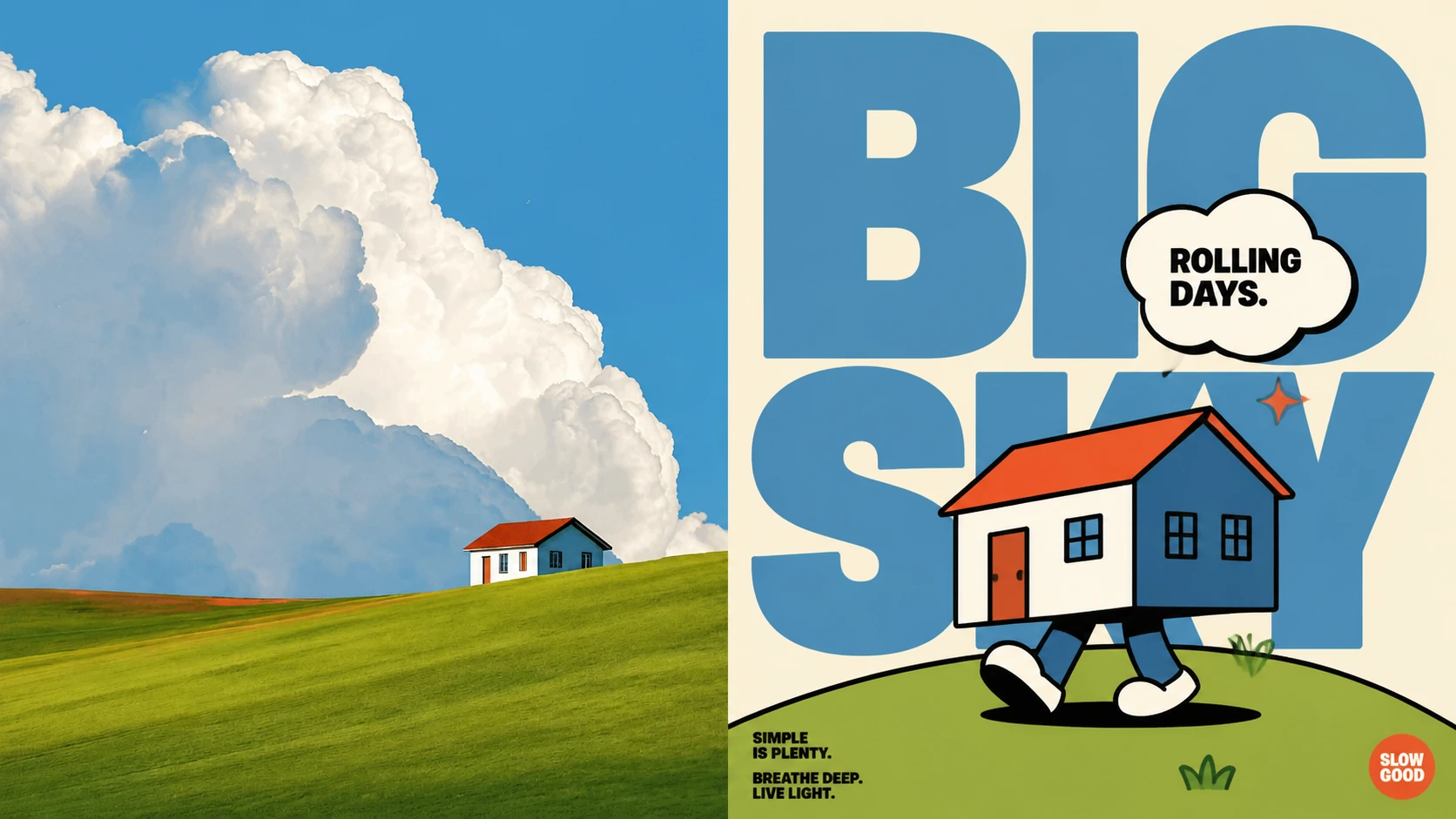
Complete AI image prompt
Create one separate premium design poster for every uploaded photograph; never combine several photos into one output. The original container is a 3:4 portrait split into two equal-height regions.

Keep the source photograph in the upper region, preserving subject identity, structure, pose, real texture, natural light, and original colour atmosphere. Apply only subtle editorial grading. Natural background extension is allowed for fit, but never stretch, distort, or alter the subject.

In the lower region, extract the most recognisable **subject, contour, pose, and narrative relationship**, then rebuild them as a **Flat Vector Mascot Illustration**. Do not trace mechanically. Identify 3–5 stable identity cues and redesign them through **rounded geometry, exaggerated proportions, simplified structure, and clear shape language** so the subject remains recognisable at small size. People and animals may gain stronger action and character; buildings, plants, objects, and vehicles may become mascot-like graphic characters, but do not force faces onto them merely for cuteness.

Use **heavy, clean black outlines, rounded geometric shapes, large flat colour areas, and very few internal details**. Selected limbs, structures, or signature traits may be enlarged for an easy, humorous, friendly proportion. A slight digitally hand-drawn spring is welcome, while the result remains clean, stable, and brand-recognisable. Avoid realistic shading, complex volume, tiny textures, and generic cartoon tracing.

Follow **Illustration-led Graphic Design**: the character is the absolute focal point, staged with **oversized background typography and only a small amount of comic speech bubbles or graphic information** to form clear foreground, middle, and background layers. Giant type may be occluded, interwoven, or cropped and must structure the page rather than act as a detached title. Use bubbles only when they add wit or narrative value. Build brand impact through scale contrast, off-centre composition, overlap, and generous negative space rather than evenly distributing elements.

Use a **limited colour system**. Select the 2–4 most distinctive and lively colours from the photograph, refine and brand them instead of copying every source colour. Establish memory with clean, high-value primary colours, stabilised by black, white, or a very pale composite tone; one high-energy accent may create a visual jump. Keep colour bright, light, and modern, avoiding neon, muddy greys, complicated gradients, and cheap candy colour.

Generate short words, phrases, or onomatopoeia from the subject’s identity, action, personality, mood, or visual metaphor rather than a fixed place or template. Use a **heavy, condensed display sans with subtly rounded and geometrically exaggerated forms** matching the character. Oversized background type may carry restrained halftone or flat texture; secondary type stays smaller and controlled. Type and character must be composed together, never as illustration first and title pasted later.

The complete result should combine **Mascot Character Design × Oversized Typography × Sticker-style Graphic × Brand Campaign Visual**: bold, friendly, intelligent, playful, modern, memorable, and still governed by premium graphic-design order. Preserve the unique identity of any person, animal, plant, building, object, vehicle, or natural subject before characterising it. Avoid realistic illustration, complex backgrounds, ordinary children’s cartoon styling, anime, 3D rendering, gradient-plastic surfaces, generic stock stickers, and templated social-media layouts.
Original style prompt
Create one separate premium design poster for every uploaded photograph; never combine several photos into one output. The original container is a 3:4 portrait split into two equal-height regions.

Keep the source photograph in the upper region, preserving subject identity, structure, pose, real texture, natural light, and original colour atmosphere. Apply only subtle editorial grading. Natural background extension is allowed for fit, but never stretch, distort, or alter the subject.

In the lower region, extract the most recognisable **subject, contour, pose, and narrative relationship**, then rebuild them as a **Flat Vector Mascot Illustration**. Do not trace mechanically. Identify 3–5 stable identity cues and redesign them through **rounded geometry, exaggerated proportions, simplified structure, and clear shape language** so the subject remains recognisable at small size. People and animals may gain stronger action and character; buildings, plants, objects, and vehicles may become mascot-like graphic characters, but do not force faces onto them merely for cuteness.

Use **heavy, clean black outlines, rounded geometric shapes, large flat colour areas, and very few internal details**. Selected limbs, structures, or signature traits may be enlarged for an easy, humorous, friendly proportion. A slight digitally hand-drawn spring is welcome, while the result remains clean, stable, and brand-recognisable. Avoid realistic shading, complex volume, tiny textures, and generic cartoon tracing.

Follow **Illustration-led Graphic Design**: the character is the absolute focal point, staged with **oversized background typography and only a small amount of comic speech bubbles or graphic information** to form clear foreground, middle, and background layers. Giant type may be occluded, interwoven, or cropped and must structure the page rather than act as a detached title. Use bubbles only when they add wit or narrative value. Build brand impact through scale contrast, off-centre composition, overlap, and generous negative space rather than evenly distributing elements.

Use a **limited colour system**. Select the 2–4 most distinctive and lively colours from the photograph, refine and brand them instead of copying every source colour. Establish memory with clean, high-value primary colours, stabilised by black, white, or a very pale composite tone; one high-energy accent may create a visual jump. Keep colour bright, light, and modern, avoiding neon, muddy greys, complicated gradients, and cheap candy colour.

Generate short words, phrases, or onomatopoeia from the subject’s identity, action, personality, mood, or visual metaphor rather than a fixed place or template. Use a **heavy, condensed display sans with subtly rounded and geometrically exaggerated forms** matching the character. Oversized background type may carry restrained halftone or flat texture; secondary type stays smaller and controlled. Type and character must be composed together, never as illustration first and title pasted later.

The complete result should combine **Mascot Character Design × Oversized Typography × Sticker-style Graphic × Brand Campaign Visual**: bold, friendly, intelligent, playful, modern, memorable, and still governed by premium graphic-design order. Preserve the unique identity of any person, animal, plant, building, object, vehicle, or natural subject before characterising it. Avoid realistic illustration, complex backgrounds, ordinary children’s cartoon styling, anime, 3D rendering, gradient-plastic surfaces, generic stock stickers, and templated social-media layouts.
More open images in the “XXD Panel 099 · Typeface Mascot” style