

Open prompts
en sample 07 AI Image Prompt
en sample 07, its complete AI image prompt, and the XXD Panel 105 · Poetic Space Anthology style are free to view and copy.
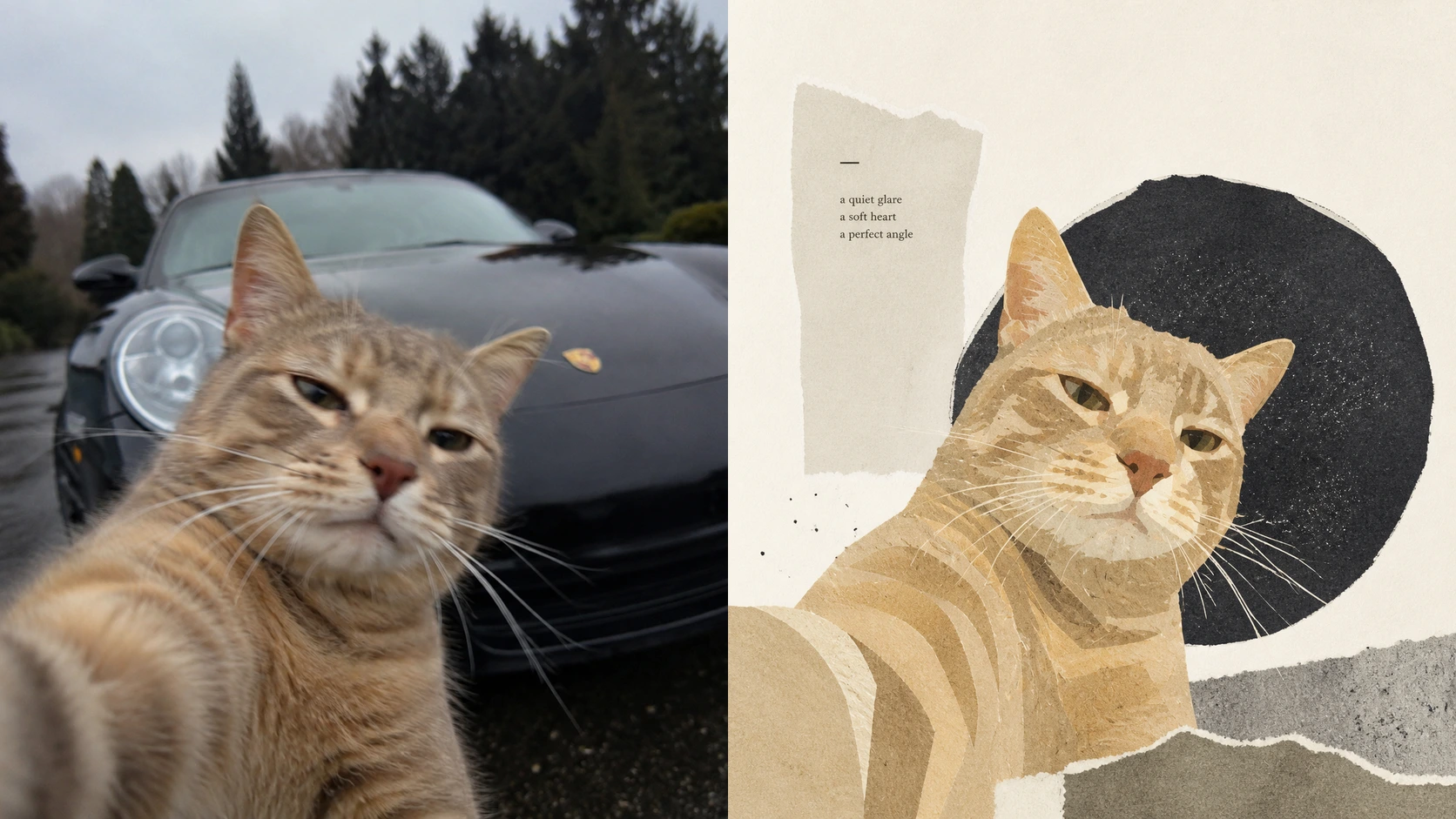
Complete AI image prompt
Please turn every photograph I upload into a separate premium design poster. Do not combine multiple images; output each photograph individually. Use an overall 3:4 portrait composition, with the upper and lower regions in a strict 1:1 height ratio, each occupying 50% of the image.

Keep the original photograph in the upper half, preserving the subject's identity, structure, pose, authentic texture, natural light and shadow, and original colour atmosphere. Apply only subtle, high-end colour grading so it has the quality of an art magazine, independent publication, or exhibition image. The surrounding environment may be extended naturally to fit the format, but the subject must not be stretched, distorted, or altered.

In the lower half, first perform an **intelligent aesthetic selection and visual simplification** of the original photograph. Do not try to retain the greatest amount of information. Instead, determine which scene, object, or relationship is the most beautiful, most characterful, most recognisable, and most compositionally valuable, then retain only one core subject and the very few supporting elements that are truly necessary. Proactively discard cluttered backgrounds, ordinary surroundings, repeated objects, and details with no narrative value, so the final image feels as though only the most beautiful moment has survived from a real memory.

Extract the retained **subject, contour, structure, pose, and narrative relationship**, and rebuild them as a poetic minimalist paper-collage illustration combining monoprint, screen print, and Risograph-style print textures. Do not fully trace the photograph. Instead, summarise the subject as pieces of paper, colour blocks, and simple geometric forms, then reorganise it through cutting, tearing, layering, and a small number of irregular shapes. The original object should remain recognisable at a glance while gaining a visual relationship that is purer and more elegant than the photograph.

Emphasise **generous negative space, a single visual centre of gravity, the proportions of flat shapes, and a rhythm of density and openness**. The subject may be re-cropped, offset, enlarged, or reduced according to the most beautiful movement in the original image; there is no need to reproduce the original composition faithfully. Keep only the fragments of space, plants, objects, or surroundings that strengthen the subject's beauty, and leave everything else blank. The image should feel like an art-directed “memory excerpt”, not an illustrated version of the photograph.

Use mixed-media collage, cut-paper collage, monoprint, screen print, and Risograph-inspired texture. Colour blocks should be flat yet papery, preserving grain, misprints, dry rubbing, uneven ink, slight registration shifts, irregular cut and torn-paper edges, and intentionally retained hand-made imperfections. Avoid smooth vectors, realistic light and shadow, complex textures, and the look of digital filters.

Extract and reorganise the most beautiful and memorable colour relationships from the photograph above; do not sample colours evenly. Use a soft, luminous, harmonious limited palette, and establish rhythm through a primary colour, supporting colour, accent colour, and generous areas of paper white. The colours should remain connected to the original image while being artistically purified and remixed. Avoid muddy greys, clutter, excessive ageing, and meaningless piles of many colours.

Use text sparingly, without presetting a fixed title, place, number, or language. Based on the photograph's retained core theme, emotion, action, or metaphor, freely generate a small number of genuinely meaningful words, short phrases, or tiny annotations. Arrange image and text with restraint by using the negative space, the edges of the subject, and relationships between flat shapes, so the words feel like quiet notes in an art publication rather than an information panel.

The overall visual character should be **poetic, minimalist, quiet, unpolished, modern, and warm**. The central principle is: **retain only the image most worth remembering; draw only the most beautiful part; let subtraction itself become the design.** Avoid complete scene reconstruction, filled backgrounds, multiple parallel subjects, accumulations of detail, cartoonisation, commercial-illustration styling, and template-like results.
Original style prompt
Please turn every photograph I upload into a separate premium design poster. Do not combine multiple images; output each photograph individually. Use an overall 3:4 portrait composition, with the upper and lower regions in a strict 1:1 height ratio, each occupying 50% of the image.

Keep the original photograph in the upper half, preserving the subject's identity, structure, pose, authentic texture, natural light and shadow, and original colour atmosphere. Apply only subtle, high-end colour grading so it has the quality of an art magazine, independent publication, or exhibition image. The surrounding environment may be extended naturally to fit the format, but the subject must not be stretched, distorted, or altered.

In the lower half, first perform an **intelligent aesthetic selection and visual simplification** of the original photograph. Do not try to retain the greatest amount of information. Instead, determine which scene, object, or relationship is the most beautiful, most characterful, most recognisable, and most compositionally valuable, then retain only one core subject and the very few supporting elements that are truly necessary. Proactively discard cluttered backgrounds, ordinary surroundings, repeated objects, and details with no narrative value, so the final image feels as though only the most beautiful moment has survived from a real memory.

Extract the retained **subject, contour, structure, pose, and narrative relationship**, and rebuild them as a poetic minimalist paper-collage illustration combining monoprint, screen print, and Risograph-style print textures. Do not fully trace the photograph. Instead, summarise the subject as pieces of paper, colour blocks, and simple geometric forms, then reorganise it through cutting, tearing, layering, and a small number of irregular shapes. The original object should remain recognisable at a glance while gaining a visual relationship that is purer and more elegant than the photograph.

Emphasise **generous negative space, a single visual centre of gravity, the proportions of flat shapes, and a rhythm of density and openness**. The subject may be re-cropped, offset, enlarged, or reduced according to the most beautiful movement in the original image; there is no need to reproduce the original composition faithfully. Keep only the fragments of space, plants, objects, or surroundings that strengthen the subject's beauty, and leave everything else blank. The image should feel like an art-directed “memory excerpt”, not an illustrated version of the photograph.

Use mixed-media collage, cut-paper collage, monoprint, screen print, and Risograph-inspired texture. Colour blocks should be flat yet papery, preserving grain, misprints, dry rubbing, uneven ink, slight registration shifts, irregular cut and torn-paper edges, and intentionally retained hand-made imperfections. Avoid smooth vectors, realistic light and shadow, complex textures, and the look of digital filters.

Extract and reorganise the most beautiful and memorable colour relationships from the photograph above; do not sample colours evenly. Use a soft, luminous, harmonious limited palette, and establish rhythm through a primary colour, supporting colour, accent colour, and generous areas of paper white. The colours should remain connected to the original image while being artistically purified and remixed. Avoid muddy greys, clutter, excessive ageing, and meaningless piles of many colours.

Use text sparingly, without presetting a fixed title, place, number, or language. Based on the photograph's retained core theme, emotion, action, or metaphor, freely generate a small number of genuinely meaningful words, short phrases, or tiny annotations. Arrange image and text with restraint by using the negative space, the edges of the subject, and relationships between flat shapes, so the words feel like quiet notes in an art publication rather than an information panel.

The overall visual character should be **poetic, minimalist, quiet, unpolished, modern, and warm**. The central principle is: **retain only the image most worth remembering; draw only the most beautiful part; let subtraction itself become the design.** Avoid complete scene reconstruction, filled backgrounds, multiple parallel subjects, accumulations of detail, cartoonisation, commercial-illustration styling, and template-like results.
More open images in the “XXD Panel 105 · Poetic Space Anthology” style