

Open prompts
en sample 08 AI Image Prompt
en sample 08, its complete AI image prompt, and the XXD Panel 091 · Blue-Line Travel Album style are free to view and copy.
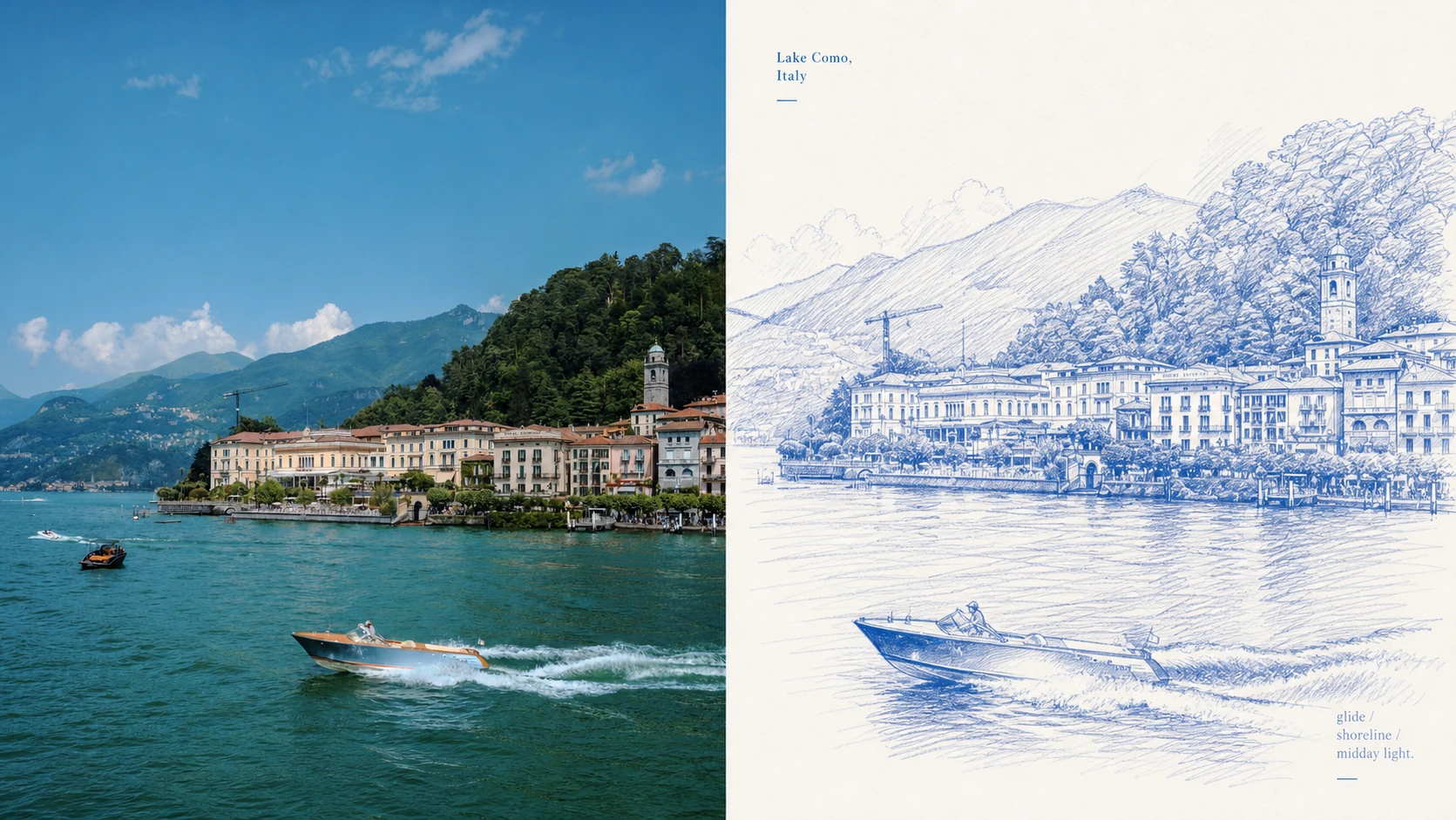
Complete AI image prompt
Turn each photo I upload into a separate premium design poster, with no multi-image collage; output each photo separately. Use an overall 3:4 portrait composition, with the upper and lower sections in a strict 1:1 height ratio, each occupying 50% of the canvas.

Retain the original photo in the upper section, preserving the subject’s identity, structure, pose, authentic texture, natural light and shadow, and original color atmosphere. Apply only subtle, sophisticated color grading to give it the visual quality of an art magazine, independent publication, or exhibition image. The surrounding environment may be extended naturally to fit the format, but the subject must not be stretched, distorted, or altered.

In the lower section, extract the photo’s most recognizable **subject, contour, pose, and narrative relationship**, and reconstruct them as a monochrome narrative illustration in the style of **Monochrome Blue Pencil / Ballpoint Pen Illustration**. Do not reproduce the entire photo; retain only the visual clues necessary to preserve the subject’s identity and the scene’s meaning. Establish form with accurate contour lines, then build light and shadow, volume, and material through directional hatching, cross-hatching, and line density, so the original is recognizable at a glance while retaining the unmistakable character of a sketchbook and editorial illustration.

Use the texture of a single blue pencil or blue ballpoint pen, with **dry grain, slight indentations, variations in pen pressure, repeated searching lines, and a visible hand-drawn direction**. “Weave” the dark areas layer by layer with dense hatching and localized cross-hatching instead of filling them with black or using soft gradients. Hair, architectural structures, turns in objects, plant contours, or other highly recognizable areas may be selectively refined; actively simplify the rest so finished and unfinished areas coexist.

The composition should emphasize **visual center of gravity, subject placement, rhythms of density and openness, directional relationships, and broad negative space**. The subject may be moderately off-center, cropped, or concentrated in a local area. Preserve only a few necessary contours and strokes of hatching from complex backgrounds rather than drawing every element in the photograph. Let the lines gather in key areas, gradually diminish through the environment, and finally disappear into the paper, giving the image the restraint of “stopping once enough has been observed.”

Keep the entire illustration strictly within a **monochrome blue palette**, without adding a second illustration color. Intelligently choose the single most suitable shade—clear cobalt blue, pen blue, ultramarine blue, or indigo blue—according to the original image’s light, darkness, and character. Build a complete tonal range through variations in line weight, pressure, number of overlaps, and density rather than relying on color gradients. Use clean natural white, very pale warm white, or a subtle paper tone for the background so the blue linework remains clear, vivid, and breathable.

Introduce only a small amount of text freely, without presetting a fixed title, number, location, or language. Generate a few genuinely meaningful words, short phrases, or annotations based on the photograph’s subject, action, mood, memory, or cultural context. **Use a slender, quiet editorial typeface with a slightly bookish typographic quality and a subtle humanistic character**. Create a restrained integration of text and blue linework through small type, generous letter spacing, and ample whitespace. Text may sit close to the subject, nest within negative space, or follow the image’s visual direction naturally; do not create a menu-like information panel.

The overall result should present a refined hand-drawn character formed by **monochrome blue linework, textured hatching, selective refinement, broad whitespace, and narrative editorial typography**, like an independently published travel sketchbook, a private visual diary, or an illustration in a cultural magazine. Avoid watercolor coloring, colored fills, large charcoal-style smudges, blurred gradients, photo-outline filters, heavy black contours, smooth vectors, a technical-drawing aesthetic, cartoons, anime, 3D rendering, and over-finished realistic sketches.
Original style prompt
Turn each photo I upload into a separate premium design poster, with no multi-image collage; output each photo separately. Use an overall 3:4 portrait composition, with the upper and lower sections in a strict 1:1 height ratio, each occupying 50% of the canvas.

Retain the original photo in the upper section, preserving the subject’s identity, structure, pose, authentic texture, natural light and shadow, and original color atmosphere. Apply only subtle, sophisticated color grading to give it the visual quality of an art magazine, independent publication, or exhibition image. The surrounding environment may be extended naturally to fit the format, but the subject must not be stretched, distorted, or altered.

In the lower section, extract the photo’s most recognizable **subject, contour, pose, and narrative relationship**, and reconstruct them as a monochrome narrative illustration in the style of **Monochrome Blue Pencil / Ballpoint Pen Illustration**. Do not reproduce the entire photo; retain only the visual clues necessary to preserve the subject’s identity and the scene’s meaning. Establish form with accurate contour lines, then build light and shadow, volume, and material through directional hatching, cross-hatching, and line density, so the original is recognizable at a glance while retaining the unmistakable character of a sketchbook and editorial illustration.

Use the texture of a single blue pencil or blue ballpoint pen, with **dry grain, slight indentations, variations in pen pressure, repeated searching lines, and a visible hand-drawn direction**. “Weave” the dark areas layer by layer with dense hatching and localized cross-hatching instead of filling them with black or using soft gradients. Hair, architectural structures, turns in objects, plant contours, or other highly recognizable areas may be selectively refined; actively simplify the rest so finished and unfinished areas coexist.

The composition should emphasize **visual center of gravity, subject placement, rhythms of density and openness, directional relationships, and broad negative space**. The subject may be moderately off-center, cropped, or concentrated in a local area. Preserve only a few necessary contours and strokes of hatching from complex backgrounds rather than drawing every element in the photograph. Let the lines gather in key areas, gradually diminish through the environment, and finally disappear into the paper, giving the image the restraint of “stopping once enough has been observed.”

Keep the entire illustration strictly within a **monochrome blue palette**, without adding a second illustration color. Intelligently choose the single most suitable shade—clear cobalt blue, pen blue, ultramarine blue, or indigo blue—according to the original image’s light, darkness, and character. Build a complete tonal range through variations in line weight, pressure, number of overlaps, and density rather than relying on color gradients. Use clean natural white, very pale warm white, or a subtle paper tone for the background so the blue linework remains clear, vivid, and breathable.

Introduce only a small amount of text freely, without presetting a fixed title, number, location, or language. Generate a few genuinely meaningful words, short phrases, or annotations based on the photograph’s subject, action, mood, memory, or cultural context. **Use a slender, quiet editorial typeface with a slightly bookish typographic quality and a subtle humanistic character**. Create a restrained integration of text and blue linework through small type, generous letter spacing, and ample whitespace. Text may sit close to the subject, nest within negative space, or follow the image’s visual direction naturally; do not create a menu-like information panel.

The overall result should present a refined hand-drawn character formed by **monochrome blue linework, textured hatching, selective refinement, broad whitespace, and narrative editorial typography**, like an independently published travel sketchbook, a private visual diary, or an illustration in a cultural magazine. Avoid watercolor coloring, colored fills, large charcoal-style smudges, blurred gradients, photo-outline filters, heavy black contours, smooth vectors, a technical-drawing aesthetic, cartoons, anime, 3D rendering, and over-finished realistic sketches.
More open images in the “XXD Panel 091 · Blue-Line Travel Album” style