
Open prompts
en sample 08 AI Image Prompt
en sample 08, its complete AI image prompt, and the XXD Panel 092 · Expressive Line Drawing Journal style are free to view and copy.
Complete AI image prompt
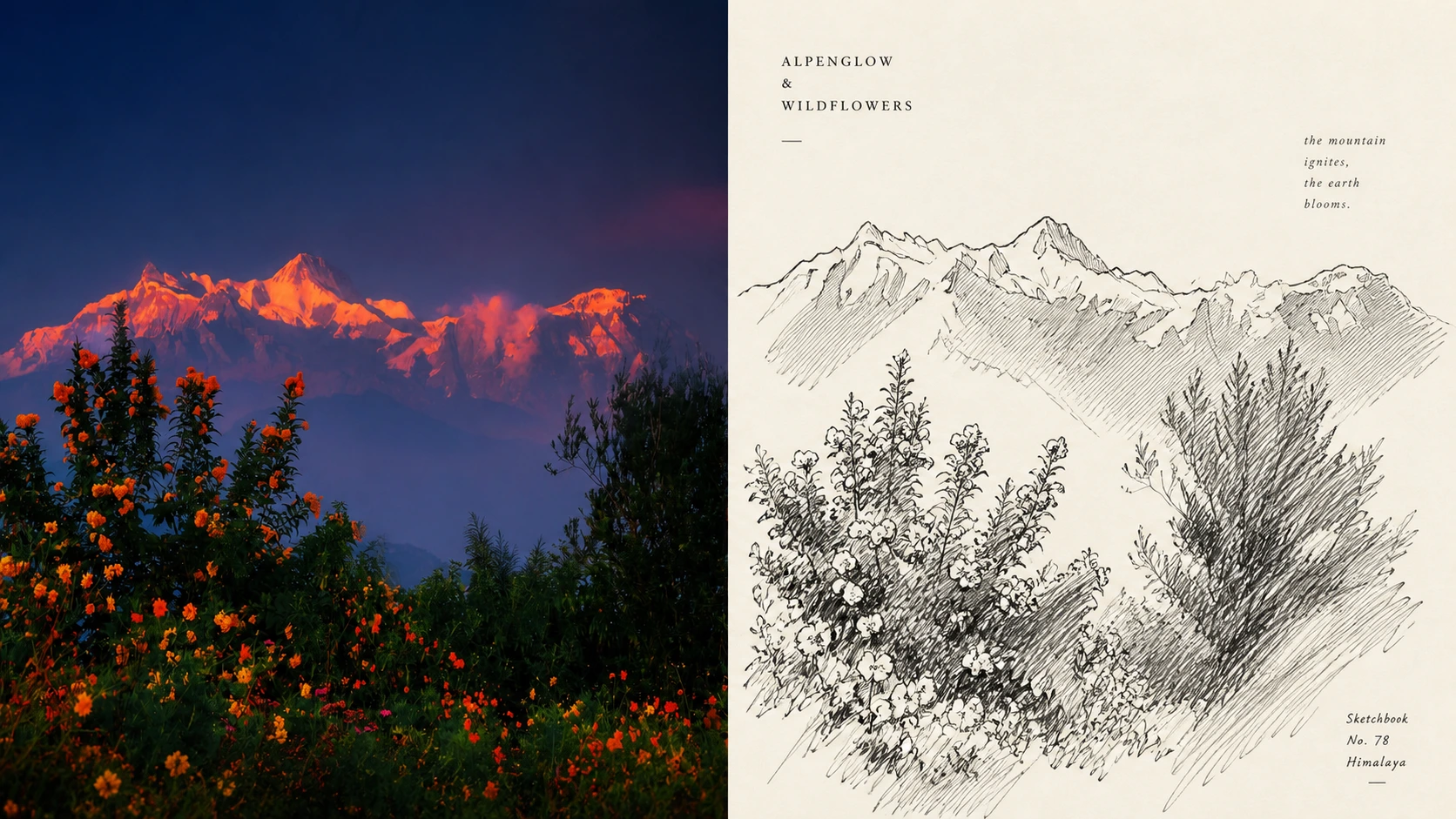
Please turn each photo I upload into a separate premium design poster. Do not create multi-image collages; output each photo individually. Use an overall 3:4 portrait composition, with the upper and lower regions in a strict 1:1 height ratio, each occupying 50% of the image.

Keep the original photo in the upper half, preserving the subject's identity, structure, pose, authentic texture, natural light and shadow, and original colour atmosphere. Apply only subtle, sophisticated colour grading to give it the visual quality of an art magazine, independent publication, or exhibition image. The surrounding environment may be extended naturally to fit the aspect ratio, but the subject must not be stretched, distorted, or altered.

In the lower half, extract the photograph's most recognisable **subject, contour, structure, pose, and narrative relationships** and reconstruct them as an expressive pen-and-ink line illustration. Do not trace the photograph in full, and do not turn it into a realistic illustration. Retain only the most essential identifying features and scene logic so that the original is immediately recognisable, while the graphic beauty produced through summarisation, reduction, and reorganisation is also clearly felt.

Build the image around **contour line drawing + modelling through hatching**: establish the subject's form primarily through loose yet accurate contour line drawing, and create tonal layers in shadowed areas and structural transitions with diagonal hatching, cross-hatching, and scribble hatching. The lines need not be overly regular; preserve quick, free, slightly rough gestural strokes, subtle repeated corrections, and variations in density that are not completely uniform, so the image conveys observation, speed, and a handmade quality at the same time.

Emphasise **negative-space composition**. Use broad negative shapes, dark masses formed by dense hatching, and their contrast with blank areas to establish a clear hierarchy and strong graphic impact. The subject does not have to be perfectly centred; reposition it according to the most powerful visual relationship in the original image. Actively simplify complex backgrounds, retaining only a few necessary environmental structures, tabletops, ground planes, boundaries, or spatial cues, so that blank space, black-and-white density, and the rhythm of the hatching together create breathing room in the composition.

Preserve throughout the relationship of **loose contour lines × geometric hatching** that you favour: the contours of people, animals, plants, objects, or architecture may be loose, flexible, and curvilinear; tabletops, walls, floors, furniture, structural boundaries, shadow directions, or environmental order should instead establish a stable compositional framework through grouped diagonal lines, cross-hatching, and linear geometric relationships, keeping the image in tension between looseness and order.

Use mainly black, grey, and paper white in the lower half. A very small amount of low-saturation accent colour may remain, but the overall image must still centre on the language of pen-and-ink line drawing. Use an off-white or light warm-white paper background with broad blank areas, avoiding muddy greys, over-rendering, and complex textures. The emphasis is not on fields of colour, but on line density, black-and-white relationships, negative shapes, and compositional rhythm.

Introduce only a small amount of text, freely distilling a short title, phrase, or miniature annotation from the content of the photograph, with no restriction on language. The text should be small, light, and restrained, with the typographic character of editorial illustration and sketchbook aesthetic. It may be distributed naturally along blank areas, boundaries, or linear structures to create a quiet, refined relationship between image and text, rather than a fixed title bar or menu-like information.

The overall style should reference **pen and ink illustration, loose contour lines, expressive linework, diagonal hatching, scribble hatching, cross-hatching, minimal black-and-white drawing, negative space, editorial illustration, sketchbook aesthetic**, producing a premium, modern, restrained, and artistic visual effect. Avoid realistic illustration, thick black comic outlines, clean vector lines, cartoon styling, excessive detail, a computer-filter look, and a templated-poster feel.
Original style prompt
Please turn each photo I upload into a separate premium design poster. Do not create multi-image collages; output each photo individually. Use an overall 3:4 portrait composition, with the upper and lower regions in a strict 1:1 height ratio, each occupying 50% of the image.

Keep the original photo in the upper half, preserving the subject's identity, structure, pose, authentic texture, natural light and shadow, and original colour atmosphere. Apply only subtle, sophisticated colour grading to give it the visual quality of an art magazine, independent publication, or exhibition image. The surrounding environment may be extended naturally to fit the aspect ratio, but the subject must not be stretched, distorted, or altered.

In the lower half, extract the photograph's most recognisable **subject, contour, structure, pose, and narrative relationships** and reconstruct them as an expressive pen-and-ink line illustration. Do not trace the photograph in full, and do not turn it into a realistic illustration. Retain only the most essential identifying features and scene logic so that the original is immediately recognisable, while the graphic beauty produced through summarisation, reduction, and reorganisation is also clearly felt.

Build the image around **contour line drawing + modelling through hatching**: establish the subject's form primarily through loose yet accurate contour line drawing, and create tonal layers in shadowed areas and structural transitions with diagonal hatching, cross-hatching, and scribble hatching. The lines need not be overly regular; preserve quick, free, slightly rough gestural strokes, subtle repeated corrections, and variations in density that are not completely uniform, so the image conveys observation, speed, and a handmade quality at the same time.

Emphasise **negative-space composition**. Use broad negative shapes, dark masses formed by dense hatching, and their contrast with blank areas to establish a clear hierarchy and strong graphic impact. The subject does not have to be perfectly centred; reposition it according to the most powerful visual relationship in the original image. Actively simplify complex backgrounds, retaining only a few necessary environmental structures, tabletops, ground planes, boundaries, or spatial cues, so that blank space, black-and-white density, and the rhythm of the hatching together create breathing room in the composition.

Preserve throughout the relationship of **loose contour lines × geometric hatching** that you favour: the contours of people, animals, plants, objects, or architecture may be loose, flexible, and curvilinear; tabletops, walls, floors, furniture, structural boundaries, shadow directions, or environmental order should instead establish a stable compositional framework through grouped diagonal lines, cross-hatching, and linear geometric relationships, keeping the image in tension between looseness and order.

Use mainly black, grey, and paper white in the lower half. A very small amount of low-saturation accent colour may remain, but the overall image must still centre on the language of pen-and-ink line drawing. Use an off-white or light warm-white paper background with broad blank areas, avoiding muddy greys, over-rendering, and complex textures. The emphasis is not on fields of colour, but on line density, black-and-white relationships, negative shapes, and compositional rhythm.

Introduce only a small amount of text, freely distilling a short title, phrase, or miniature annotation from the content of the photograph, with no restriction on language. The text should be small, light, and restrained, with the typographic character of editorial illustration and sketchbook aesthetic. It may be distributed naturally along blank areas, boundaries, or linear structures to create a quiet, refined relationship between image and text, rather than a fixed title bar or menu-like information.

The overall style should reference **pen and ink illustration, loose contour lines, expressive linework, diagonal hatching, scribble hatching, cross-hatching, minimal black-and-white drawing, negative space, editorial illustration, sketchbook aesthetic**, producing a premium, modern, restrained, and artistic visual effect. Avoid realistic illustration, thick black comic outlines, clean vector lines, cartoon styling, excessive detail, a computer-filter look, and a templated-poster feel.
More open images in the “XXD Panel 092 · Expressive Line Drawing Journal” style