
Open prompts
en sample 08 AI Image Prompt
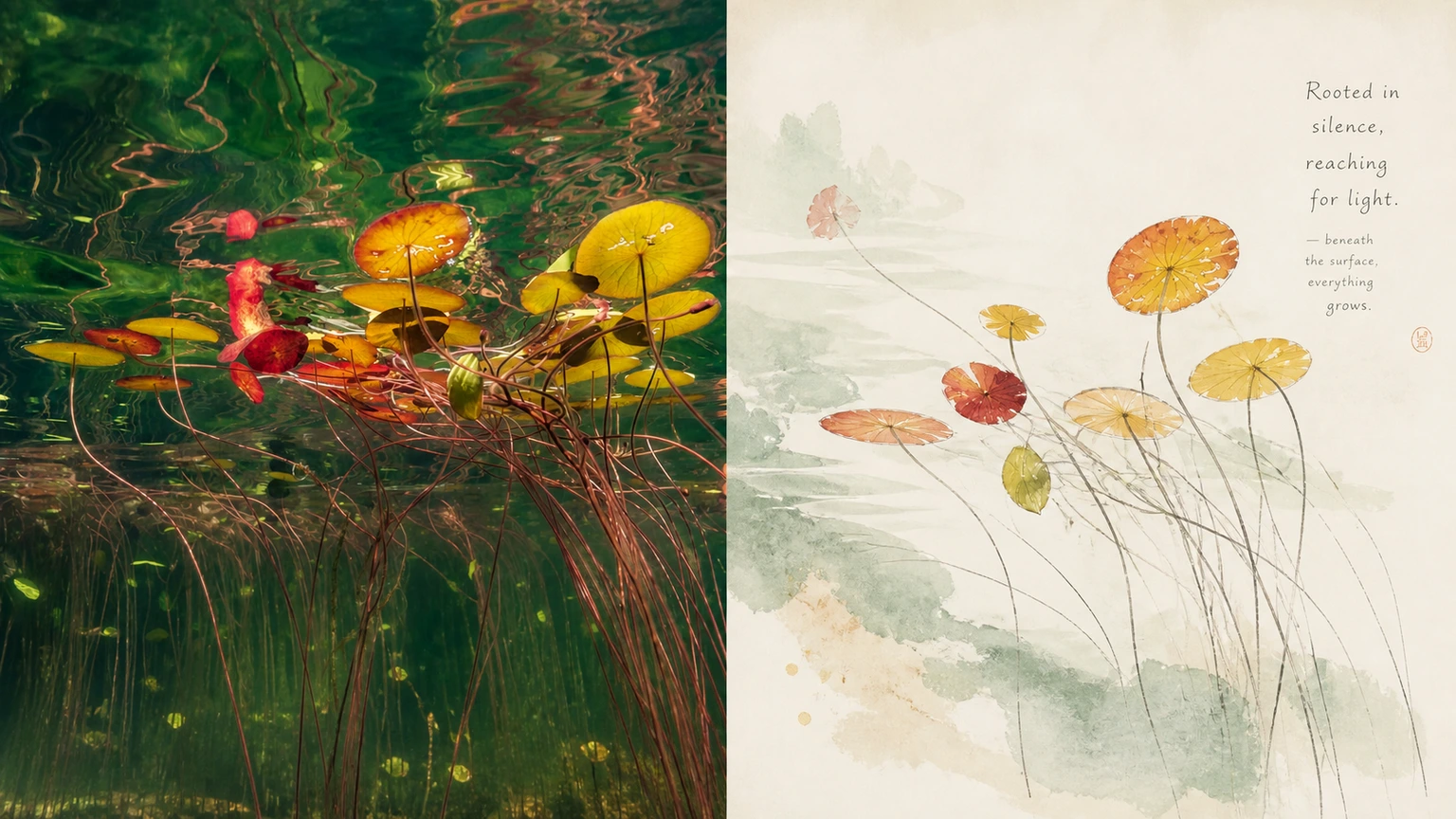
en sample 08, its complete AI image prompt, and the XXD Panel 068 · Eastern Freehand Album style are free to view and copy.
Complete AI image prompt
Please make each photo I upload into an independent high-end design poster. No splicing of multiple pictures, and each photo will be output separately. The overall composition adopts a 3:4 vertical version, continuing the two-layer logic of the upper and lower parts: the upper part is real photography, the lower part is oriental freehand artistic reconstruction, and the upper and lower parts maintain a hard cut of 40:50.
The upper part retains the original photo, maintaining the subject's identity, structure, posture, real texture, natural light and shadow, and original color atmosphere. It only undergoes slight advanced photography color grading to give it the quality of art magazines, independent publications, and exhibition photography. The environmental background can be naturally expanded to fit the frame, but the subject must not be stretched, distorted, or changed.

The lower part extracts the most identifiable ** subjects, outlines, postures and narrative relationships ** in the photo, retaining only the truly memorable themes, metaphors and visual relationships of the original picture, and reconstructs it into a modern edited picture with the temperament of Chinese freehand painting. Instead of completely tracing the photo, take the initiative to delete the background and minor details in a way that "less is more than more, and the intention is beyond the reach of the pen". Use a small amount of ink lines, light colors, color blocks and blanks to reorganize the subject so that people can recognize the original object at a glance, while retaining observation, imagination and aftertaste.

The composition draws on the ** operating position, white versus black, virtual and real, and density gathering and dispersion of Chinese paintings**, while maintaining the visual focus and format order of modern graphic design. The subject does not have to be centered. It can be offset, suspended, partially cropped or concentrated on one side according to its own posture, movement and narrative focus; a large and meaningful blank space is reserved on the other side, allowing the blank space to bear air, distance, time, silence and imagination. The picture only retains a clear main narrative, and the other elements are pointed out, making "where the painting ends and where it stops" itself become part of the composition.

The painting language adopts **'s slender and varied hand-painted ink lines, freehand outlines and restrained light colors **. Lines can be discontinuous, heavy, dry, hesitant, and have natural manual errors; use slightly heavier ink lines to stabilize the structure in some parts, and the remaining edges are allowed to disappear into the blank space. The color does not pursue complete filling, but uses partial over-dyeing, dot dyeing and blending of color and ink to establish rhythm, retaining the airiness and unfinished feeling of the paper surface.

The color matching is intelligently translated based on the comprehensive color temperature of the photo above and the most vital characteristic color, and does not fix a certain color system. The overall ** is elegant, soft, transparent, slightly gray but not dirty**. It uses a very light paper color as the base, and then extracts 2-4 of the most recognizable colors from the original image for dilution, purification and orientalization. The key color of the main body is slightly clearer, and the ambient color is quickly weakened. Layers are formed through shades, coldness and warmth, area and white space to avoid highly saturated color collisions and full-page coloring.

The text should become part of the picture like a traditional inscription, rather than having a title added later. Freely generate a small number of words, phrases, short sentences or fragments based on the subject, emotion, action, cultural context, sense of time or metaphor of the photo, without fixing the language, format and content. They can be arranged vertically along the subject's movement, the edge of the blank space, the visual axis or one side of the picture, forming a relationship with the painting that echoes, avoids, intersperses or contrasts with the scene. ** uses the small, sparse, restrained, oriental inscription-style handwritten font ** with slight strokes and natural ink color changes. It can be supplemented by a very small amount of more modern and finer editing fonts to form a hierarchy between ancient and modern times, but no menu-style layout, fixed title bars or large paragraphs of explanations are allowed.

The overall presentation should have **the blank space and charm of oriental freehand brushwork, the warmth of hand-drawn lines, the elegance of pastel colors, and the precise order of modern editorial design**. Like an Oriental observation book re-arranged by a contemporary artist, rather than a copy of a traditional Chinese painting. Avoid complete realistic depictions, full-page backgrounds, heavy ink and wash, fine brushstrokes, antiques, cartoon Chinese style, antique templates, sticker collages, commercial posters and mechanized layout.
Original style prompt
Please make each photo I upload into an independent high-end design poster. No splicing of multiple pictures, and each photo will be output separately. The overall composition adopts a 3:4 vertical version, continuing the two-layer logic of the upper and lower parts: the upper part is real photography, the lower part is oriental freehand artistic reconstruction, and the upper and lower parts maintain a hard cut of 40:50.
The upper part retains the original photo, maintaining the subject's identity, structure, posture, real texture, natural light and shadow, and original color atmosphere. It only undergoes slight advanced photography color grading to give it the quality of art magazines, independent publications, and exhibition photography. The environmental background can be naturally expanded to fit the frame, but the subject must not be stretched, distorted, or changed.

The lower part extracts the most identifiable ** subjects, outlines, postures and narrative relationships ** in the photo, retaining only the truly memorable themes, metaphors and visual relationships of the original picture, and reconstructs it into a modern edited picture with the temperament of Chinese freehand painting. Instead of completely tracing the photo, take the initiative to delete the background and minor details in a way that "less is more than more, and the intention is beyond the reach of the pen". Use a small amount of ink lines, light colors, color blocks and blanks to reorganize the subject so that people can recognize the original object at a glance, while retaining observation, imagination and aftertaste.

The composition draws on the ** operating position, white versus black, virtual and real, and density gathering and dispersion of Chinese paintings**, while maintaining the visual focus and format order of modern graphic design. The subject does not have to be centered. It can be offset, suspended, partially cropped or concentrated on one side according to its own posture, movement and narrative focus; a large and meaningful blank space is reserved on the other side, allowing the blank space to bear air, distance, time, silence and imagination. The picture only retains a clear main narrative, and the other elements are pointed out, making "where the painting ends and where it stops" itself become part of the composition.

The painting language adopts **'s slender and varied hand-painted ink lines, freehand outlines and restrained light colors **. Lines can be discontinuous, heavy, dry, hesitant, and have natural manual errors; use slightly heavier ink lines to stabilize the structure in some parts, and the remaining edges are allowed to disappear into the blank space. The color does not pursue complete filling, but uses partial over-dyeing, dot dyeing and blending of color and ink to establish rhythm, retaining the airiness and unfinished feeling of the paper surface.

The color matching is intelligently translated based on the comprehensive color temperature of the photo above and the most vital characteristic color, and does not fix a certain color system. The overall ** is elegant, soft, transparent, slightly gray but not dirty**. It uses a very light paper color as the base, and then extracts 2-4 of the most recognizable colors from the original image for dilution, purification and orientalization. The key color of the main body is slightly clearer, and the ambient color is quickly weakened. Layers are formed through shades, coldness and warmth, area and white space to avoid highly saturated color collisions and full-page coloring.

The text should become part of the picture like a traditional inscription, rather than having a title added later. Freely generate a small number of words, phrases, short sentences or fragments based on the subject, emotion, action, cultural context, sense of time or metaphor of the photo, without fixing the language, format and content. They can be arranged vertically along the subject's movement, the edge of the blank space, the visual axis or one side of the picture, forming a relationship with the painting that echoes, avoids, intersperses or contrasts with the scene. ** uses the small, sparse, restrained, oriental inscription-style handwritten font ** with slight strokes and natural ink color changes. It can be supplemented by a very small amount of more modern and finer editing fonts to form a hierarchy between ancient and modern times, but no menu-style layout, fixed title bars or large paragraphs of explanations are allowed.

The overall presentation should have **the blank space and charm of oriental freehand brushwork, the warmth of hand-drawn lines, the elegance of pastel colors, and the precise order of modern editorial design**. Like an Oriental observation book re-arranged by a contemporary artist, rather than a copy of a traditional Chinese painting. Avoid complete realistic depictions, full-page backgrounds, heavy ink and wash, fine brushstrokes, antiques, cartoon Chinese style, antique templates, sticker collages, commercial posters and mechanized layout.
More open images in the “XXD Panel 068 · Eastern Freehand Album” style