

Open prompts
en sample 09 AI Image Prompt
en sample 09, its complete AI image prompt, and the XXD Panel 018 · Handcut Paper Journal style are free to view and copy.
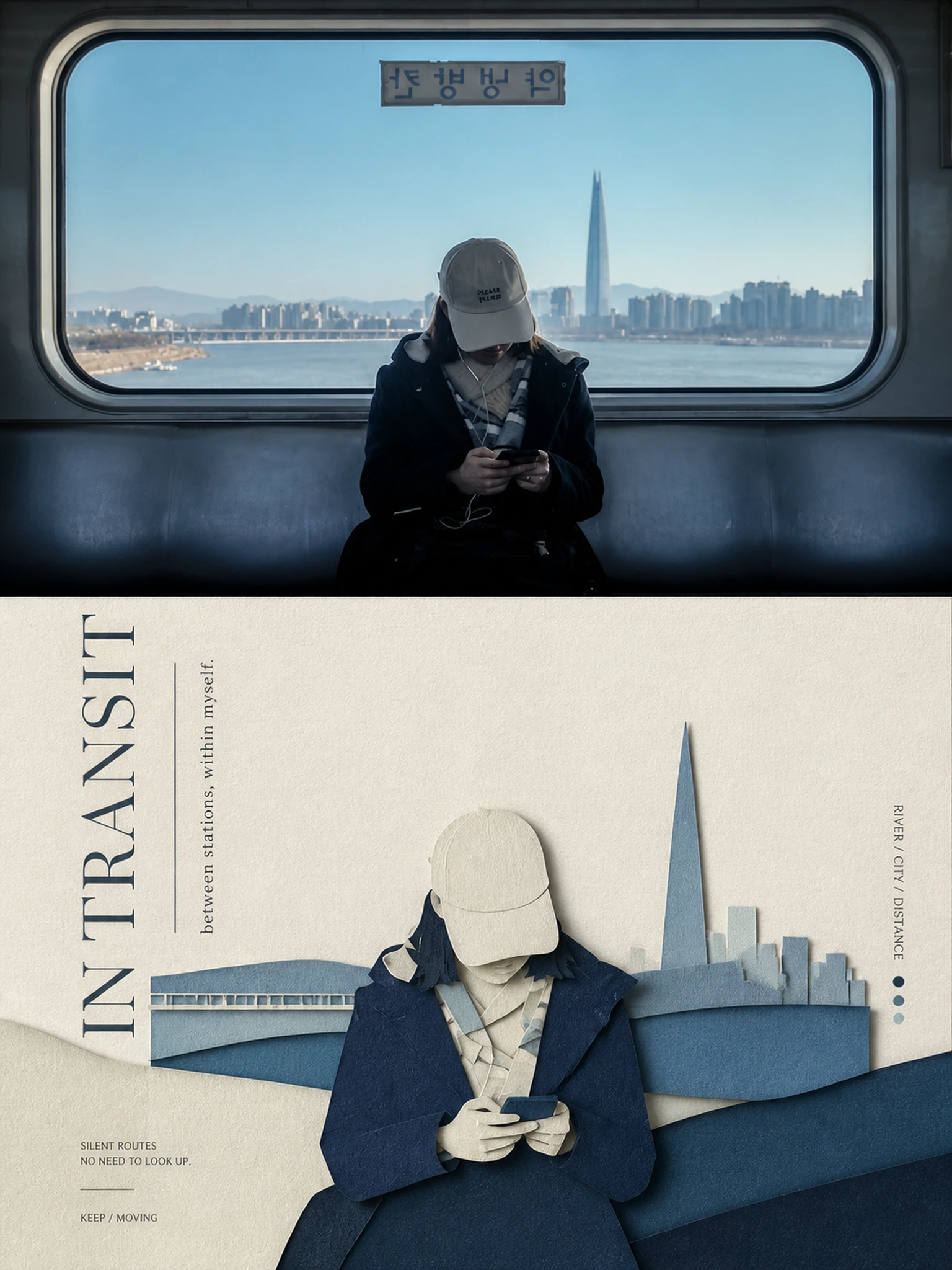
Complete AI image prompt
Please make every photo I upload into its own standalone high-end design poster; no multi-image collages, each photo output separately. The overall composition uses a 3:4 vertical format, with the upper and lower zones strictly 1:1 in height, each taking up 50% of the frame.

The upper half keeps the original photo, preserving the subject's structure, real texture, natural light and shadow, and original color atmosphere, applying only a slight high-end photographic color grade so that it carries the texture of art magazines, independent publications, and exhibition photography. To fit the frame, the sky, ground, or environmental background may be extended naturally, but the subject must not be stretched, distorted, or altered.

The lower half extracts the most recognizable **subject, outline, pose, and narrative relationships** from the photo and reconstructs them into minimalist handcrafted layered papercutting and paper-sculpture collage. Use one core subject as the visual anchor, re-summarizing its key outline, proportions, and structure through folding, cutting, layering, and occlusion rather than mechanically replicating details. Then select a small number of environmental relationships from the original image and transform them into foreground, middle-ground, and background paper layers, establishing a clear hierarchy through differences in scale, axes, positive and negative shapes, front-to-back occlusion, and large areas of negative space, so that the subject is recognizable at a glance while retaining the restraint and order of a modern editorial composition.

Extract the most recognizable and spirited colors from the photo above and transform them into a limited, harmonious paper-color group. Use warm ivory or light-colored paper as the base, establishing space through a primary color, a dark structural color, light-colored layers, and a very small amount of accent color. Use delicate matte cardstock, visible paper fibers, crisp cut edges, and soft contact shadows, with naturally diffused light that emphasizes the thickness of the folded layers and a genuine handcrafted tactile quality. Avoid plastic 3D, cheap cardstock, neon colors, and complex gradients.

The text establishes a complete **high-end editorial microtypography system**. Distill a short main title from the photo's subject identity, place, action, material, emotion, or symbolic meaning, and pair it with 2–4 groups of extremely small supporting text, flexibly combining object names, place information, numbers, chapter markers, serial numbers, coordinate-like numbers, direction words, state words, material words, classification labels, or one extremely short poetic annotation; do not use years. The main title provides recognition and emotion, while the small text provides order, rhythm, and refinement.

The text must be composed together with the papercut forms. It may be arranged along the edges of paper layers, the subject's outline, geometric axes, or negative space, and may also be set horizontally or vertically, rotated, widely letter-spaced, aligned to an edge, pressed into a corner, extended across color blocks, embedded between paper layers, or occluded and interwoven with the subject. The main title may be moderately transformed into papercut or origami letterforms, while the small text maintains fine, restrained modern editorial typography. Use contrasts in type size and changes in direction to form a reading path, so that **the paper art is responsible for visual memory, and the miniature text is responsible for high-end order**.

The overall visual temperament combines **real photography × handcrafted papercutting × high-end editorial design**: clean, elegant, delicately tactile, modern, and collectible. Whether the subject is a person, animal, plant, building, object, vehicle, or natural landscape, maintain one core subject, a small number of paper layers, large areas of negative space, and precise microtypography, avoiding a children's-craft feel, complex accumulation, repeated subjects, an e-commerce-display feel, and a template feel.
Original style prompt
Please make every photo I upload into its own standalone high-end design poster; no multi-image collages, each photo output separately. The overall composition uses a 3:4 vertical format, with the upper and lower zones strictly 1:1 in height, each taking up 50% of the frame.

The upper half keeps the original photo, preserving the subject's structure, real texture, natural light and shadow, and original color atmosphere, applying only a slight high-end photographic color grade so that it carries the texture of art magazines, independent publications, and exhibition photography. To fit the frame, the sky, ground, or environmental background may be extended naturally, but the subject must not be stretched, distorted, or altered.

The lower half extracts the most recognizable **subject, outline, pose, and narrative relationships** from the photo and reconstructs them into minimalist handcrafted layered papercutting and paper-sculpture collage. Use one core subject as the visual anchor, re-summarizing its key outline, proportions, and structure through folding, cutting, layering, and occlusion rather than mechanically replicating details. Then select a small number of environmental relationships from the original image and transform them into foreground, middle-ground, and background paper layers, establishing a clear hierarchy through differences in scale, axes, positive and negative shapes, front-to-back occlusion, and large areas of negative space, so that the subject is recognizable at a glance while retaining the restraint and order of a modern editorial composition.

Extract the most recognizable and spirited colors from the photo above and transform them into a limited, harmonious paper-color group. Use warm ivory or light-colored paper as the base, establishing space through a primary color, a dark structural color, light-colored layers, and a very small amount of accent color. Use delicate matte cardstock, visible paper fibers, crisp cut edges, and soft contact shadows, with naturally diffused light that emphasizes the thickness of the folded layers and a genuine handcrafted tactile quality. Avoid plastic 3D, cheap cardstock, neon colors, and complex gradients.

The text establishes a complete **high-end editorial microtypography system**. Distill a short main title from the photo's subject identity, place, action, material, emotion, or symbolic meaning, and pair it with 2–4 groups of extremely small supporting text, flexibly combining object names, place information, numbers, chapter markers, serial numbers, coordinate-like numbers, direction words, state words, material words, classification labels, or one extremely short poetic annotation; do not use years. The main title provides recognition and emotion, while the small text provides order, rhythm, and refinement.

The text must be composed together with the papercut forms. It may be arranged along the edges of paper layers, the subject's outline, geometric axes, or negative space, and may also be set horizontally or vertically, rotated, widely letter-spaced, aligned to an edge, pressed into a corner, extended across color blocks, embedded between paper layers, or occluded and interwoven with the subject. The main title may be moderately transformed into papercut or origami letterforms, while the small text maintains fine, restrained modern editorial typography. Use contrasts in type size and changes in direction to form a reading path, so that **the paper art is responsible for visual memory, and the miniature text is responsible for high-end order**.

The overall visual temperament combines **real photography × handcrafted papercutting × high-end editorial design**: clean, elegant, delicately tactile, modern, and collectible. Whether the subject is a person, animal, plant, building, object, vehicle, or natural landscape, maintain one core subject, a small number of paper layers, large areas of negative space, and precise microtypography, avoiding a children's-craft feel, complex accumulation, repeated subjects, an e-commerce-display feel, and a template feel.
More open images in the “XXD Panel 018 · Handcut Paper Journal” style