

Open prompts
en sample 10 AI Image Prompt
en sample 10, its complete AI image prompt, and the XXD Panel 020 · Impasto Micro-Landscape style are free to view and copy.
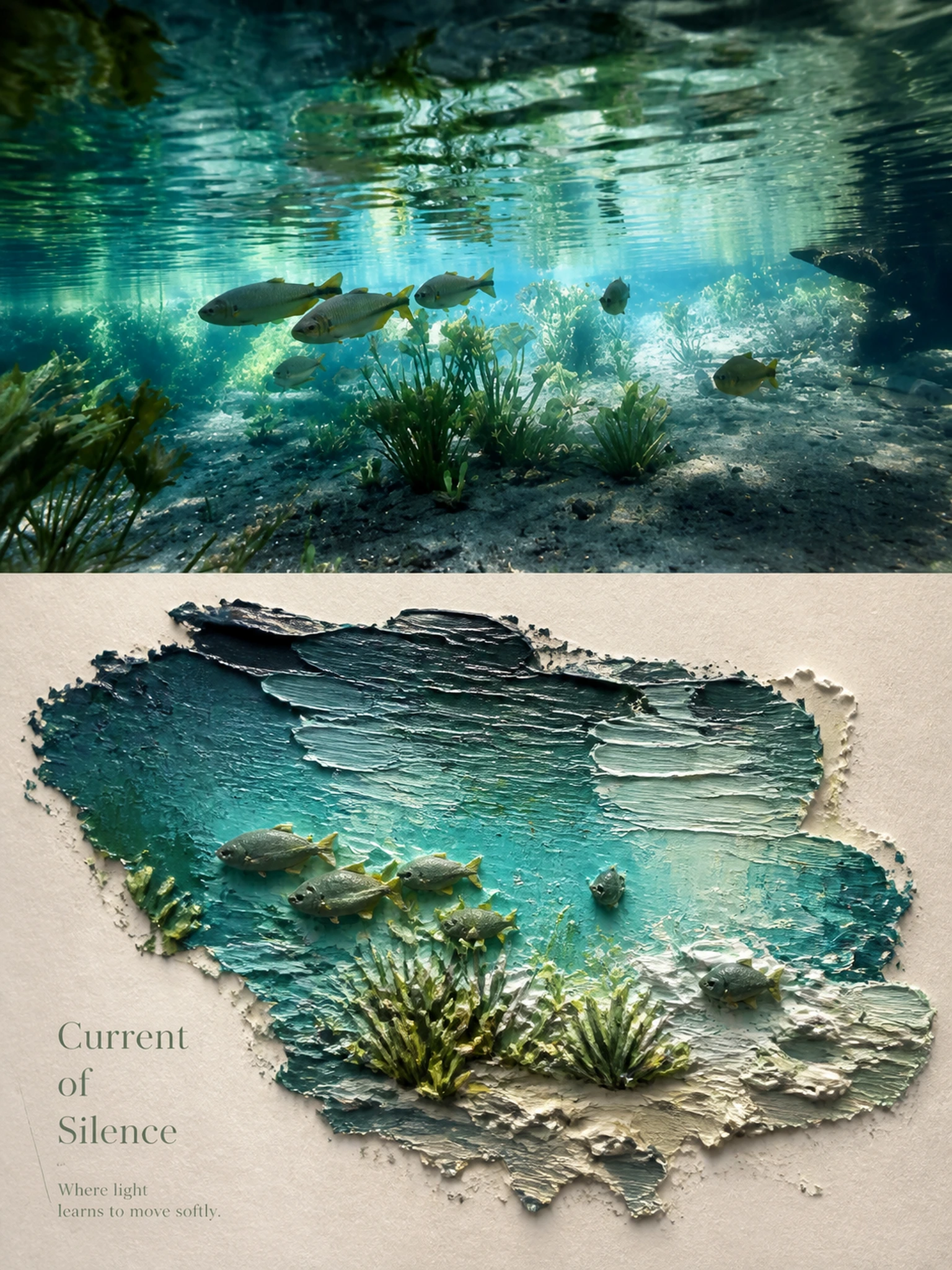
Complete AI image prompt
Turn every uploaded photograph into a separate premium design poster. Do not make a multi-image collage; output each photograph independently. The legacy presentation is a 3:4 vertical top–bottom diptych: real photography above and an impasto miniature scene below. When the outer Skill specifies another mode or size, replace only that delivery container and preserve the impasto transformation aesthetic below.

In the reality region, retain the original photograph and preserve subject identity, structure, pose, spatial relationships, authentic materials, natural light, and original colour atmosphere. Only apply restrained editorial colour grading. The environment may be extended naturally for the canvas, but never stretch, distort, mirror, or alter the subject.

In the design region, first understand the photograph’s most recognisable subject, action, relationship, and emotion, then rebuild it as a dimensional miniature scene embedded in thick paint. Do not reduce the subject to a flat geometric icon or apply an ordinary illustration filter. Render it as a tactile miniature object, relief, or sculptural painting that remains instantly identifiable while removing irrelevant background and minor clutter.

Use warm white, ivory, or natural paper-white coarse-textured paper with generous negative space. Form one irregular, directional island of impasto paint: a diagonal band, palette-knife scrape, torn elongated stroke, or naturally spreading pigment terrain. The miniature must grow from the paint and interact through support, embedding, overlap, buildup, sinking, or extension. Never paste a complete scene inside a rectangular picture frame.

Make the material convincingly physical: palette-knife buildup, scraped ridges, broken edges, exposed ground, layered coverage, local highlights, and soft shadows created by paint thickness. Give the subject the volume of impasto modelling and miniature sculpture. Concentrate detail only where recognition requires it; elsewhere let forms merge into brushwork, become partly swallowed by paint, or dissolve at the edge. Avoid smooth plastic 3D, flat vector art, ordinary watercolour washes, regular geometric collage, and unrelated decorative splashes.

Derive colour from the source photograph’s most distinctive and emotionally forceful colour relationship. Choose one dominant impasto field, then use a small number of dark structural tones, paper neutrals, and key highlights to model the subject. Colour may be rich, bright, or restrained, but it must belong to the source atmosphere and identity. Do not use a fixed universal palette or turn every work into grey beige.

Build the composition around one impasto anchor, one core miniature scene, and large paper whitespace. Let the subject’s direction determine the paint island’s orientation, scale, and off-centre position. Use strong scale contrast, visual weight, and breathing room. Keep only a few supporting elements that genuinely participate in the source narrative; do not create a second centre or fill the page.

Typography follows the photograph’s meaning and the impasto composition’s whitespace. When model-generated copy is requested, derive one short meaningful title from the subject, action, place, emotion, or metaphor, with only a few editorial microtexts. The title must be bound to the image; do not add unrelated explanations, template sections, or years. When the user supplies exact copy, reproduce it verbatim without rewriting, translation, or extra titles. Follow the explicitly requested language or locale, using restrained serif, fine editorial typography, or an equally refined script appropriate to that language. Type enters the whitespace lightly and never overpowers the impasto subject.

The final character is real photography × palette-knife impasto × dimensional miniature scene × generous paper whitespace × premium editorial typography. It should carry the weight of real pigment and the precision of miniature narrative: quiet, dramatic, tactile, and collectible. Avoid minimalist geometric icons, flat travel posters, cartoon toys, full-scene replication, commercial templates, and meaningless abstraction.
Original style prompt
Turn every uploaded photograph into a separate premium design poster. Do not make a multi-image collage; output each photograph independently. The legacy presentation is a 3:4 vertical top–bottom diptych: real photography above and an impasto miniature scene below. When the outer Skill specifies another mode or size, replace only that delivery container and preserve the impasto transformation aesthetic below.

In the reality region, retain the original photograph and preserve subject identity, structure, pose, spatial relationships, authentic materials, natural light, and original colour atmosphere. Only apply restrained editorial colour grading. The environment may be extended naturally for the canvas, but never stretch, distort, mirror, or alter the subject.

In the design region, first understand the photograph’s most recognisable subject, action, relationship, and emotion, then rebuild it as a dimensional miniature scene embedded in thick paint. Do not reduce the subject to a flat geometric icon or apply an ordinary illustration filter. Render it as a tactile miniature object, relief, or sculptural painting that remains instantly identifiable while removing irrelevant background and minor clutter.

Use warm white, ivory, or natural paper-white coarse-textured paper with generous negative space. Form one irregular, directional island of impasto paint: a diagonal band, palette-knife scrape, torn elongated stroke, or naturally spreading pigment terrain. The miniature must grow from the paint and interact through support, embedding, overlap, buildup, sinking, or extension. Never paste a complete scene inside a rectangular picture frame.

Make the material convincingly physical: palette-knife buildup, scraped ridges, broken edges, exposed ground, layered coverage, local highlights, and soft shadows created by paint thickness. Give the subject the volume of impasto modelling and miniature sculpture. Concentrate detail only where recognition requires it; elsewhere let forms merge into brushwork, become partly swallowed by paint, or dissolve at the edge. Avoid smooth plastic 3D, flat vector art, ordinary watercolour washes, regular geometric collage, and unrelated decorative splashes.

Derive colour from the source photograph’s most distinctive and emotionally forceful colour relationship. Choose one dominant impasto field, then use a small number of dark structural tones, paper neutrals, and key highlights to model the subject. Colour may be rich, bright, or restrained, but it must belong to the source atmosphere and identity. Do not use a fixed universal palette or turn every work into grey beige.

Build the composition around one impasto anchor, one core miniature scene, and large paper whitespace. Let the subject’s direction determine the paint island’s orientation, scale, and off-centre position. Use strong scale contrast, visual weight, and breathing room. Keep only a few supporting elements that genuinely participate in the source narrative; do not create a second centre or fill the page.

Typography follows the photograph’s meaning and the impasto composition’s whitespace. When model-generated copy is requested, derive one short meaningful title from the subject, action, place, emotion, or metaphor, with only a few editorial microtexts. The title must be bound to the image; do not add unrelated explanations, template sections, or years. When the user supplies exact copy, reproduce it verbatim without rewriting, translation, or extra titles. Follow the explicitly requested language or locale, using restrained serif, fine editorial typography, or an equally refined script appropriate to that language. Type enters the whitespace lightly and never overpowers the impasto subject.

The final character is real photography × palette-knife impasto × dimensional miniature scene × generous paper whitespace × premium editorial typography. It should carry the weight of real pigment and the precision of miniature narrative: quiet, dramatic, tactile, and collectible. Avoid minimalist geometric icons, flat travel posters, cartoon toys, full-scene replication, commercial templates, and meaningless abstraction.
More open images in the “XXD Panel 020 · Impasto Micro-Landscape” style