

Open prompts
en sample 11 AI Image Prompt
en sample 11, its complete AI image prompt, and the XXD Panel 060 · Zen Minimalist Poem style are free to view and copy.
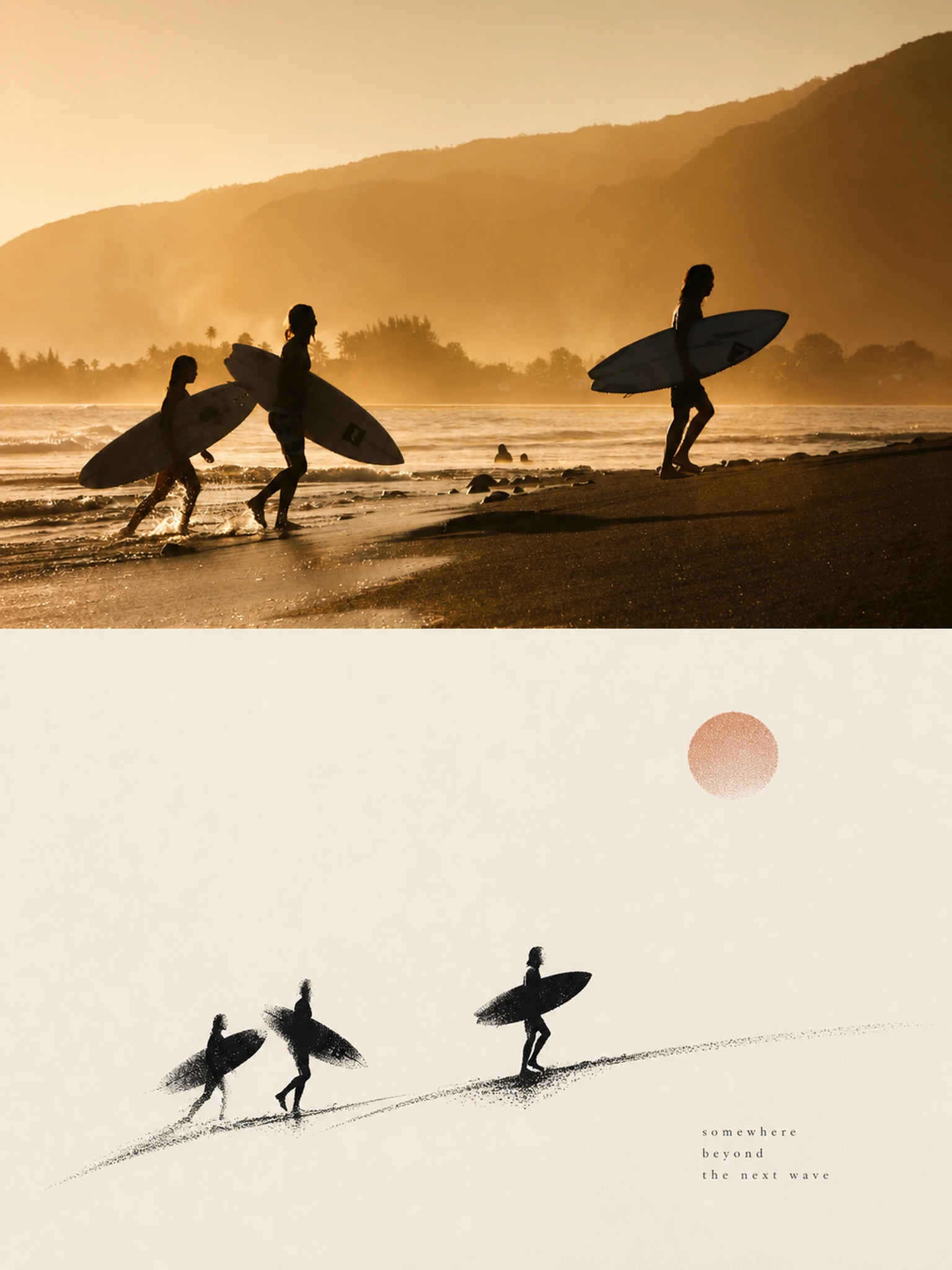
Complete AI image prompt
Turn each photograph I upload into its own independent, high-end design poster. Do not combine multiple images; output every photograph separately. Use an overall 3:4 portrait composition and retain the two-tier top-and-bottom logic: real photography in the upper section and a minimalist abstract reconstruction in the lower section.

Preserve the original photograph in the upper section, maintaining the subject's identity, structure, posture, authentic texture, natural light and shadow, and original colour atmosphere. Apply only subtle, high-end photographic grading so it carries the quality of an art magazine, independent publication, and exhibition photography. The surrounding environment may be extended naturally to fit the canvas, but the subject must not be stretched, distorted, or altered.

In the lower section, extract the photograph's most recognizable subject, silhouette, posture, spatial relationships, and emotional metaphor, then reconstruct them into an image with Zen quietude, philosophical reflection, and minimalist abstraction. Do not reproduce the whole scene or trace the original details. Preserve only the image's most essential graphic logic: one most crucial form, one relationship most worth remembering, and one visual proposition with the greatest meaning. The result should retain a sense of where the original object came from while allowing the viewer to read a deeper quietness, solitude, sense of time, act of looking, or sense of existence.

Build the lower section upon extensive negative space and minimalist composition. Keep visual elements as few as possible, usually retaining only one to three core forms. The subject need not appear realistically; it may become a more abstract and symbolic black primary form, such as a contour, silhouette, plane, ripple, mountain shape, circle, eye-like form, path, broken boundary, dissolving structure, or another hard-to-name but highly distilled image. These forms must arise from understanding the original photograph's subtext and implication, not from arbitrary decoration.

Use the black-led minimalist abstract image system shown in the supplied reference as the visual language. Let black carry the main image, forming shapes through halftone dots, grids, stripes, wave lines, grain, displacement, repetition, dissolution, dilution, or local distortion. Graphic boundaries may be crisp, or gradually loosen, blur, and break in selected areas so that “appearing” and “disappearing” coexist. The background colour is not fixed, but it must remain extremely pale, quiet, and close to the feeling of paper. According to the original photograph's overall colour temperature, it may shift flexibly among off-white, grey-white, sand white, mist grey, pale ochre, pale pink-grey, or extremely pale blue-grey, giving the black subject greater spirituality and breathing room.

The composition should be more professionally resolved than ordinary abstract illustration. Pay close attention to the proportion of negative space, visual centre of gravity, isolated relationships, contrast of scale, positive and negative shape, rhythms of density and openness, and the viewer's path through the image. The subject may be suspended, off-centre, lowered, raised, or reduced in scale so that emptiness itself becomes part of the meaning. A very small number of supporting forms may be added—a distant line, a blurred terrain, one circle, a trace of shadow, a tiny person, or a lightly repeated group of symbols—but every one must serve the central proposition and must not create a second narrative centre.

The overall character is not a decorative “Oriental style.” It is closer to a quiet, spacious, philosophical, allegorical, introspective, improvisational yet restrained mode of visual thought. A slight touch of childlike innocence, humour, or wit is allowed, but it must remain extremely light and must not disrupt the work's airiness or refinement.

Do not predefine a fixed title, number, location, or language, and do not create menu-like information. Based on the photograph's subject, action, emotion, or metaphor, freely generate only a very small amount of genuinely meaningful text—a character, word, or short sentence—and place it lightly in the negative space. Text should be extremely sparse, light, and restrained, like a line of narration, a conceptual note, or a fragment of thought. Together with the graphic form, it should create philosophical resonance rather than explain the image.

The overall result should feel like an independently published handbook of visual philosophy or a poetic art poster: black-led, extremely pale in background, very sparse in form, immense in negative space, deep in implication, quiet yet resonant. Avoid realistic reconstruction, crowded scenes, colour-led imagery, complex narratives, cartoon qualities, an excess of decorative Oriental symbols, e-commerce illustration aesthetics, and template-like poster design.
Original style prompt
Turn each photograph I upload into its own independent, high-end design poster. Do not combine multiple images; output every photograph separately. Use an overall 3:4 portrait composition and retain the two-tier top-and-bottom logic: real photography in the upper section and a minimalist abstract reconstruction in the lower section.

Preserve the original photograph in the upper section, maintaining the subject's identity, structure, posture, authentic texture, natural light and shadow, and original colour atmosphere. Apply only subtle, high-end photographic grading so it carries the quality of an art magazine, independent publication, and exhibition photography. The surrounding environment may be extended naturally to fit the canvas, but the subject must not be stretched, distorted, or altered.

In the lower section, extract the photograph's most recognizable subject, silhouette, posture, spatial relationships, and emotional metaphor, then reconstruct them into an image with Zen quietude, philosophical reflection, and minimalist abstraction. Do not reproduce the whole scene or trace the original details. Preserve only the image's most essential graphic logic: one most crucial form, one relationship most worth remembering, and one visual proposition with the greatest meaning. The result should retain a sense of where the original object came from while allowing the viewer to read a deeper quietness, solitude, sense of time, act of looking, or sense of existence.

Build the lower section upon extensive negative space and minimalist composition. Keep visual elements as few as possible, usually retaining only one to three core forms. The subject need not appear realistically; it may become a more abstract and symbolic black primary form, such as a contour, silhouette, plane, ripple, mountain shape, circle, eye-like form, path, broken boundary, dissolving structure, or another hard-to-name but highly distilled image. These forms must arise from understanding the original photograph's subtext and implication, not from arbitrary decoration.

Use the black-led minimalist abstract image system shown in the supplied reference as the visual language. Let black carry the main image, forming shapes through halftone dots, grids, stripes, wave lines, grain, displacement, repetition, dissolution, dilution, or local distortion. Graphic boundaries may be crisp, or gradually loosen, blur, and break in selected areas so that “appearing” and “disappearing” coexist. The background colour is not fixed, but it must remain extremely pale, quiet, and close to the feeling of paper. According to the original photograph's overall colour temperature, it may shift flexibly among off-white, grey-white, sand white, mist grey, pale ochre, pale pink-grey, or extremely pale blue-grey, giving the black subject greater spirituality and breathing room.

The composition should be more professionally resolved than ordinary abstract illustration. Pay close attention to the proportion of negative space, visual centre of gravity, isolated relationships, contrast of scale, positive and negative shape, rhythms of density and openness, and the viewer's path through the image. The subject may be suspended, off-centre, lowered, raised, or reduced in scale so that emptiness itself becomes part of the meaning. A very small number of supporting forms may be added—a distant line, a blurred terrain, one circle, a trace of shadow, a tiny person, or a lightly repeated group of symbols—but every one must serve the central proposition and must not create a second narrative centre.

The overall character is not a decorative “Oriental style.” It is closer to a quiet, spacious, philosophical, allegorical, introspective, improvisational yet restrained mode of visual thought. A slight touch of childlike innocence, humour, or wit is allowed, but it must remain extremely light and must not disrupt the work's airiness or refinement.

Do not predefine a fixed title, number, location, or language, and do not create menu-like information. Based on the photograph's subject, action, emotion, or metaphor, freely generate only a very small amount of genuinely meaningful text—a character, word, or short sentence—and place it lightly in the negative space. Text should be extremely sparse, light, and restrained, like a line of narration, a conceptual note, or a fragment of thought. Together with the graphic form, it should create philosophical resonance rather than explain the image.

The overall result should feel like an independently published handbook of visual philosophy or a poetic art poster: black-led, extremely pale in background, very sparse in form, immense in negative space, deep in implication, quiet yet resonant. Avoid realistic reconstruction, crowded scenes, colour-led imagery, complex narratives, cartoon qualities, an excess of decorative Oriental symbols, e-commerce illustration aesthetics, and template-like poster design.
More open images in the “XXD Panel 060 · Zen Minimalist Poem” style