

Open prompts
en sample 12 AI Image Prompt
en sample 12, its complete AI image prompt, and the XXD Panel 085 · Handmade Model Journal style are free to view and copy.
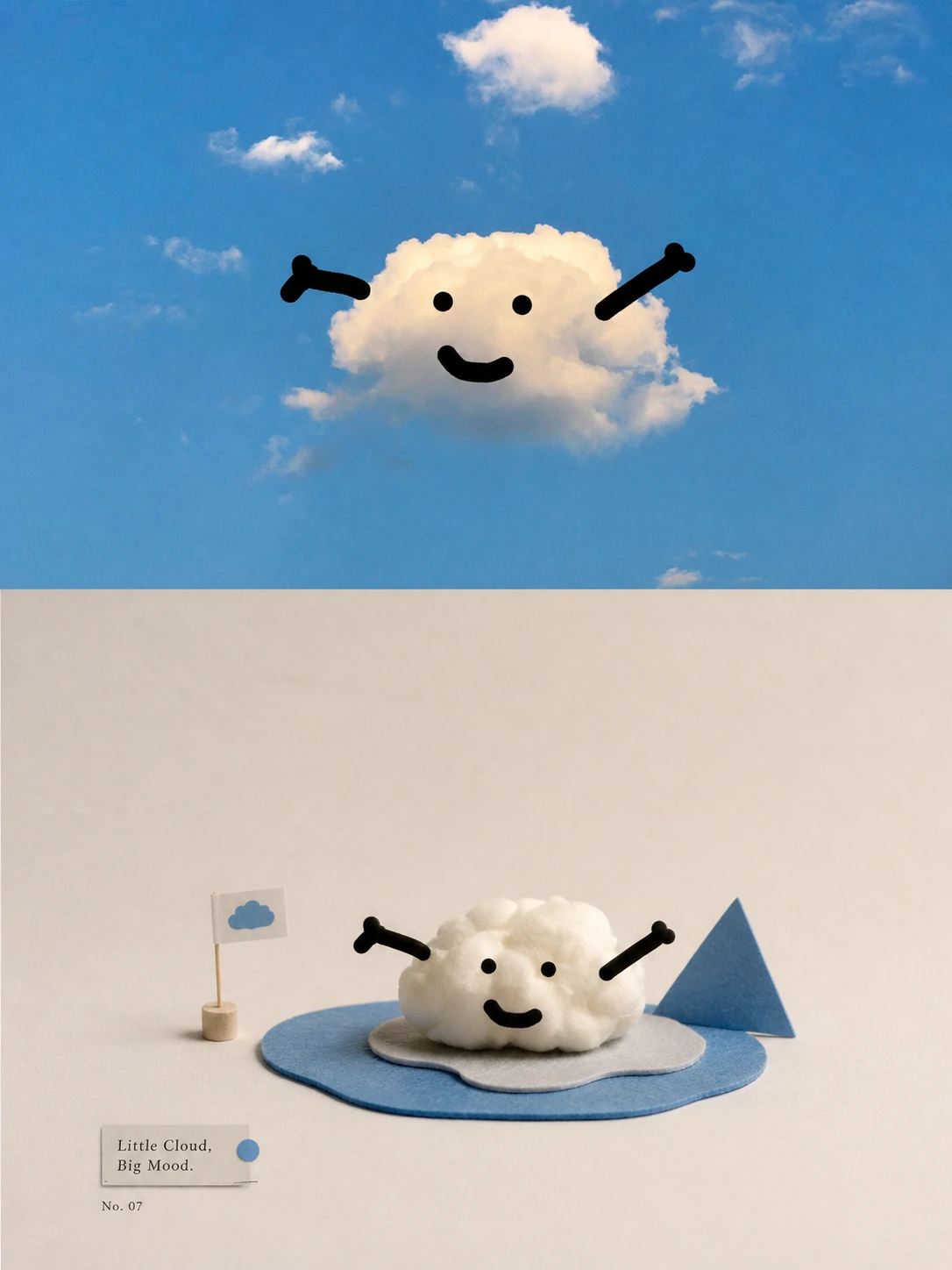
Complete AI image prompt
Turn each photograph I upload into a separate premium design poster. Do not combine multiple images; output each photograph separately. Use an overall 3:4 portrait composition, with the upper and lower regions kept at a strict 1:1 height ratio, each occupying 50% of the image.

Retain the original photograph in the upper half, preserving the subject's identity, structure, pose, authentic texture, natural light and shadow, and original colour atmosphere. Apply only subtle, premium colour grading to give it the quality of an art magazine, independent publication, or exhibition image. The surrounding environment may be extended naturally to fit the aspect ratio, but the subject must not be stretched, distorted, or altered.

In the lower half, extract the photograph's most recognisable **subject, silhouette, pose, material relationships, and narrative structure**, and reconstruct them as a minimal **handmade miniature stage / collectible three-dimensional cover**. Do not reproduce the photograph realistically. Retain only the most essential identity traits and spatial relationships, rebuilding them with clay, felt, hand-cut paper, string, cardboard, and a small amount of matte modelling material. Compress the complex scene into a simple, quiet miniature installation that remains instantly recognisable.

Keep the subject to approximately **20%–30%** of the lower half, centred low or shifted slightly according to the photograph's centre of gravity, with abundant negative space around it. Prioritise visual balance, scale relationships, positive and negative shapes, layering, and breathing room. Do not fill the scene or accumulate decoration; add only the very few environmental elements that genuinely support the subject's narrative, so it resembles a small stage independently displayed on the page of an art publication.

The materials must have the tactile quality of a real handmade object. Preserve slight fingerprints and modelling marks in the clay, felt fibres, paper thickness, hand-cut edges, bent string, and cardboard seams. Allow slight asymmetry, crookedness, and fabrication error. Keep surfaces mostly matte, soft, and delicate, with only very subtle natural shadows to establish layers. Avoid glossy CG, plastic reflections, and an excessively polished 3D-rendered appearance.

Extract and retune the most recognisable and life-filled colours from the upper photograph. Reduce the number of colours and moderately increase their brightness and purity, making them cleaner, warmer, and lighter. Match the background intelligently to the photograph's overall colour temperature with an extremely pale, near-white soft ground, letting the materials themselves become the visual focus. Retain one or two brighter signature colours from the original as memory anchors where appropriate. Avoid muddy grey, darkness, too many colours, and a cheap candy-like look.

Let a small amount of text enter freely, distilling a concise title, phrase, or micro-annotation from the photograph without fixing its language or information format. Treat the text as a **small sticker, embossed label, hand-cut paper slip, or understated printed notation** that relates naturally to the miniature installation. Keep the type small, restrained, and surrounded by generous space, like a refined caption in an independent publication or art archive. Do not use garbled text, pseudo-writing, or complex information panels.

The overall result should combine the character of an **independent-publication cover, art-exhibition poster, collectible visual-study page, and handmade model photograph**: quiet, modern, restrained, refined, and warmed by real materials, while maintaining a clear subject narrative and premium negative space. Avoid children's-toy advertising, cheap cartooning, excessive cuteness, an oversized subject, complex backgrounds, photographic copying, pure 3D rendering, smooth digital illustration, plastic texture, too many colours, garbled text, watermarks, and template-poster styling.
Original style prompt
Turn each photograph I upload into a separate premium design poster. Do not combine multiple images; output each photograph separately. Use an overall 3:4 portrait composition, with the upper and lower regions kept at a strict 1:1 height ratio, each occupying 50% of the image.

Retain the original photograph in the upper half, preserving the subject's identity, structure, pose, authentic texture, natural light and shadow, and original colour atmosphere. Apply only subtle, premium colour grading to give it the quality of an art magazine, independent publication, or exhibition image. The surrounding environment may be extended naturally to fit the aspect ratio, but the subject must not be stretched, distorted, or altered.

In the lower half, extract the photograph's most recognisable **subject, silhouette, pose, material relationships, and narrative structure**, and reconstruct them as a minimal **handmade miniature stage / collectible three-dimensional cover**. Do not reproduce the photograph realistically. Retain only the most essential identity traits and spatial relationships, rebuilding them with clay, felt, hand-cut paper, string, cardboard, and a small amount of matte modelling material. Compress the complex scene into a simple, quiet miniature installation that remains instantly recognisable.

Keep the subject to approximately **20%–30%** of the lower half, centred low or shifted slightly according to the photograph's centre of gravity, with abundant negative space around it. Prioritise visual balance, scale relationships, positive and negative shapes, layering, and breathing room. Do not fill the scene or accumulate decoration; add only the very few environmental elements that genuinely support the subject's narrative, so it resembles a small stage independently displayed on the page of an art publication.

The materials must have the tactile quality of a real handmade object. Preserve slight fingerprints and modelling marks in the clay, felt fibres, paper thickness, hand-cut edges, bent string, and cardboard seams. Allow slight asymmetry, crookedness, and fabrication error. Keep surfaces mostly matte, soft, and delicate, with only very subtle natural shadows to establish layers. Avoid glossy CG, plastic reflections, and an excessively polished 3D-rendered appearance.

Extract and retune the most recognisable and life-filled colours from the upper photograph. Reduce the number of colours and moderately increase their brightness and purity, making them cleaner, warmer, and lighter. Match the background intelligently to the photograph's overall colour temperature with an extremely pale, near-white soft ground, letting the materials themselves become the visual focus. Retain one or two brighter signature colours from the original as memory anchors where appropriate. Avoid muddy grey, darkness, too many colours, and a cheap candy-like look.

Let a small amount of text enter freely, distilling a concise title, phrase, or micro-annotation from the photograph without fixing its language or information format. Treat the text as a **small sticker, embossed label, hand-cut paper slip, or understated printed notation** that relates naturally to the miniature installation. Keep the type small, restrained, and surrounded by generous space, like a refined caption in an independent publication or art archive. Do not use garbled text, pseudo-writing, or complex information panels.

The overall result should combine the character of an **independent-publication cover, art-exhibition poster, collectible visual-study page, and handmade model photograph**: quiet, modern, restrained, refined, and warmed by real materials, while maintaining a clear subject narrative and premium negative space. Avoid children's-toy advertising, cheap cartooning, excessive cuteness, an oversized subject, complex backgrounds, photographic copying, pure 3D rendering, smooth digital illustration, plastic texture, too many colours, garbled text, watermarks, and template-poster styling.
More open images in the “XXD Panel 085 · Handmade Model Journal” style