

Open prompts
en sample 12 AI Image Prompt
en sample 12, its complete AI image prompt, and the XXD Panel 090 · Visual Thinking Map style are free to view and copy.
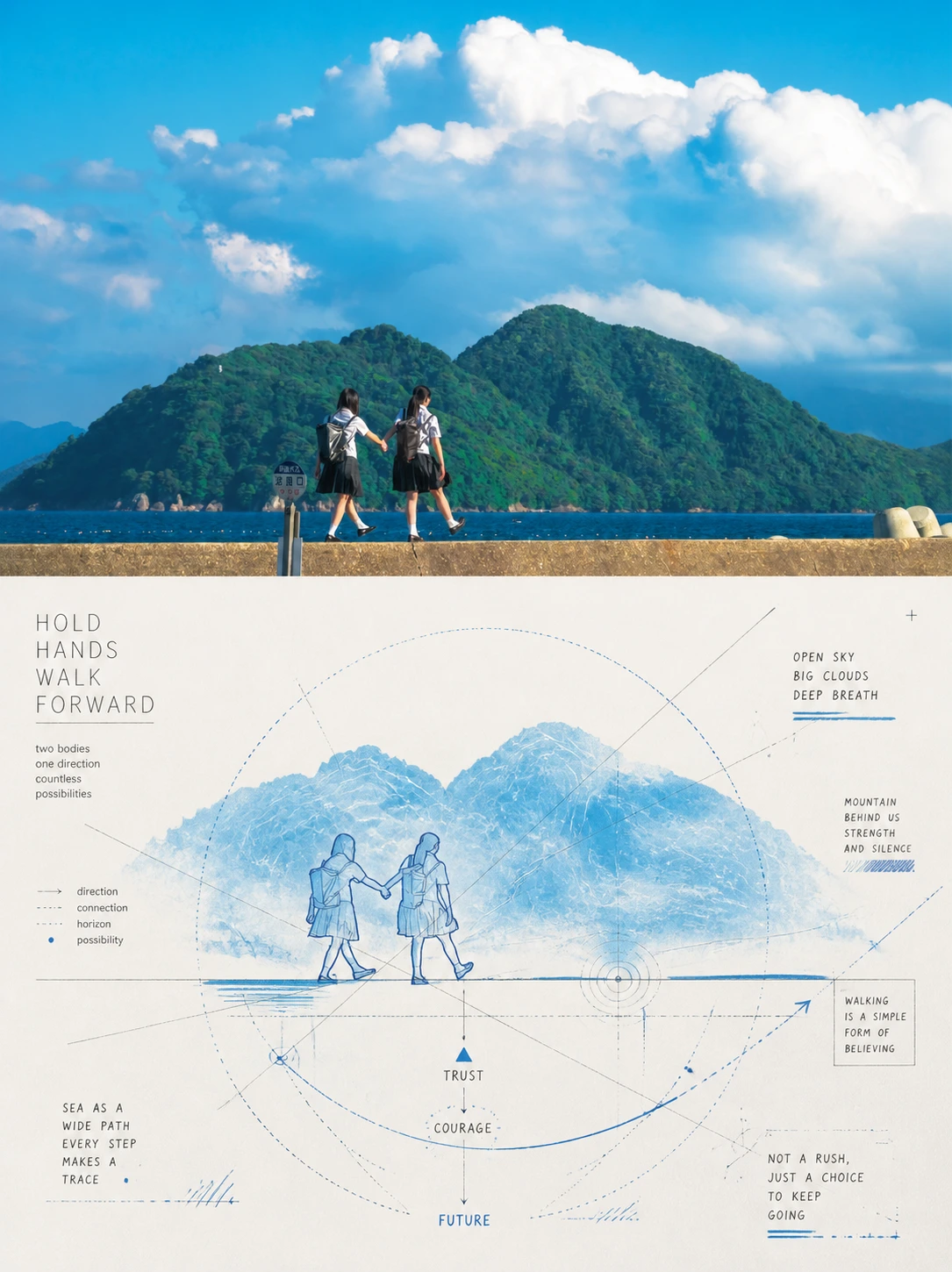
Complete AI image prompt
Please turn each photograph I upload into a separate premium design poster. Do not create multi-image collages; output each photograph individually. Use an overall 3:4 portrait composition, with the upper and lower regions at a strict 1:1 height ratio, each occupying 50% of the canvas.

Retain the original photograph in the upper half, preserving the subject's identity, structure, pose, authentic texture, natural light and shadow, and original colour atmosphere. Apply only subtle, refined colour grading so that it has the visual quality of an art magazine, independent publication, or exhibition image. The surrounding background may be extended naturally to fit the format, but the subject must not be stretched, distorted, or altered.

In the lower half, extract the photograph's most recognisable **subject, contour, pose, and narrative relationships**, but do not depict the original object directly. Instead, translate this information into a diagrammatic abstraction in the style of **Diagrammatic Abstraction / Conceptual Mapping**. Treat the photograph's core object as a “conceptual centre,” and break its action, direction, space, emotion, relationships, and metaphors down into words, nodes, trajectories, regions, arrows, and connections, as though directly drawing the thought process and structure of meaning behind the photograph.

Build the composition jointly through a **textual semantic system + geometric relationship system + handmade mark system**. The subject's most important contour, direction, or pose may subtly form the underlying geometric skeleton; then establish rational order through triangular structures, broken lines, intersecting axes, radiating lines, relationship lines, angular networks, and selective framing. Add a small number of contour-like curves, field lines, waveform trajectories, or paths around the periphery to create spatial relationships of diffusion, flow, convergence, and extension. Do not turn it into a standard flowchart or scientific diagram; preserve an artistic quality poised between painting, diagram, and thinking notes.

The image may incorporate many **repeated directional short lines, rhythmic strokes, dots, ticks, symbols, and local handwritten traces**, forming a mark-making field with varying directions and densities according to the subject's force, speed, emotion, or spatial density. Keep the geometric lines clear, sharp, and restrained, while allowing the handmade marks slight shifts, breaks, and irregularities, creating tension between rational structure and embodied brushwork. Preserve broad areas of whitespace so that relationships, directions, and information have ample room to breathe.

For the palette, extract and remix **the 1–3 most vibrant and meaningful colours** from the photograph above; do not copy the photograph's colours directly or sample them evenly. Use black, charcoal grey, or a deep composite colour for the main text and geometric skeleton, then use vivid colours drawn from the original image for nodes, trajectories, density fields, and local accents. Colours should be bright, clean, and energetic without becoming oversaturated, creating a clear hierarchy through a large pale ground and a small amount of high-intensity colour. Avoid muddy greys, complex composite hues, fluorescent effects, and meaningless accumulations of many colours.

Text itself is a graphic structure; do not preset a fixed title, number, location, or language. Freely distil keywords, short phrases, conceptual fragments, or invented marks from the photograph's subject, action, relationships, emotion, sound, sense of time, or symbolic meaning, and make them participate in the composition through **contrasts of scale, rotation, repetition, overlap, arrangement along paths, partial fragmentation, and spatial connection**. Use **slender, rational editorial typefaces with a subtle tension of experimental typography; letterforms should remain clear but may be slightly stretched, compressed, slanted, or shifted off the baseline**, so that the text is both readable and behaves like nodes, coordinates, and visual notation within the diagram.

The overall result should present an experimental visual language of **Visual Thinking × Concept Mapping × Diagrammatic Drawing × Experimental Typography × Visual Notation**: from a distance, it has clear geometric order and a distinct visual focus; up close, it is rich with relationships among text, trajectories, symbols, and handmade traces. Whether the original image depicts a person, animal, building, plant, object, vehicle, or natural landscape, do not turn it into an object-explanation diagram. Reinterpret it instead as a visual thinking map about **relationships, processes, states, and meaning**.

Avoid traditional mind maps, standard flowcharts, data dashboards, technology UI, cyber interfaces, regular grids that fill the canvas, decorative random lines, dense accumulations of complex information, realistic illustration, and templated infographics.
Original style prompt
Please turn each photograph I upload into a separate premium design poster. Do not create multi-image collages; output each photograph individually. Use an overall 3:4 portrait composition, with the upper and lower regions at a strict 1:1 height ratio, each occupying 50% of the canvas.

Retain the original photograph in the upper half, preserving the subject's identity, structure, pose, authentic texture, natural light and shadow, and original colour atmosphere. Apply only subtle, refined colour grading so that it has the visual quality of an art magazine, independent publication, or exhibition image. The surrounding background may be extended naturally to fit the format, but the subject must not be stretched, distorted, or altered.

In the lower half, extract the photograph's most recognisable **subject, contour, pose, and narrative relationships**, but do not depict the original object directly. Instead, translate this information into a diagrammatic abstraction in the style of **Diagrammatic Abstraction / Conceptual Mapping**. Treat the photograph's core object as a “conceptual centre,” and break its action, direction, space, emotion, relationships, and metaphors down into words, nodes, trajectories, regions, arrows, and connections, as though directly drawing the thought process and structure of meaning behind the photograph.

Build the composition jointly through a **textual semantic system + geometric relationship system + handmade mark system**. The subject's most important contour, direction, or pose may subtly form the underlying geometric skeleton; then establish rational order through triangular structures, broken lines, intersecting axes, radiating lines, relationship lines, angular networks, and selective framing. Add a small number of contour-like curves, field lines, waveform trajectories, or paths around the periphery to create spatial relationships of diffusion, flow, convergence, and extension. Do not turn it into a standard flowchart or scientific diagram; preserve an artistic quality poised between painting, diagram, and thinking notes.

The image may incorporate many **repeated directional short lines, rhythmic strokes, dots, ticks, symbols, and local handwritten traces**, forming a mark-making field with varying directions and densities according to the subject's force, speed, emotion, or spatial density. Keep the geometric lines clear, sharp, and restrained, while allowing the handmade marks slight shifts, breaks, and irregularities, creating tension between rational structure and embodied brushwork. Preserve broad areas of whitespace so that relationships, directions, and information have ample room to breathe.

For the palette, extract and remix **the 1–3 most vibrant and meaningful colours** from the photograph above; do not copy the photograph's colours directly or sample them evenly. Use black, charcoal grey, or a deep composite colour for the main text and geometric skeleton, then use vivid colours drawn from the original image for nodes, trajectories, density fields, and local accents. Colours should be bright, clean, and energetic without becoming oversaturated, creating a clear hierarchy through a large pale ground and a small amount of high-intensity colour. Avoid muddy greys, complex composite hues, fluorescent effects, and meaningless accumulations of many colours.

Text itself is a graphic structure; do not preset a fixed title, number, location, or language. Freely distil keywords, short phrases, conceptual fragments, or invented marks from the photograph's subject, action, relationships, emotion, sound, sense of time, or symbolic meaning, and make them participate in the composition through **contrasts of scale, rotation, repetition, overlap, arrangement along paths, partial fragmentation, and spatial connection**. Use **slender, rational editorial typefaces with a subtle tension of experimental typography; letterforms should remain clear but may be slightly stretched, compressed, slanted, or shifted off the baseline**, so that the text is both readable and behaves like nodes, coordinates, and visual notation within the diagram.

The overall result should present an experimental visual language of **Visual Thinking × Concept Mapping × Diagrammatic Drawing × Experimental Typography × Visual Notation**: from a distance, it has clear geometric order and a distinct visual focus; up close, it is rich with relationships among text, trajectories, symbols, and handmade traces. Whether the original image depicts a person, animal, building, plant, object, vehicle, or natural landscape, do not turn it into an object-explanation diagram. Reinterpret it instead as a visual thinking map about **relationships, processes, states, and meaning**.

Avoid traditional mind maps, standard flowcharts, data dashboards, technology UI, cyber interfaces, regular grids that fill the canvas, decorative random lines, dense accumulations of complex information, realistic illustration, and templated infographics.
More open images in the “XXD Panel 090 · Visual Thinking Map” style