

Open prompts
en sample 12 AI Image Prompt
en sample 12, its complete AI image prompt, and the XXD Panel 045 · Cozy Block City style are free to view and copy.
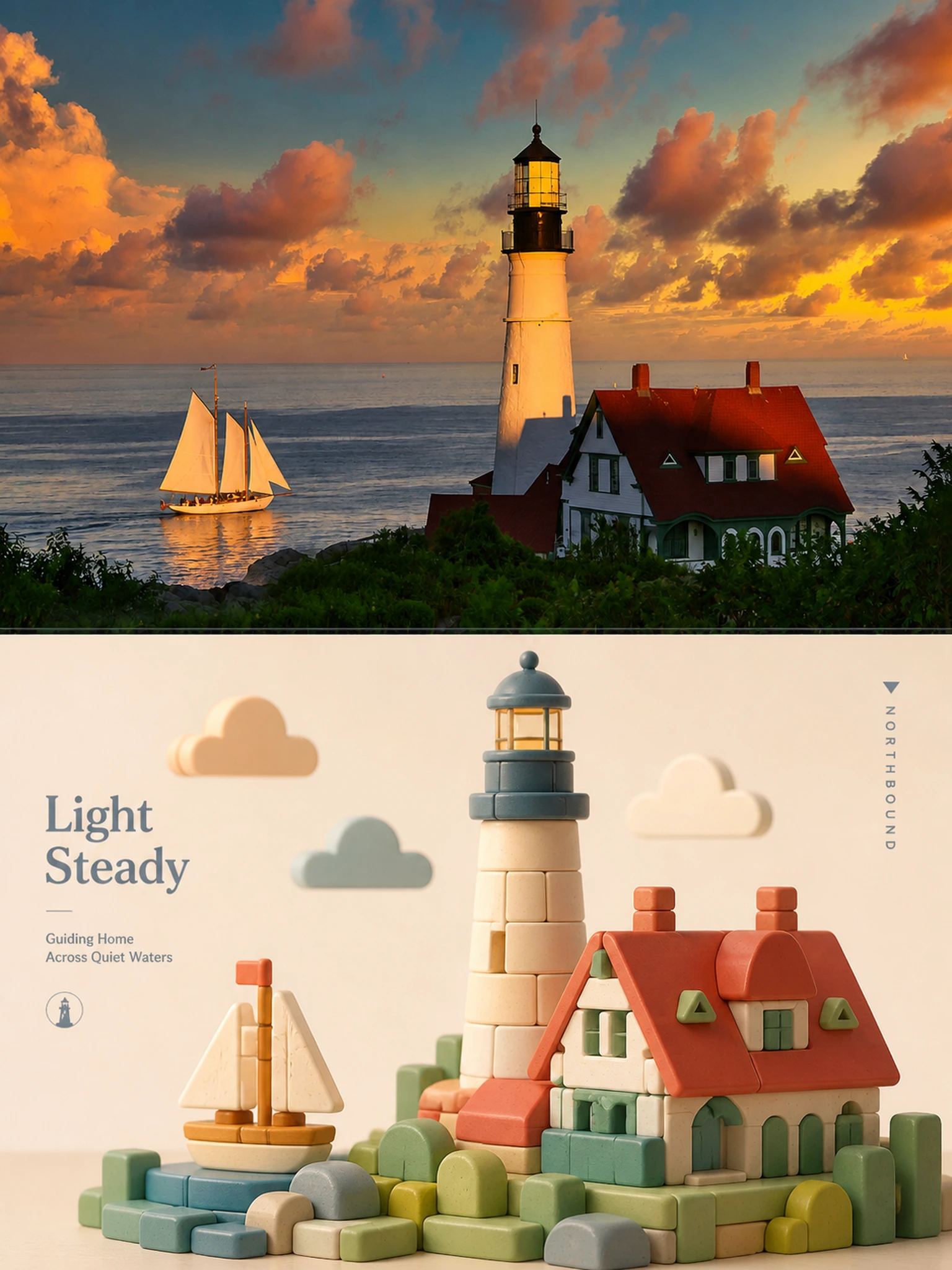
Complete AI image prompt
Please make every photo I upload into its own standalone high-end design poster; no multi-image collages, each photo output separately. The overall composition uses a 3:4 vertical format, with the upper and lower zones strictly 1:1 in height, each taking up 50% of the frame.

The upper half keeps the original photo, preserving the subject's structure, spatial relationships, real materials, natural light and shadow, and original color atmosphere, applying only a slight high-end photographic color grade so that it carries the texture of art magazines, independent publications, and exhibition photography. To fit the frame, the environmental background may be extended naturally, but the subject must not be stretched, distorted, or altered.

The lower half extracts the most recognizable **subject, outline, pose, and narrative relationships** from the photo and, following a “deconstruct—select—distill—reconstruct” logic, transforms them into a **healing-style building-block sculpture with a 3D / isometric sense of space**. Focus on retaining the subject's most distinctive volumetric proportions, axes, curves, interweaving, layering, occlusion, and negative space, reorganizing them with rounded, concise, tactile modular masses. Do not reproduce every detail completely, but the correspondence with the original image above must be immediately perceptible.

The composition adapts to the subject's own visual center of gravity, direction of pose, and spatial relationships, establishing rhythm through large and small masses, staggered heights, front-back interweaving, local suspension, variations in density, and extensive negative space. The blocks may be joined, stacked, nested, passed through one another, or naturally misaligned, allowing the subject to retain its identity while gaining the sculptural quality and relaxed imagination of a contemporary art toy. Avoid mechanical disassembly and simple pixelation.

**The color scheme must be generated through analysis of the upper original image itself.** First identify the most vital and recognizable primary color relationships in the photo, as well as the overall color temperature, value hierarchy, warm-cool interplay, and key accent colors; then remix these colors into a healing palette that is softer, clearer, brighter, and airier. Preserve the hue identity and emotional memory of the original image, while moderately raising lightness, reducing harsh contrast, and purifying muddy, dirty, miscellaneous colors, so that the colors feel gentle, playful, light, and refined. Different photos should naturally produce different color schemes; do not use any fixed preset palette or forcibly add colors absent from the original image for the sake of a “healing feel.”

Color establishes rhythm through **areas of primary color, layers of secondary color, lighter and darker shades from the same source, and a very small number of vivid accent colors**, making the subject look rich but not cluttered, cute but not cloying, and soft yet spirited. The blocks use a delicate matte texture with soft diffuse reflection and a slight tactile quality resembling paper pulp, wood, powder wax, or a flexible material; corners are rounded and shadows are soft. Avoid plastic highlights, metallic effects, heavy CG, and the texture of cheap toys.

Typography establishes a light, high-end editorial micro-layout system. Distill a 2–5-word title from the photo's light and shadow, movement, space, emotion, or symbolic meaning, and accompany it with a small number of status words, locations, numbers, directional words, or micro-annotations; do not use years. Text may be arranged along block edges, module seams, visual axes, or negative space, and may also interweave, overlap, and align with the masses, allowing it to become a natural part of the building-block composition.

The overall visual character is **real photography × healing building blocks × isometric space × original-image color translation × high-end editorial design**: gentle, light, playful, quiet, refined, and imaginative without being childish. Whether the subject is a person, animal, plant, building, object, food, vehicle, or natural landscape, a unique block combination and color scheme should be developed from the original image's own structure and colors. Avoid fixed palettes, LEGO-style replication, children's cartoons, an e-commerce toy-display feel, and a template-like feel.
Original style prompt
Please make every photo I upload into its own standalone high-end design poster; no multi-image collages, each photo output separately. The overall composition uses a 3:4 vertical format, with the upper and lower zones strictly 1:1 in height, each taking up 50% of the frame.

The upper half keeps the original photo, preserving the subject's structure, spatial relationships, real materials, natural light and shadow, and original color atmosphere, applying only a slight high-end photographic color grade so that it carries the texture of art magazines, independent publications, and exhibition photography. To fit the frame, the environmental background may be extended naturally, but the subject must not be stretched, distorted, or altered.

The lower half extracts the most recognizable **subject, outline, pose, and narrative relationships** from the photo and, following a “deconstruct—select—distill—reconstruct” logic, transforms them into a **healing-style building-block sculpture with a 3D / isometric sense of space**. Focus on retaining the subject's most distinctive volumetric proportions, axes, curves, interweaving, layering, occlusion, and negative space, reorganizing them with rounded, concise, tactile modular masses. Do not reproduce every detail completely, but the correspondence with the original image above must be immediately perceptible.

The composition adapts to the subject's own visual center of gravity, direction of pose, and spatial relationships, establishing rhythm through large and small masses, staggered heights, front-back interweaving, local suspension, variations in density, and extensive negative space. The blocks may be joined, stacked, nested, passed through one another, or naturally misaligned, allowing the subject to retain its identity while gaining the sculptural quality and relaxed imagination of a contemporary art toy. Avoid mechanical disassembly and simple pixelation.

**The color scheme must be generated through analysis of the upper original image itself.** First identify the most vital and recognizable primary color relationships in the photo, as well as the overall color temperature, value hierarchy, warm-cool interplay, and key accent colors; then remix these colors into a healing palette that is softer, clearer, brighter, and airier. Preserve the hue identity and emotional memory of the original image, while moderately raising lightness, reducing harsh contrast, and purifying muddy, dirty, miscellaneous colors, so that the colors feel gentle, playful, light, and refined. Different photos should naturally produce different color schemes; do not use any fixed preset palette or forcibly add colors absent from the original image for the sake of a “healing feel.”

Color establishes rhythm through **areas of primary color, layers of secondary color, lighter and darker shades from the same source, and a very small number of vivid accent colors**, making the subject look rich but not cluttered, cute but not cloying, and soft yet spirited. The blocks use a delicate matte texture with soft diffuse reflection and a slight tactile quality resembling paper pulp, wood, powder wax, or a flexible material; corners are rounded and shadows are soft. Avoid plastic highlights, metallic effects, heavy CG, and the texture of cheap toys.

Typography establishes a light, high-end editorial micro-layout system. Distill a 2–5-word title from the photo's light and shadow, movement, space, emotion, or symbolic meaning, and accompany it with a small number of status words, locations, numbers, directional words, or micro-annotations; do not use years. Text may be arranged along block edges, module seams, visual axes, or negative space, and may also interweave, overlap, and align with the masses, allowing it to become a natural part of the building-block composition.

The overall visual character is **real photography × healing building blocks × isometric space × original-image color translation × high-end editorial design**: gentle, light, playful, quiet, refined, and imaginative without being childish. Whether the subject is a person, animal, plant, building, object, food, vehicle, or natural landscape, a unique block combination and color scheme should be developed from the original image's own structure and colors. Avoid fixed palettes, LEGO-style replication, children's cartoons, an e-commerce toy-display feel, and a template-like feel.
More open images in the “XXD Panel 045 · Cozy Block City” style