

Open prompts
maple dusk structural slide AI Image Prompt
maple dusk structural slide, its complete AI image prompt, and the Presentations & Courseware · Printmaking · Line Art · 280 style are free to view and copy.
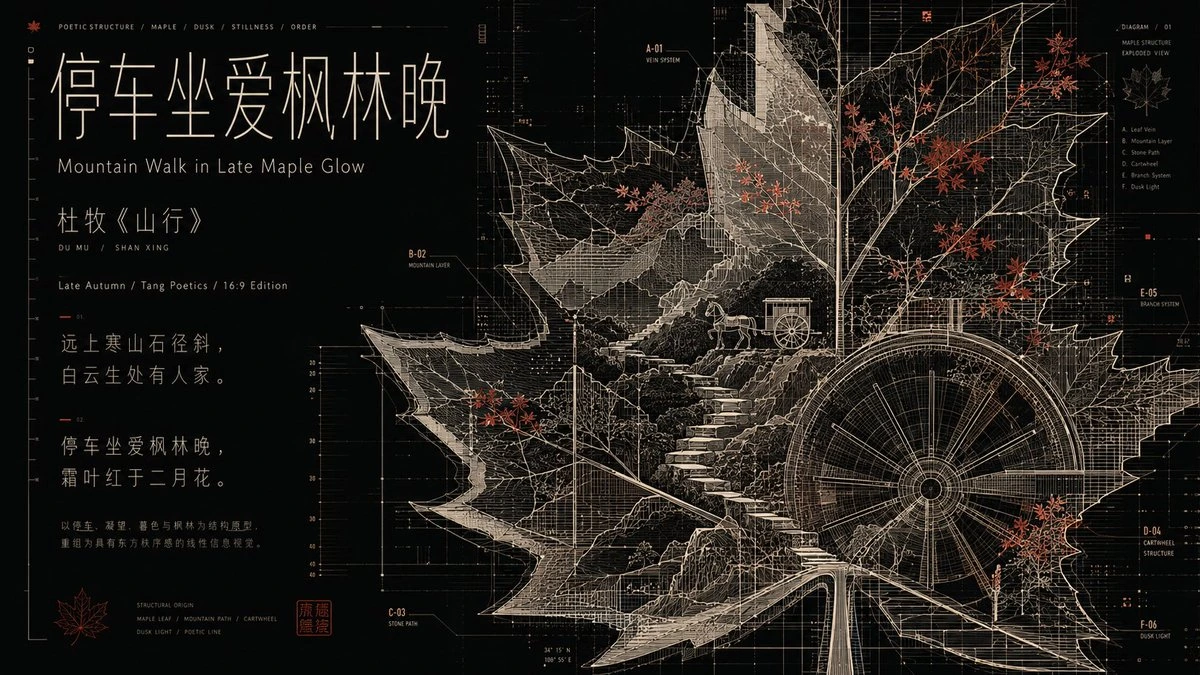
Complete AI image prompt
Compress the theme’s central meaning into one monumental line-built composite in which character strokes, natural forms, architectural members, or narrative objects interlock, penetrate, and support one another, producing both immediate pictographic recognition and the precision of an exploded technical section. Give this composite roughly two thirds of the visual weight, crop it decisively at the frame, and allow selected line bundles to continue beyond the edge; reserve the opposite side as a continuous dark information field, balancing unequal masses across a generous distance. Construct the main form from luminous hairlines, nested contours, sectional offsets, radial structures, repeated short strokes, and minute indexing. Translate theme-derived landscapes, plants, artifacts, figures, or spaces into measurable components, moving from an enormous outer silhouette down through several scales to tiny embedded scenes so the viewer reads one forceful symbol first and then explores its internal world. In the information field, use tall narrow Chinese display lettering with restrained stroke contrast to establish the main vertical or horizontal rhythm; step subtitles, source, date, and explanatory copy down through smaller levels on a shared baseline. Place sparse coordinates, legends, section marks, and parameters close to the composite edge so they explain the construction like a research drawing without stealing weight. Hold a strong value opposition between an optically clean, extremely deep cool-dark field and ivory-white linework. Let the theme supply only one tiny high-energy accent color for seals, path nodes, leaves, droplets, or decisive annotations, allowing it to jump briefly along the reading route. Model light, depth, and volume through line width, spacing, overlap, and crop while the dark field remains continuous and even. Across a slide system, preserve the relationship of monumental composite, lateral information field, and orbiting technical notation; subjects and inner narratives may change, but the mass hierarchy, edge pressure, linear precision, and single accent remain stable.
Original style prompt
Compress the theme’s central meaning into one monumental line-built composite in which character strokes, natural forms, architectural members, or narrative objects interlock, penetrate, and support one another, producing both immediate pictographic recognition and the precision of an exploded technical section. Give this composite roughly two thirds of the visual weight, crop it decisively at the frame, and allow selected line bundles to continue beyond the edge; reserve the opposite side as a continuous dark information field, balancing unequal masses across a generous distance. Construct the main form from luminous hairlines, nested contours, sectional offsets, radial structures, repeated short strokes, and minute indexing. Translate theme-derived landscapes, plants, artifacts, figures, or spaces into measurable components, moving from an enormous outer silhouette down through several scales to tiny embedded scenes so the viewer reads one forceful symbol first and then explores its internal world. In the information field, use tall narrow Chinese display lettering with restrained stroke contrast to establish the main vertical or horizontal rhythm; step subtitles, source, date, and explanatory copy down through smaller levels on a shared baseline. Place sparse coordinates, legends, section marks, and parameters close to the composite edge so they explain the construction like a research drawing without stealing weight. Hold a strong value opposition between an optically clean, extremely deep cool-dark field and ivory-white linework. Let the theme supply only one tiny high-energy accent color for seals, path nodes, leaves, droplets, or decisive annotations, allowing it to jump briefly along the reading route. Model light, depth, and volume through line width, spacing, overlap, and crop while the dark field remains continuous and even. Across a slide system, preserve the relationship of monumental composite, lateral information field, and orbiting technical notation; subjects and inner narratives may change, but the mass hierarchy, edge pressure, linear precision, and single accent remain stable.
More open images in the “Presentations & Courseware · Printmaking · Line Art · 280” style