



Open prompts
sample 01 AI Image Prompt
sample 01, its complete AI image prompt, and the Presentations & Courseware · Solar Terms · Paper Texture · 286 style are free to view and copy.
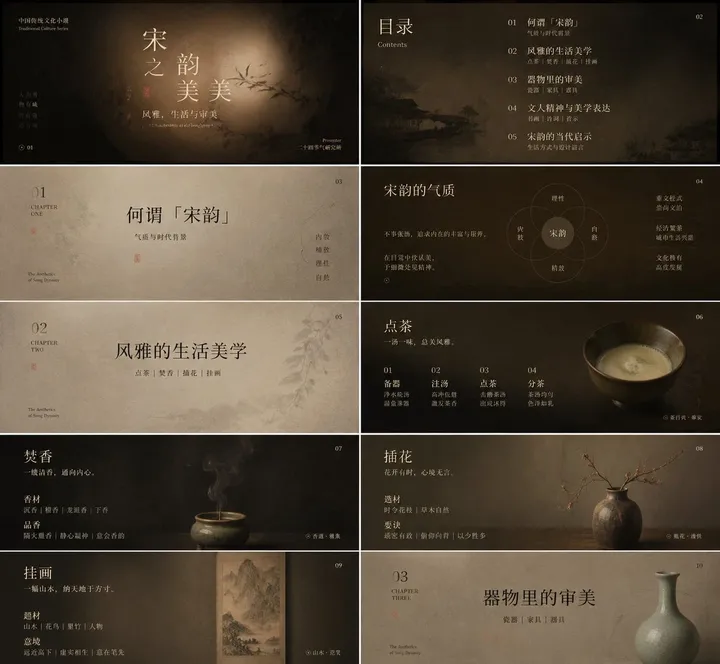
Complete AI image prompt
Build the image around an extreme scale discontinuity: the theme’s most recognizable form becomes a monumental, tactile mass, with partial sections, skin, or silhouette pressing in from the edges; pair two unequal giant masses as a framing device and balance them across generous darkness or a calm pale field. At ground level, stage a miniature world of people, tools, and purposeful actions derived from the theme’s meaning, anchored by precise contact shadows, reflections, overlap, and scale diminution so the first read is iconic and the second reveals an intimate narrative. Govern the space through dominant, subdominant, and minute visual weights rather than fixed coordinates. Lead the eye from an oversized chapter number and concise theme name to one short proposition, then through modular information columns and into the miniature scene; keep the editorial grid disciplined while cropped subject matter and a few spanning elements deliberately break it. Use a steep typographic scale jump: very large condensed numerals, a highly legible display title with crisp strokes and a stable center of gravity, then lightweight supporting copy in short columns with open leading. Preserve valid anatomy for Chinese, Latin, or any requested script, aligning multilingual forms by optical mass. Organize four to six compact information units with ordered numbers, fine rules, circular monoline icons, and brief copy; repeated intervals create rhythm, while one tiny seal-like square may carry the sole warm accent. Derive color from the theme’s own material and emotional associations. A dark realization uses a near-black environment around one or two concentrated subject hues; a pale realization uses warm paper neutrals, ink-dark type, and restrained object color. Both retain a broad low-value or low-chroma field, luminous lettering, and a very small accent allowance. Make illumination causal to material: for sensorial themes, use low directional light across beads of moisture, translucent sections, specular surfaces, and a reflective ground; for contemplative themes, use localized warm illumination on objects, softly fibrous paper, or thin atmospheric diffusion, with gradual shadow falloff and edges receding into air. Unite photoreal material presence with rigorous information design, keep peak resolution on the monumental surface and miniature activity, soften distant detail, and preserve the tension between restrained East Asian editorial order and cinematic wonder at an inhabitable giant world.
More open images in the “Presentations & Courseware · Solar Terms · Paper Texture · 286” style