
Open prompts
sample 01 AI Image Prompt
sample 01, its complete AI image prompt, and the Illustration & Visual Styles · Bright · 013 style are free to view and copy.
Complete AI image prompt
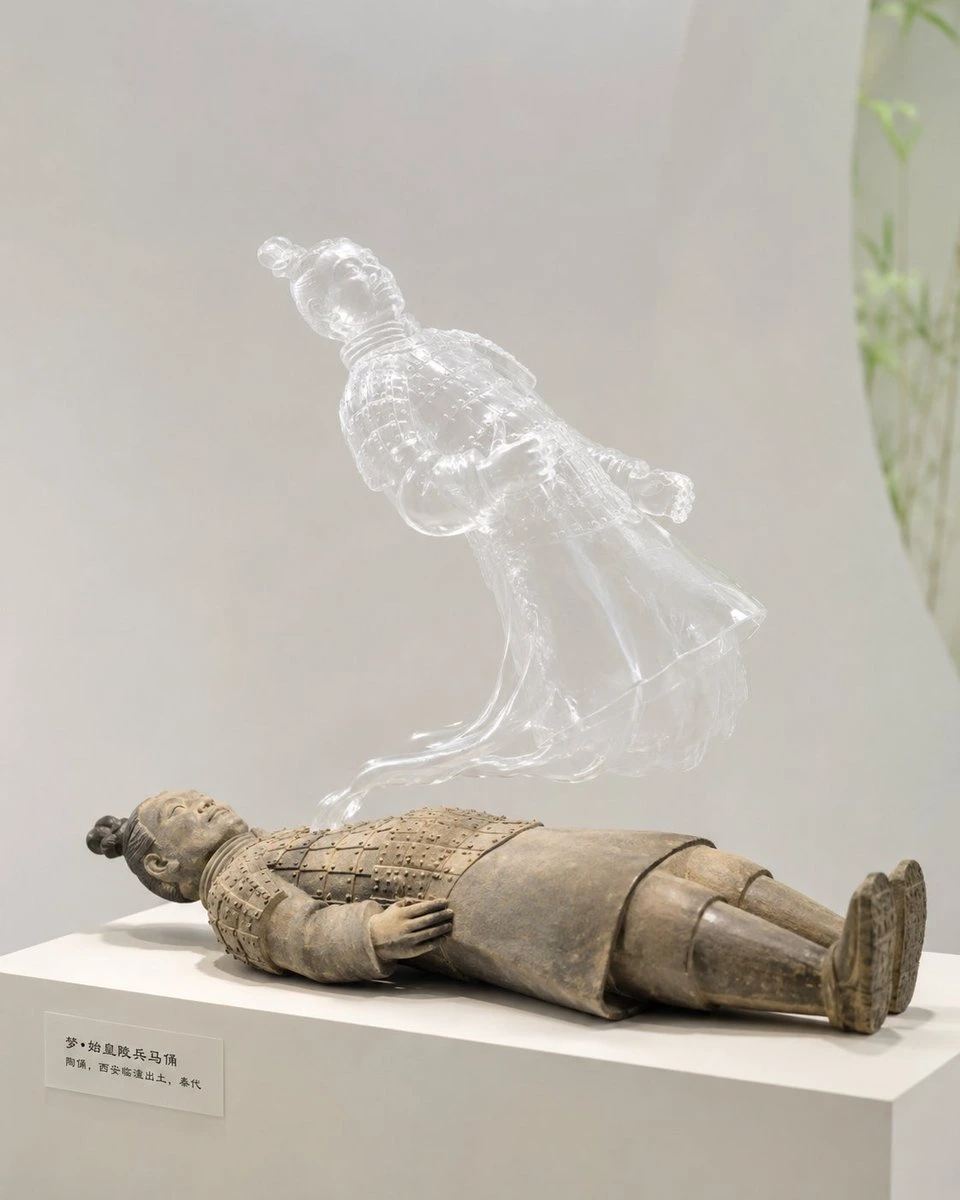
Stage the subject as two simultaneous states: a quiet, materially substantial body resting in full recognizable form on a minimal display plinth, and its translucent double lifting free above it. Let the resting form retain the theme’s defining silhouette, construction, costume, surface character, and symbolic details; use a relaxed closed pose, convincing weight, and a stable contact shadow to imply temporary dormancy. Draw a narrow continuous strand from the body’s core, curve it upward, and gradually expand it into a complete three-dimensional duplicate whose gesture is more open and buoyant. The rising form must preserve the same identity and theme-derived attachments, so the departure reads through uninterrupted morphological continuity rather than an applied effect. Anchor the composition with one dense horizontal mass and answer it with a lighter displaced floating mass; connect them through a flowing S-shaped viewing path. Balance this unequal pair against generous open space, keeping the main sculptural event dominant while the plinth and one restrained caption card function only as scale cues and a faint informational beat. Build the double as clear cast resin or blown glass: thin luminous rims, soft refraction, rolling specular highlights, and nested internal planes reveal its volume while the center remains highly transparent. Near the physical body, taper the material into fine stretched filaments; toward the floating end, restore a fully legible solid silhouette. Derive color from the subject itself, allowing only muted transparent color layers, small identity marks, or a key symbolic attachment inside the otherwise clear form; let ambient white illumination produce a controlled milky glow. Render the resting body in the theme’s own plausible material, preserving its weight and tactile logic, whether soft, matte, dense, or rugged, and oppose that grounded surface with the spirit’s smooth optical clarity. Place the event in a bright, low-contrast exhibition environment of near-white or pale warm gray, with a seamless curved backdrop and clean plinth geometry. Broad top-side illumination should wrap the physical form evenly, while stronger rim and transmitted light define the transparent double; keep shadows broad and light and the air optically clear. Permit only sparse, softly receding environmental cues. Set any caption information in small, orderly, low-weight typography that establishes a credible gallery context without competing for attention. The result should feel like meticulously installed surreal sculptural photography: hushed, gently humorous, ceremonial, and physically convincing, with precise edges, continuous transparent transitions, and believable points of contact.
Original style prompt
Stage the subject as two simultaneous states: a quiet, materially substantial body resting in full recognizable form on a minimal display plinth, and its translucent double lifting free above it. Let the resting form retain the theme’s defining silhouette, construction, costume, surface character, and symbolic details; use a relaxed closed pose, convincing weight, and a stable contact shadow to imply temporary dormancy. Draw a narrow continuous strand from the body’s core, curve it upward, and gradually expand it into a complete three-dimensional duplicate whose gesture is more open and buoyant. The rising form must preserve the same identity and theme-derived attachments, so the departure reads through uninterrupted morphological continuity rather than an applied effect. Anchor the composition with one dense horizontal mass and answer it with a lighter displaced floating mass; connect them through a flowing S-shaped viewing path. Balance this unequal pair against generous open space, keeping the main sculptural event dominant while the plinth and one restrained caption card function only as scale cues and a faint informational beat. Build the double as clear cast resin or blown glass: thin luminous rims, soft refraction, rolling specular highlights, and nested internal planes reveal its volume while the center remains highly transparent. Near the physical body, taper the material into fine stretched filaments; toward the floating end, restore a fully legible solid silhouette. Derive color from the subject itself, allowing only muted transparent color layers, small identity marks, or a key symbolic attachment inside the otherwise clear form; let ambient white illumination produce a controlled milky glow. Render the resting body in the theme’s own plausible material, preserving its weight and tactile logic, whether soft, matte, dense, or rugged, and oppose that grounded surface with the spirit’s smooth optical clarity. Place the event in a bright, low-contrast exhibition environment of near-white or pale warm gray, with a seamless curved backdrop and clean plinth geometry. Broad top-side illumination should wrap the physical form evenly, while stronger rim and transmitted light define the transparent double; keep shadows broad and light and the air optically clear. Permit only sparse, softly receding environmental cues. Set any caption information in small, orderly, low-weight typography that establishes a credible gallery context without competing for attention. The result should feel like meticulously installed surreal sculptural photography: hushed, gently humorous, ceremonial, and physically convincing, with precise edges, continuous transparent transitions, and believable points of contact.
More open images in the “Illustration & Visual Styles · Bright · 013” style