

Open prompts
sample 01 AI Image Prompt
sample 01, its complete AI image prompt, and the Presentations & Courseware · Paper Texture · Bright · 288 style are free to view and copy.
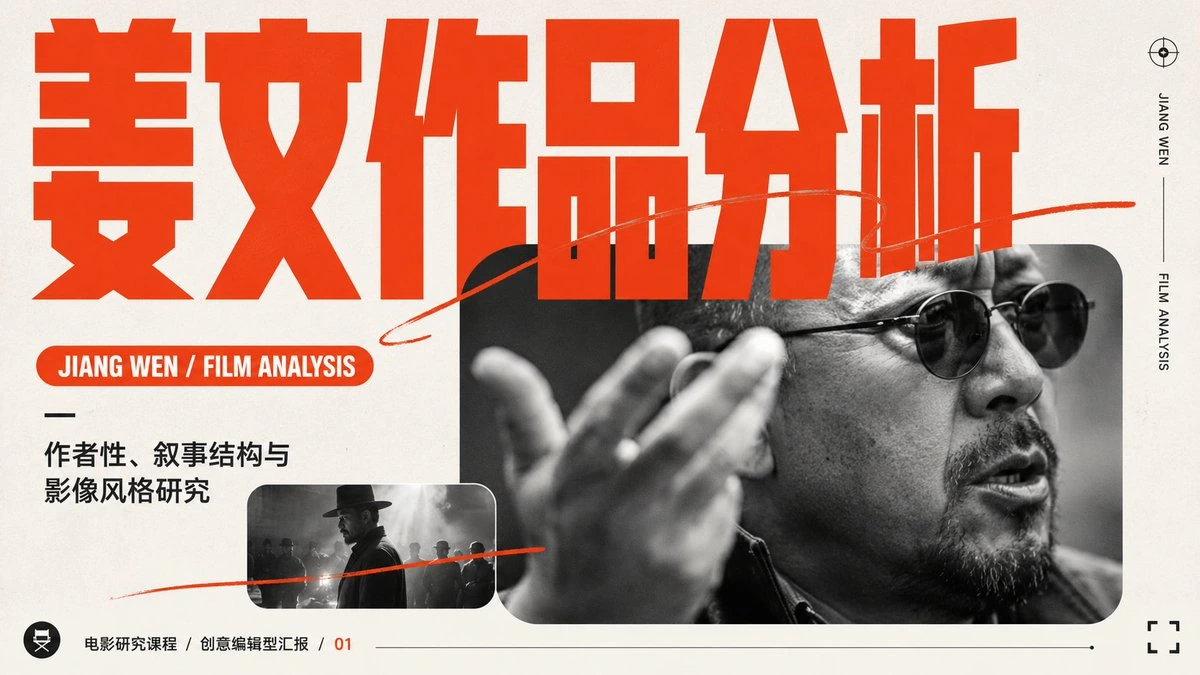
Complete AI image prompt
Build the first read as a commanding wall of oversized red display lettering, set several times heavier than all supporting information and interlocked with the principal image through overlap and occlusion. Give the title an ultra-bold, condensed, nearly monoline geometric skeleton; compress stroke spacing, component widths, and counters, add a few purposeful cuts, and preserve valid, immediately recognizable anatomy in the selected writing system. Let this typographic mass span modules and press against an edge while a high-contrast black-and-white documentary or realistic image, closely cropped around a decisive pose, expression, gesture, or structural direction, occupies a large rounded-rectangle window and pushes back as the second center of gravity. Govern the remaining material with an asymmetric modular grid: dense information islands are separated by generous warm-white space, the eye enters through the giant title, follows the subject's directional energy, then resolves through numbered modules, cards, and a fine baseline. Derive the title meaning, representative subject, symbolic links, narrative evidence, and information hierarchy entirely from the subject matter. Use a small set of secondary black-and-white images as compact rounded windows, sequential thumbnails, or detail crops that behave as evidence; let a selected secondary frame cross a module boundary or sit partly beneath the title. Restrict the system to an even warm-white matte paper field, deep black type, grayscale imagery, pale gray cards, and one saturated orange-red accent. Reserve orange-red for the giant title, chapter numerals, capsule labels, key dots, and one continuous freehand annotation stroke, so a limited color area drives the strongest rhythm against broad white and restrained black-gray fields. Set supporting copy in a clear, compact sans serif with sharp hierarchy; align dashes, slashes, two-digit numerals, lettered sections, and multilingual micro-headings by optical weight. Group related points inside soft-cornered pale gray cards, contrasting bold index figures with fine body copy. Maintain a quiet peripheral interface of slender side indexes, crosshair-like registration marks, corner viewfinder symbols, and a footer assembled from a small circular identifier, section text, a red folio, and one extended hairline. Draw the orange-red annotation as a loose editorial gesture with a slight loop, crossing lettering, open field, and photography while preserving essential recognition; its lone organic path is the controlled violation that animates the rectilinear grid. Keep the paper field uniform, flat ink areas dense and unbroken, and all glyph and image edges crisp, combining the authority of a research dossier with the impact of mass communication.
Original style prompt
Build the first read as a commanding wall of oversized red display lettering, set several times heavier than all supporting information and interlocked with the principal image through overlap and occlusion. Give the title an ultra-bold, condensed, nearly monoline geometric skeleton; compress stroke spacing, component widths, and counters, add a few purposeful cuts, and preserve valid, immediately recognizable anatomy in the selected writing system. Let this typographic mass span modules and press against an edge while a high-contrast black-and-white documentary or realistic image, closely cropped around a decisive pose, expression, gesture, or structural direction, occupies a large rounded-rectangle window and pushes back as the second center of gravity. Govern the remaining material with an asymmetric modular grid: dense information islands are separated by generous warm-white space, the eye enters through the giant title, follows the subject's directional energy, then resolves through numbered modules, cards, and a fine baseline. Derive the title meaning, representative subject, symbolic links, narrative evidence, and information hierarchy entirely from the subject matter. Use a small set of secondary black-and-white images as compact rounded windows, sequential thumbnails, or detail crops that behave as evidence; let a selected secondary frame cross a module boundary or sit partly beneath the title. Restrict the system to an even warm-white matte paper field, deep black type, grayscale imagery, pale gray cards, and one saturated orange-red accent. Reserve orange-red for the giant title, chapter numerals, capsule labels, key dots, and one continuous freehand annotation stroke, so a limited color area drives the strongest rhythm against broad white and restrained black-gray fields. Set supporting copy in a clear, compact sans serif with sharp hierarchy; align dashes, slashes, two-digit numerals, lettered sections, and multilingual micro-headings by optical weight. Group related points inside soft-cornered pale gray cards, contrasting bold index figures with fine body copy. Maintain a quiet peripheral interface of slender side indexes, crosshair-like registration marks, corner viewfinder symbols, and a footer assembled from a small circular identifier, section text, a red folio, and one extended hairline. Draw the orange-red annotation as a loose editorial gesture with a slight loop, crossing lettering, open field, and photography while preserving essential recognition; its lone organic path is the controlled violation that animates the rectilinear grid. Keep the paper field uniform, flat ink areas dense and unbroken, and all glyph and image edges crisp, combining the authority of a research dossier with the impact of mass communication.
More open images in the “Presentations & Courseware · Paper Texture · Bright · 288” style