



Open prompts
sample 01 AI Image Prompt
sample 01, its complete AI image prompt, and the Illustration & Visual Styles · Pixel Art · 3D · 019 style are free to view and copy.
Complete AI image prompt
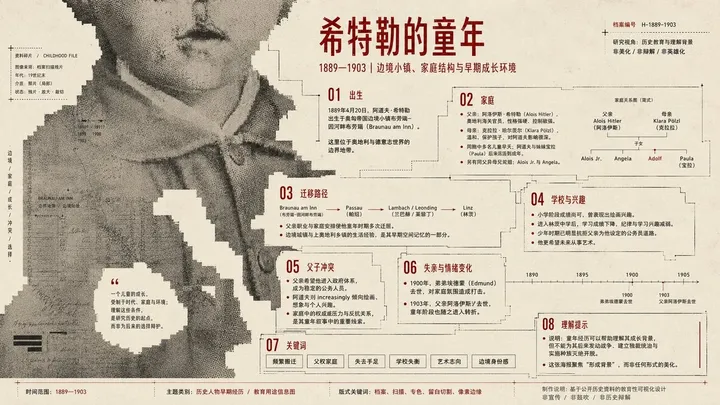
Turn the theme’s most recognizable primary form into an enormous charcoal-black archival image carrying roughly half of the visual weight, tightly cropped to press against the frame and rendered through dense, regular halftone dots. Build its contour from alternating right-angled pixel steps that cut into the surrounding paper space, forcing the image, substrate, and information modules into an interlocking figure-ground relationship. Organize the remaining space with a disciplined archival grid that is deliberately interrupted: one oversized headline creates the entry point beside a compact date or scope line, followed by numbered information cells, relational diagrams, route arrows, keyword tabs, a quotation block, and a continuous timeline; all copy, symbols, nodes, and narrative cues must be generated from the theme. Enforce three pronounced scale levels: a tall, broad, heavy headline; narrow bold section numerals as red anchors; compact small sans-serif body text with still smaller annotations. Keep every writing system orthographically valid and align mixed scripts by optical weight, character width, stroke density, tracking, and leading. Construct module boundaries from hairline black rules, dotted segments, short ticks, registration crosses, open brackets, and angular connector paths; make the rules detour along the stepped subject contour, bridge columns through open paper, and serve simultaneously as navigation, measurement, and assembly marks. Allow selected boxes to lose a corner or project beyond a column while every endpoint still resolves to shared hidden baselines. Maintain forceful asymmetric equilibrium: counter the dense giant form with broad light paper space and small text islands, then taper information density from headline to numbered nodes, branching relations, and timeline ticks, with sparse marginal annotations acting as distant echoes. Limit the palette to warm ivory paper, charcoal black, and one deep low-value red; reserve the red for the headline, numerals, key nodes, a few arrows, and datum lines so a very small color area stitches the reading path together, while its exact hue may shift within the subject’s emotional and material associations. Use matte, absorbent uncoated archival paper; confine stable black halftone screening to the main image and a few printed blocks, keep body type and structural rules flat and crisp, and let only faint paper fibers and scan-like tonal drift appear in the substrate while information fields remain highly legible. The result should feel researched, catalogued, and visually reconstructed: cool, restrained, and analytical, energized by monumental cropping, stepped pixel voids, and red indexing.
More open images in the “Illustration & Visual Styles · Pixel Art · 3D · 019” style