

Open prompts
sample 01 AI Image Prompt
sample 01, its complete AI image prompt, and the Typography & Posters · Paper Texture · Bright · 245 style are free to view and copy.
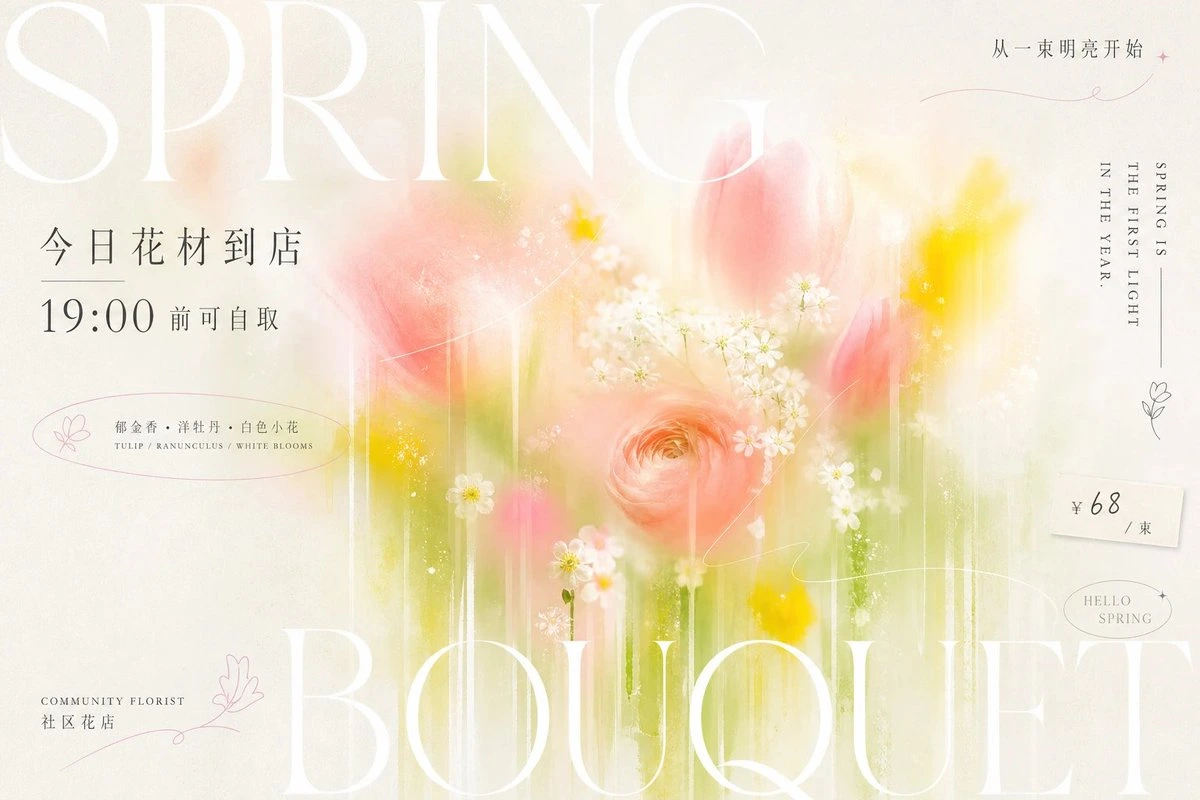
Complete AI image prompt
Build the first read around a subject emerging inside an almost-white diffused light field: keep one recognizably resolved focal detail while translucent overlaps, soft halos, and wet-in-wet washes dissolve the remaining contours into the ground. Pull theme-derived shapes and hues downward into fine trails of unequal length so literal imagery, light, and fluid pigment behave as one breathing layer. Frame this apparition with an extreme typographic scale jump. Oversized high-contrast Latin serifs, or orthographically valid target-script display forms with equivalent thick-thin modulation, sharp terminals, open counters, and airy rhythm, run beyond the edges and are partially cropped, acting as luminous foreground architecture. Gather primary information at a restrained middle scale; distribute captions, dates, numerals, short phrases, and multilingual support copy as tiny edge and whitespace notes with light weight, generous tracking, open leading, and occasional vertical setting. Preserve a three-stage reading sequence of edge-pressing display type, emerging subject, then drifting microcopy. Use asymmetrical dynamic balance rather than a rigid block: a continuous central image field carries the dominant mass, broad milky emptiness aerates it, and giant edge lettering is counterweighted across distance by small peripheral information islands. Let object count and copy length change while spacing, scale contrast, and separated clusters retain the same editorial cadence. Construct the ground from even ivory, cream white, and the palest cool gray. The subject supplies two to four clear low-to-medium-chroma hues, diffused as colored mist, transparent blooms, and gentle warm-cool transitions; reserve peak chroma for the focal point and a few luminous pinpoints, then let color recede into white radiance. Keep highlights translucent, shadows shallow and soft, and depth dependent on veiled overlap and atmospheric separation. Thread only a few theme-derived monoline symbols, long hairline arcs, oval or capsule outlines, tiny stars, and dots through the open field; they may connect information lightly but remain open around the subject, using softened subject colors or a fine gray-gold line and echoing its native shape logic. Finish with a clean, finely matte paper surface, wet feathering and evaporation-softened wash boundaries, a softly modeled yet intact focal structure, and crisp lettering; allow the near-white display forms to register through immense scale and a slight value shift. Let each subject redefine the main form, symbolism, attachments, color source, narrative temperature, and information content while preserving the causal system of high-key veiling, downward chromatic flow, cropped monumental lettering, micro-editorial annotation, and weightless line motifs, yielding a fresh, ethereal, contemporary commercial finish.
Original style prompt
Build the first read around a subject emerging inside an almost-white diffused light field: keep one recognizably resolved focal detail while translucent overlaps, soft halos, and wet-in-wet washes dissolve the remaining contours into the ground. Pull theme-derived shapes and hues downward into fine trails of unequal length so literal imagery, light, and fluid pigment behave as one breathing layer. Frame this apparition with an extreme typographic scale jump. Oversized high-contrast Latin serifs, or orthographically valid target-script display forms with equivalent thick-thin modulation, sharp terminals, open counters, and airy rhythm, run beyond the edges and are partially cropped, acting as luminous foreground architecture. Gather primary information at a restrained middle scale; distribute captions, dates, numerals, short phrases, and multilingual support copy as tiny edge and whitespace notes with light weight, generous tracking, open leading, and occasional vertical setting. Preserve a three-stage reading sequence of edge-pressing display type, emerging subject, then drifting microcopy. Use asymmetrical dynamic balance rather than a rigid block: a continuous central image field carries the dominant mass, broad milky emptiness aerates it, and giant edge lettering is counterweighted across distance by small peripheral information islands. Let object count and copy length change while spacing, scale contrast, and separated clusters retain the same editorial cadence. Construct the ground from even ivory, cream white, and the palest cool gray. The subject supplies two to four clear low-to-medium-chroma hues, diffused as colored mist, transparent blooms, and gentle warm-cool transitions; reserve peak chroma for the focal point and a few luminous pinpoints, then let color recede into white radiance. Keep highlights translucent, shadows shallow and soft, and depth dependent on veiled overlap and atmospheric separation. Thread only a few theme-derived monoline symbols, long hairline arcs, oval or capsule outlines, tiny stars, and dots through the open field; they may connect information lightly but remain open around the subject, using softened subject colors or a fine gray-gold line and echoing its native shape logic. Finish with a clean, finely matte paper surface, wet feathering and evaporation-softened wash boundaries, a softly modeled yet intact focal structure, and crisp lettering; allow the near-white display forms to register through immense scale and a slight value shift. Let each subject redefine the main form, symbolism, attachments, color source, narrative temperature, and information content while preserving the causal system of high-key veiling, downward chromatic flow, cropped monumental lettering, micro-editorial annotation, and weightless line motifs, yielding a fresh, ethereal, contemporary commercial finish.
More open images in the “Typography & Posters · Paper Texture · Bright · 245” style