

Open prompts
sample 01 AI Image Prompt
sample 01, its complete AI image prompt, and the Typography & Posters · Bright · 222 style are free to view and copy.
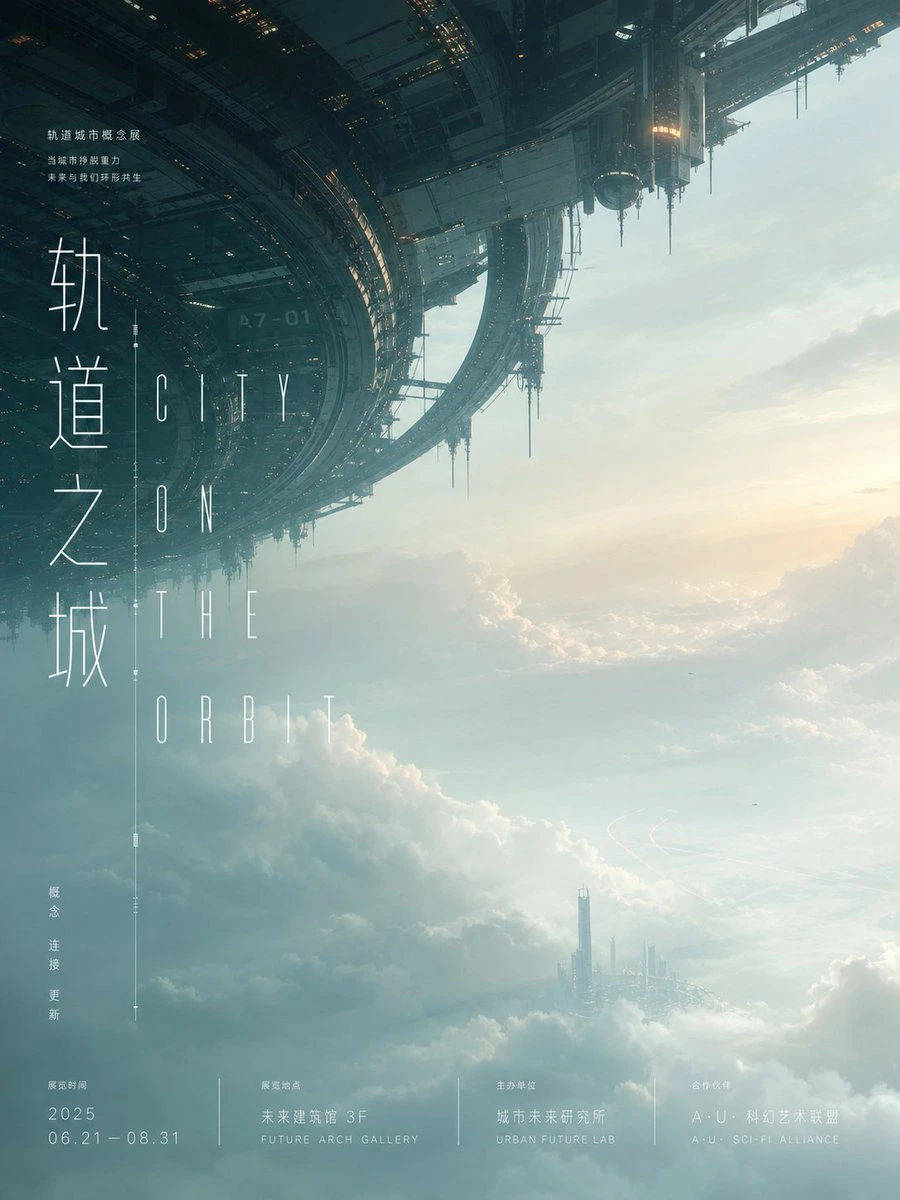
Complete AI image prompt
Translate the subject’s most recognizable structure, material logic, and symbolism into a monumental precision-built mass suspended upside down from the upper edge, extending beyond the frame and carrying roughly one third of the visual weight. Build it from theme-derived rings, modular chambers, trusses, conduits, cable bundles, articulated arms, and a few hanging components, with crisp near-field engineering detail, sparse cool-white indicators, and only occasional warm service lights establishing scale. Beneath this dense dark overhang, open an abrupt expanse of high-key luminous haze: a decisive figure-ground break from mechanical pressure to silence and weightlessness. Let that emptiness descend into layered clouds whose overlapping foreground, middle distance, atmospheric perspective, and diffused volumetric light progressively soften contrast; reveal only minute theme-derived carriers, landmarks, or information silhouettes through gaps in the clouds so their tiny scale amplifies the structure above. Maintain asymmetric dynamic equilibrium between the heavy upper boundary and the broad bright atmospheric field. Guide the eye laterally along the constructed edge, through the glowing void, then downward into cloud depth and distant traces. The theme may alter the structural anatomy and module count, while the inverted edge pressure, dense-to-empty ratio, and dramatic scale jump remain invariant. Derive color from the subject’s emotional temperature and material associations: a low-saturation cool dominant field, deep blue-gray, teal, or violet carrying the structure, milky white, mist blue, and pale gray carrying the air, with restrained amber or blush confined to indicator lights and illuminated cloud rims. Use remote enveloping light, narrow highlights over cool matte metal, softly emissive glass or translucent chambers, and continuous delicate tonal transitions across sky and vapor. Treat lettering as spatial coordinates rather than opaque blocks. Use an ultra-light monoline sans construction with even strokes, open counters, precise terminals, and valid anatomy for the chosen writing system. Break primary information into widely tracked display columns or an airy matrix crossing the open field; connect nodes, calibration ticks, and minute symbols with hairline axes. Arrange secondary information as narrow marginal columns with small type and generous tracking, preserving at least three scales of hierarchy: display glyphs, annotations, and micro labels. Offset type against the suspended mass without covering its defining silhouette; let white or ice-blue information lines hover lightly in haze. Keep surfaces optically clean, edges controlled, and the overall tone quiet, immense, exacting, and poised between a technical archive and poetic spatial narrative.
Original style prompt
Translate the subject’s most recognizable structure, material logic, and symbolism into a monumental precision-built mass suspended upside down from the upper edge, extending beyond the frame and carrying roughly one third of the visual weight. Build it from theme-derived rings, modular chambers, trusses, conduits, cable bundles, articulated arms, and a few hanging components, with crisp near-field engineering detail, sparse cool-white indicators, and only occasional warm service lights establishing scale. Beneath this dense dark overhang, open an abrupt expanse of high-key luminous haze: a decisive figure-ground break from mechanical pressure to silence and weightlessness. Let that emptiness descend into layered clouds whose overlapping foreground, middle distance, atmospheric perspective, and diffused volumetric light progressively soften contrast; reveal only minute theme-derived carriers, landmarks, or information silhouettes through gaps in the clouds so their tiny scale amplifies the structure above. Maintain asymmetric dynamic equilibrium between the heavy upper boundary and the broad bright atmospheric field. Guide the eye laterally along the constructed edge, through the glowing void, then downward into cloud depth and distant traces. The theme may alter the structural anatomy and module count, while the inverted edge pressure, dense-to-empty ratio, and dramatic scale jump remain invariant. Derive color from the subject’s emotional temperature and material associations: a low-saturation cool dominant field, deep blue-gray, teal, or violet carrying the structure, milky white, mist blue, and pale gray carrying the air, with restrained amber or blush confined to indicator lights and illuminated cloud rims. Use remote enveloping light, narrow highlights over cool matte metal, softly emissive glass or translucent chambers, and continuous delicate tonal transitions across sky and vapor. Treat lettering as spatial coordinates rather than opaque blocks. Use an ultra-light monoline sans construction with even strokes, open counters, precise terminals, and valid anatomy for the chosen writing system. Break primary information into widely tracked display columns or an airy matrix crossing the open field; connect nodes, calibration ticks, and minute symbols with hairline axes. Arrange secondary information as narrow marginal columns with small type and generous tracking, preserving at least three scales of hierarchy: display glyphs, annotations, and micro labels. Offset type against the suspended mass without covering its defining silhouette; let white or ice-blue information lines hover lightly in haze. Keep surfaces optically clean, edges controlled, and the overall tone quiet, immense, exacting, and poised between a technical archive and poetic spatial narrative.
More open images in the “Typography & Posters · Bright · 222” style