

Open prompts
sample 01 AI Image Prompt
sample 01, its complete AI image prompt, and the Good Morning & Daily Greetings · Good Morning · Good Night · 185 style are free to view and copy.
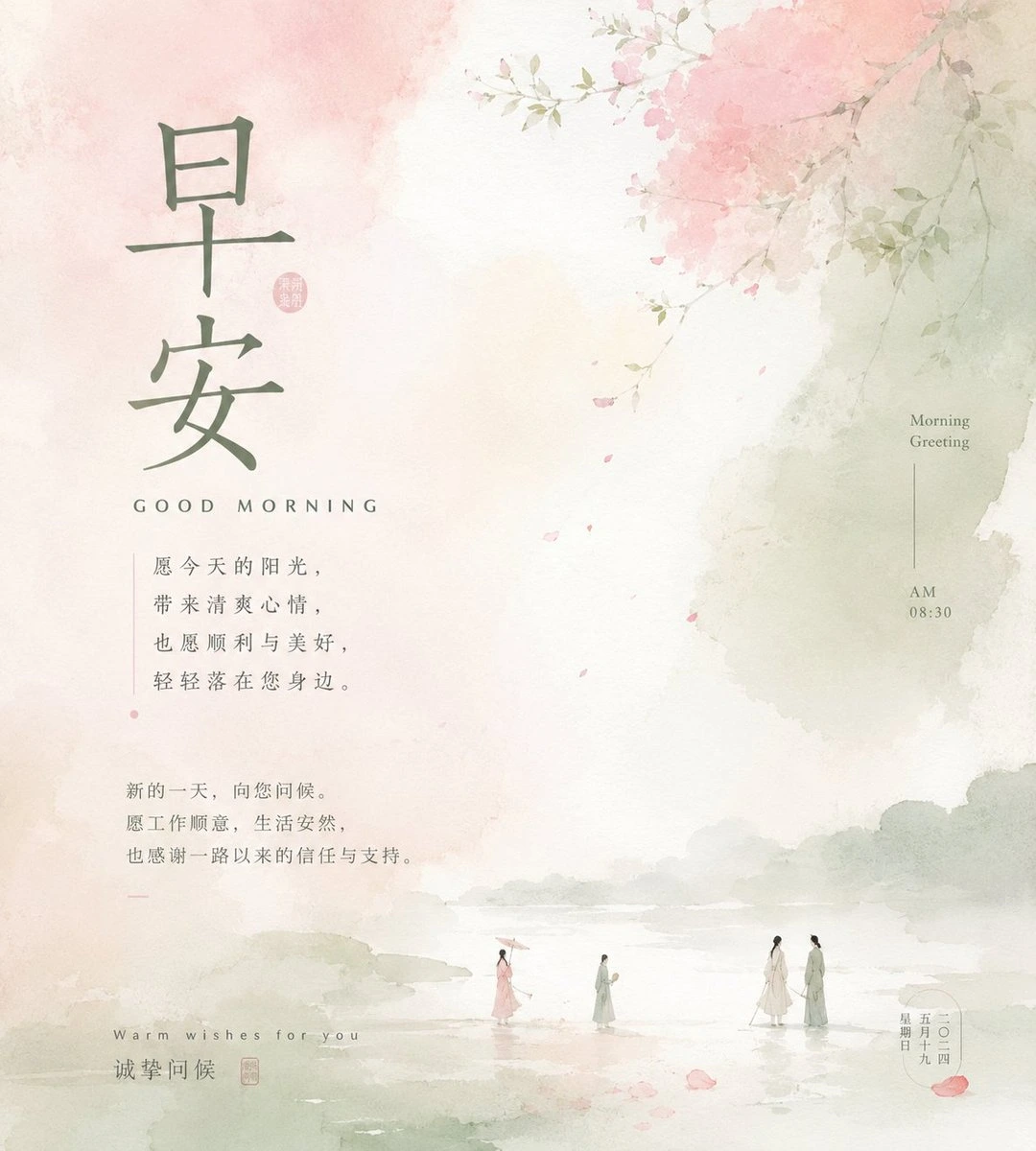
Complete AI image prompt
Build the first read around a theme-led display title with overwhelming visual weight: use legible, writing-system-aware lettering with an open skeleton, modulated stroke pressure, restrained terminals, and valid native glyph anatomy; for Chinese text, preserve complete components and credible calligraphic stroke order. Counter this title with dramatically smaller, widely spaced supporting type. Organize brief copy, metadata, time or category cues as narrow columns, short floating passages, or fine-rule-linked clusters that share an implied axis while varying their intervals; let the theme determine wording, reading direction, symbolic seal, and information priority. Treat the large lettering as a stable anchor on one side and let theme-derived environmental forms advance inward from the opposite side and the outer edges, balancing unequal masses across an expansive central void. The eye should enter through the title, cross the open field, pause at minor information, descend to a miniature narrative near the lower edge, then return through peripheral imagery. Construct the background as transparent watercolor and dilute ink absorbed into paper: wet-on-wet blooms, softly feathered transitions, natural pigment pooling, and reserved paper light remain localized to borders, distant planes, and environmental masses while the central field stays luminous and airy. Create depth through overlap, diminishing scale, dissolving contours, and compressed distant values. Derive framing growth, atmospheric forms, terrain, object contours, or equivalent peripheral motifs from the theme; distill its central symbol into one small suspended celestial-like mark or weightless emblem that quietly activates the open field. Add a few tiny theme-related figures, objects, or action silhouettes near the lower edge, rendered with economical ink lines and restrained color shapes to establish scale, emotional temperature, and narrative aftertaste. Allow a bounded shift between a high-key paper-white mode and a low-key ink-black mode according to the subject’s mood, but preserve one dominant value field, two or three desaturated watercolor supports, and a single vermilion seal-like accent. In the light mode, diffuse tender neighboring hues such as misty pink, gray green, and warm paper white; in the dark mode, surround smoky green and muted pink with deep ink while setting the lettering in a warm pale tone. In either mode, broad low contrast must support only a few crisp focal notes. Fuse poetic imagery, editorial information, and traditional marking into one measured system: hairline rules, tiny widely tracked Latin support text, small dots, and a compact square seal act only as rhythm. Keep watercolor contours soft and intermittently lost at the periphery, while glyph structures, key rules, and essential silhouettes remain clear. The finished language feels quiet, courteous, intimate, and ceremonially composed.
Original style prompt
Build the first read around a theme-led display title with overwhelming visual weight: use legible, writing-system-aware lettering with an open skeleton, modulated stroke pressure, restrained terminals, and valid native glyph anatomy; for Chinese text, preserve complete components and credible calligraphic stroke order. Counter this title with dramatically smaller, widely spaced supporting type. Organize brief copy, metadata, time or category cues as narrow columns, short floating passages, or fine-rule-linked clusters that share an implied axis while varying their intervals; let the theme determine wording, reading direction, symbolic seal, and information priority. Treat the large lettering as a stable anchor on one side and let theme-derived environmental forms advance inward from the opposite side and the outer edges, balancing unequal masses across an expansive central void. The eye should enter through the title, cross the open field, pause at minor information, descend to a miniature narrative near the lower edge, then return through peripheral imagery. Construct the background as transparent watercolor and dilute ink absorbed into paper: wet-on-wet blooms, softly feathered transitions, natural pigment pooling, and reserved paper light remain localized to borders, distant planes, and environmental masses while the central field stays luminous and airy. Create depth through overlap, diminishing scale, dissolving contours, and compressed distant values. Derive framing growth, atmospheric forms, terrain, object contours, or equivalent peripheral motifs from the theme; distill its central symbol into one small suspended celestial-like mark or weightless emblem that quietly activates the open field. Add a few tiny theme-related figures, objects, or action silhouettes near the lower edge, rendered with economical ink lines and restrained color shapes to establish scale, emotional temperature, and narrative aftertaste. Allow a bounded shift between a high-key paper-white mode and a low-key ink-black mode according to the subject’s mood, but preserve one dominant value field, two or three desaturated watercolor supports, and a single vermilion seal-like accent. In the light mode, diffuse tender neighboring hues such as misty pink, gray green, and warm paper white; in the dark mode, surround smoky green and muted pink with deep ink while setting the lettering in a warm pale tone. In either mode, broad low contrast must support only a few crisp focal notes. Fuse poetic imagery, editorial information, and traditional marking into one measured system: hairline rules, tiny widely tracked Latin support text, small dots, and a compact square seal act only as rhythm. Keep watercolor contours soft and intermittently lost at the periphery, while glyph structures, key rules, and essential silhouettes remain clear. The finished language feels quiet, courteous, intimate, and ceremonially composed.
More open images in the “Good Morning & Daily Greetings · Good Morning · Good Night · 185” style