

Open prompts
sample 01 AI Image Prompt
sample 01, its complete AI image prompt, and the Typography & Posters · Batch · 250 style are free to view and copy.
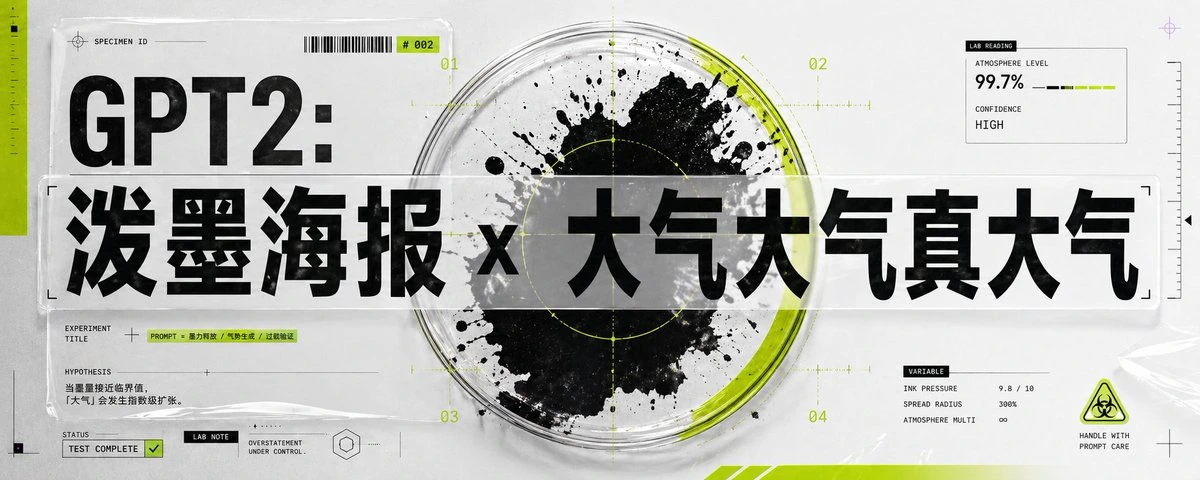
Complete AI image prompt
Build the first read around an extremely enlarged, custom heavy display headline that functions as the primary pictorial mass. Give the lettering dense black strokes, forceful vertical-horizontal contrast, compressed yet fully legible counters, purposeful component compression, angular cuts, and wedge-like terminals; redesign topology, joins, counters, and spacing according to the valid anatomy of the chosen writing system. A short secondary script fragment or symbol may act as a high-energy hinge, while all wording and identifiers come from the subject rather than an existing brand. Organize the field with a commanding horizontal axis: the headline reads as an almost continuous dark block, while a broad material event derived from the subject gathers, flows, erupts, or sweeps beneath it, behind it, or through selected letter areas. Let the subject determine the material's viscosity, transparency, reflectance, edge behavior, and direction. Fuse type and image through shared contours, occlusion, and tangent contact so the physical action explains the words instead of decorating them. Maintain a dramatic three-tier mass ratio between monumental headline, expansive material band, and tiny technical information. The eye should hit the lettering first, travel laterally along the continuous material curve, then resolve peripheral numbers, scales, and notes. Stabilize everything with a disciplined grid of hairline frames, baselines, crosshair registration marks, and measured intervals; allow only the giant type and material action to cross that system as a controlled violation. Preserve enough uninterrupted open field or solid color around the center to intensify its pressure. Derive the palette from the subject within strict bounds: one dominant field color, black-and-white structural values, and one luminous signal accent, using either an evenly lit precision field, a high-temperature saturated field, or a dark low-key surface while retaining severe value separation and very few colors. Carry the accent into fine interface rules, and let highlights obey the actual material. Convert secondary subject information into specimen-style identifiers, parameters, concise annotations, status bars, seal-like identity blocks, and a restrained footer; set these in narrow sans-serif forms and monospaced numerals with wide tracking and rigorous alignment, visually light and clearly subordinate. Match production behavior to the chosen semantic temperature: precision surfaces use even bright fields, transparent media, and crisp hard edges; saturated surfaces use real pigment sweeps with localized screened printing; dark surfaces use thick glossy matter shaped by low-key light and restrained metallic glints. Confine tactile variation to the moving material layer, keeping headline faces, information rules, and the outer field sharp and intact. The finished system must combine proclamation-scale typographic pressure, the credibility of a technical record, and the physical impact of subject-specific matter, with every detail reinforcing the headline–material–information chain.
Original style prompt
Build the first read around an extremely enlarged, custom heavy display headline that functions as the primary pictorial mass. Give the lettering dense black strokes, forceful vertical-horizontal contrast, compressed yet fully legible counters, purposeful component compression, angular cuts, and wedge-like terminals; redesign topology, joins, counters, and spacing according to the valid anatomy of the chosen writing system. A short secondary script fragment or symbol may act as a high-energy hinge, while all wording and identifiers come from the subject rather than an existing brand. Organize the field with a commanding horizontal axis: the headline reads as an almost continuous dark block, while a broad material event derived from the subject gathers, flows, erupts, or sweeps beneath it, behind it, or through selected letter areas. Let the subject determine the material's viscosity, transparency, reflectance, edge behavior, and direction. Fuse type and image through shared contours, occlusion, and tangent contact so the physical action explains the words instead of decorating them. Maintain a dramatic three-tier mass ratio between monumental headline, expansive material band, and tiny technical information. The eye should hit the lettering first, travel laterally along the continuous material curve, then resolve peripheral numbers, scales, and notes. Stabilize everything with a disciplined grid of hairline frames, baselines, crosshair registration marks, and measured intervals; allow only the giant type and material action to cross that system as a controlled violation. Preserve enough uninterrupted open field or solid color around the center to intensify its pressure. Derive the palette from the subject within strict bounds: one dominant field color, black-and-white structural values, and one luminous signal accent, using either an evenly lit precision field, a high-temperature saturated field, or a dark low-key surface while retaining severe value separation and very few colors. Carry the accent into fine interface rules, and let highlights obey the actual material. Convert secondary subject information into specimen-style identifiers, parameters, concise annotations, status bars, seal-like identity blocks, and a restrained footer; set these in narrow sans-serif forms and monospaced numerals with wide tracking and rigorous alignment, visually light and clearly subordinate. Match production behavior to the chosen semantic temperature: precision surfaces use even bright fields, transparent media, and crisp hard edges; saturated surfaces use real pigment sweeps with localized screened printing; dark surfaces use thick glossy matter shaped by low-key light and restrained metallic glints. Confine tactile variation to the moving material layer, keeping headline faces, information rules, and the outer field sharp and intact. The finished system must combine proclamation-scale typographic pressure, the credibility of a technical record, and the physical impact of subject-specific matter, with every detail reinforcing the headline–material–information chain.
More open images in the “Typography & Posters · Batch · 250” style