

Open prompts
sample 02 AI Image Prompt
sample 02, its complete AI image prompt, and the Infographics & Visual Guides · Bright · 131 style are free to view and copy.
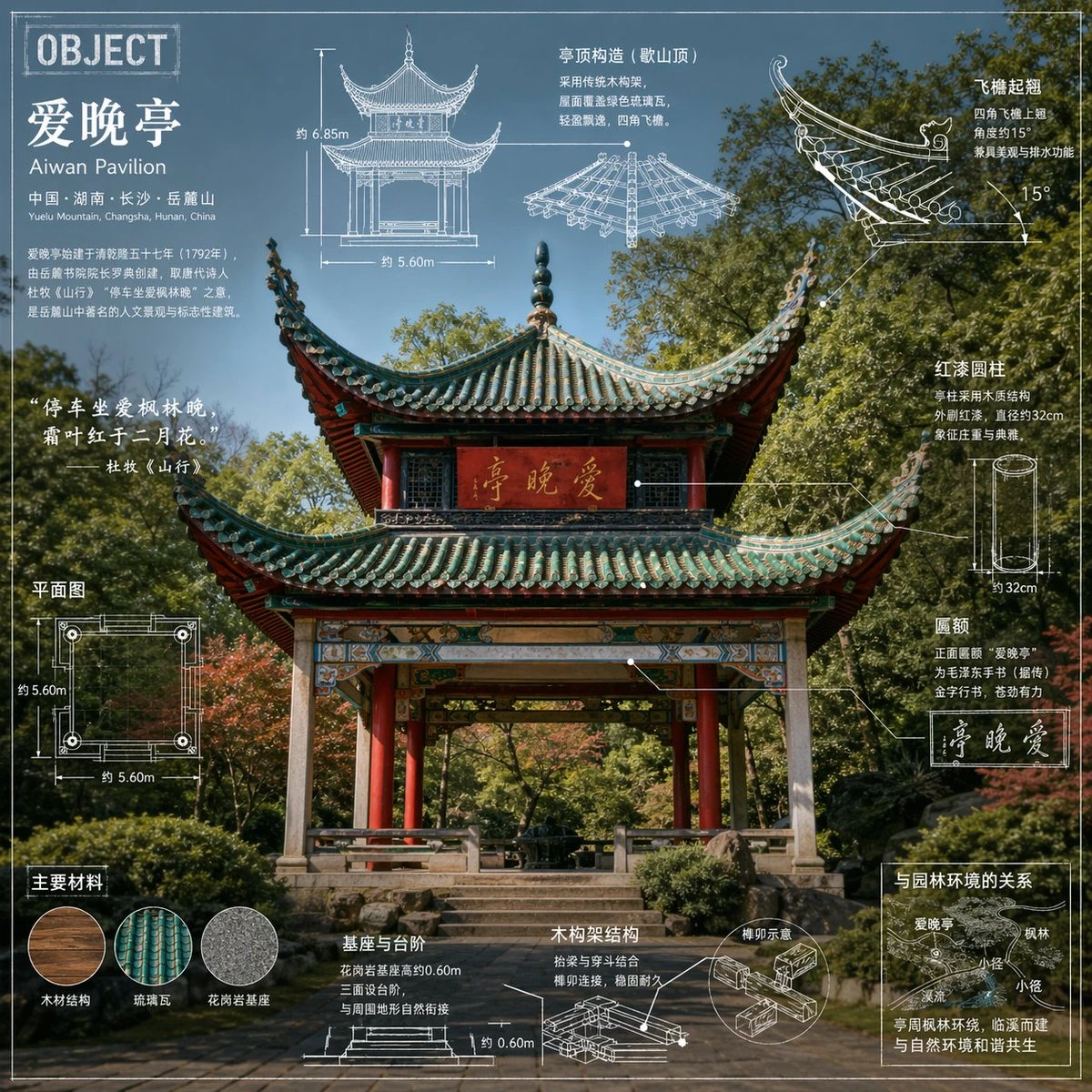
Complete AI image prompt
Build the image around a dominant documentary photograph whose theme-defined main form retains a complete, immediately recognizable silhouette and enough structural resolution to reward close inspection. Give it a near-frontal, stable axis and monumental visual weight, while a real setting continues behind it to establish scale, place, use, and atmosphere. Keep the environmental field restrained, cool-leaning, and middle-to-dark in value; let the subject’s authentic materials and a small concentration of warmer theme-derived color provide the chromatic anchor. Grow a precise white survey layer from the subject’s contours and key joints: fine continuous outlines, dimension arrows, angle arcs, terminal dots, and right-angled leader lines must land on the corresponding photographic features so technical drawing and physical evidence validate each other. Use the peripheral breathing room for compact orthographic construction studies, exploded structural logic, circular detail enlargements, material sample discs, spatial relationships, and concise scale figures, all generated from the theme’s actual makeup, function, symbolism, and narrative. Preserve a dominant-center to light-periphery hierarchy: the main form commands most of the visual field, while explanatory modules form a restrained ring near the edges and shift within a bounded range between axial stability and asymmetrical equilibrium. The eye reads the subject first, follows leaders into local evidence, then settles on the outer summary; route fine lines around the highest-recognition details. Enclose the system with an exceptionally thin white rule, interrupted at the corners by short drafting ticks or open right angles. Divide information through open space, reserving hairline boxes and translucent dark panels for the few dense clusters that need contrast. Treat lettering as an archival instrument: the theme name receives the largest scale, a category tag sits in a narrow outlined nameplate, and descriptions, measurements, locations, and relationships descend through two or three clear sizes. Preserve valid glyph anatomy and natural spacing in the primary writing system; coordinate any secondary script at lower scale with a clean sans serif, generous tracking, aligned baselines, and matched optical weight. Culturally inflected display forms may shape short headings, while supporting copy stays lucid and rational. Keep natural daylight, credible shadows, material reflections, and atmospheric depth in the photograph; render every overlay evenly bright with crisp edges and restrained line-weight contrast, producing a visual dossier that feels monumental at first glance, intricate up close, measurable, explorable, and rigorously ordered.
Original style prompt
Build the image around a dominant documentary photograph whose theme-defined main form retains a complete, immediately recognizable silhouette and enough structural resolution to reward close inspection. Give it a near-frontal, stable axis and monumental visual weight, while a real setting continues behind it to establish scale, place, use, and atmosphere. Keep the environmental field restrained, cool-leaning, and middle-to-dark in value; let the subject’s authentic materials and a small concentration of warmer theme-derived color provide the chromatic anchor. Grow a precise white survey layer from the subject’s contours and key joints: fine continuous outlines, dimension arrows, angle arcs, terminal dots, and right-angled leader lines must land on the corresponding photographic features so technical drawing and physical evidence validate each other. Use the peripheral breathing room for compact orthographic construction studies, exploded structural logic, circular detail enlargements, material sample discs, spatial relationships, and concise scale figures, all generated from the theme’s actual makeup, function, symbolism, and narrative. Preserve a dominant-center to light-periphery hierarchy: the main form commands most of the visual field, while explanatory modules form a restrained ring near the edges and shift within a bounded range between axial stability and asymmetrical equilibrium. The eye reads the subject first, follows leaders into local evidence, then settles on the outer summary; route fine lines around the highest-recognition details. Enclose the system with an exceptionally thin white rule, interrupted at the corners by short drafting ticks or open right angles. Divide information through open space, reserving hairline boxes and translucent dark panels for the few dense clusters that need contrast. Treat lettering as an archival instrument: the theme name receives the largest scale, a category tag sits in a narrow outlined nameplate, and descriptions, measurements, locations, and relationships descend through two or three clear sizes. Preserve valid glyph anatomy and natural spacing in the primary writing system; coordinate any secondary script at lower scale with a clean sans serif, generous tracking, aligned baselines, and matched optical weight. Culturally inflected display forms may shape short headings, while supporting copy stays lucid and rational. Keep natural daylight, credible shadows, material reflections, and atmospheric depth in the photograph; render every overlay evenly bright with crisp edges and restrained line-weight contrast, producing a visual dossier that feels monumental at first glance, intricate up close, measurable, explorable, and rigorously ordered.
More open images in the “Infographics & Visual Guides · Bright · 131” style