

Open prompts
sample 02 AI Image Prompt
sample 02, its complete AI image prompt, and the Typography & Posters · Bright · 226 style are free to view and copy.
Complete AI image prompt
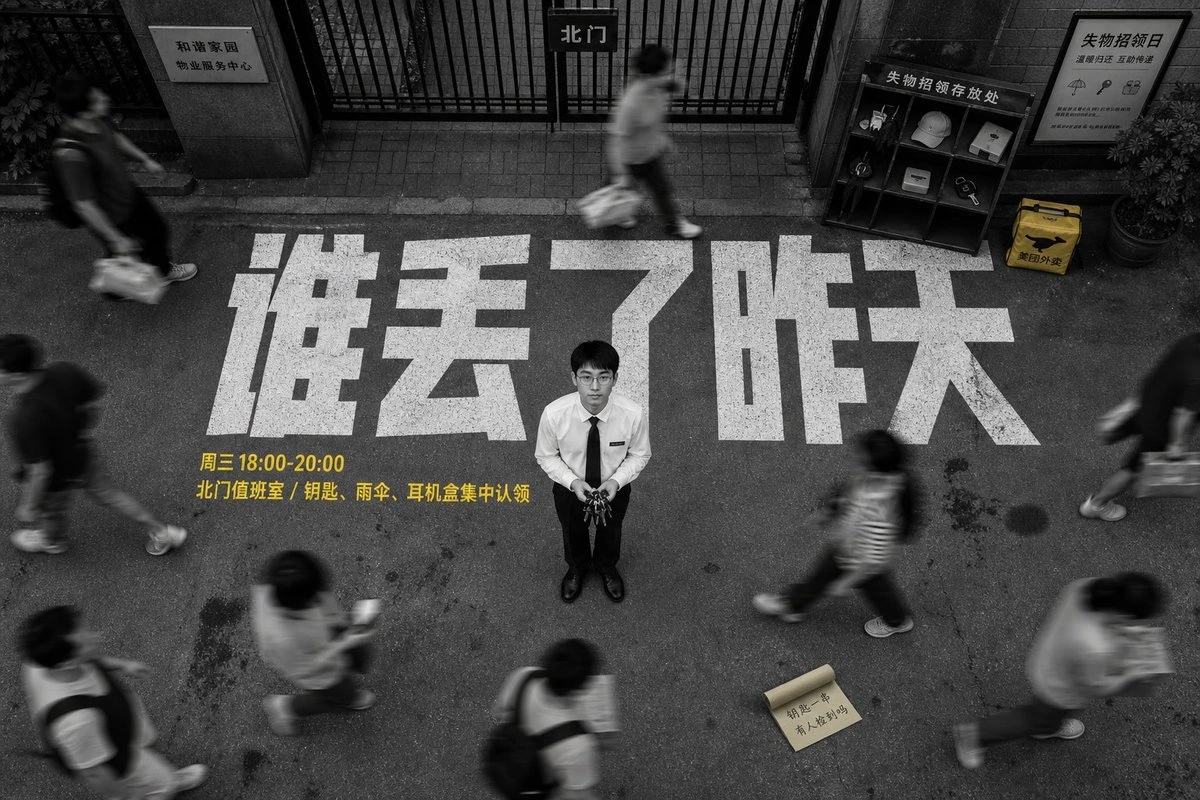
Turn a real public environment into a readable graphic field through a near-vertical overhead photographic viewpoint. The first read is a monumental theme-derived statement laid directly across the ground in enormous pale lettering; a much smaller but sharply resolved key figure or object holds the visual axis while surrounding pedestrians, vehicles, or environmental participants stream across it in several directions. Build a dynamic equilibrium between a still central monument and a moving peripheral field: the lettering carries the greatest area and luminance, the compact focal subject arrests the eye through crisp contour and inward, frontal posture, and cropped moving bodies enter from the edges, overlap the glyphs, and lead the gaze outward through elongated exposure blur. Keep street texture, circulation markings, thresholds, and site fixtures as photographic evidence of scale and direction, all subordinate to the type–subject hierarchy. Construct the main lettering from an ultra-bold, low-contrast, compressed geometric sans skeleton adapted to the valid anatomy of the target writing system: enlarged primary stems, heavy cross strokes, squared joins, tight counters, close spacing, modular rhythm, and selective angular cuts. Allow the lockup to stretch or skew slightly with the site's perspective so it reads as broad matte paint bonded to the ground; the coarse pavement causes fine, localized breaks only within the pale painted layer, while the focal subject, vehicles, and built structures retain firm photographic edges. Set one or two clusters of supporting information in a narrow, widely spaced small face within quieter space beside the dominant words, carrying theme-supplied time, place, or explanatory content; the abrupt scale jump must intensify the physical pressure of the main lettering. Use restrained monochrome documentary tonality: deep environmental blacks surround luminous gray-white type, while middle values preserve clothing folds, reflected moisture, and site material. Reserve a single high-chroma accent for one semantically decisive theme-derived accessory, garment detail, symbol, or brief information cue; keep its area tiny but optically forceful, and derive its hue from the theme's emotional temperature and symbolic meaning. Maintain plausible ambient direction, contact shadows, and photographic depth, lifting local contrast around the still focal subject while speed stretches only the moving field. The result should feel immediate, austere, socially observant, and physically embedded in an authentic public scene, with giant ground lettering, frozen focus, and circulating motion operating as one narrative mechanism.
Original style prompt
Turn a real public environment into a readable graphic field through a near-vertical overhead photographic viewpoint. The first read is a monumental theme-derived statement laid directly across the ground in enormous pale lettering; a much smaller but sharply resolved key figure or object holds the visual axis while surrounding pedestrians, vehicles, or environmental participants stream across it in several directions. Build a dynamic equilibrium between a still central monument and a moving peripheral field: the lettering carries the greatest area and luminance, the compact focal subject arrests the eye through crisp contour and inward, frontal posture, and cropped moving bodies enter from the edges, overlap the glyphs, and lead the gaze outward through elongated exposure blur. Keep street texture, circulation markings, thresholds, and site fixtures as photographic evidence of scale and direction, all subordinate to the type–subject hierarchy. Construct the main lettering from an ultra-bold, low-contrast, compressed geometric sans skeleton adapted to the valid anatomy of the target writing system: enlarged primary stems, heavy cross strokes, squared joins, tight counters, close spacing, modular rhythm, and selective angular cuts. Allow the lockup to stretch or skew slightly with the site's perspective so it reads as broad matte paint bonded to the ground; the coarse pavement causes fine, localized breaks only within the pale painted layer, while the focal subject, vehicles, and built structures retain firm photographic edges. Set one or two clusters of supporting information in a narrow, widely spaced small face within quieter space beside the dominant words, carrying theme-supplied time, place, or explanatory content; the abrupt scale jump must intensify the physical pressure of the main lettering. Use restrained monochrome documentary tonality: deep environmental blacks surround luminous gray-white type, while middle values preserve clothing folds, reflected moisture, and site material. Reserve a single high-chroma accent for one semantically decisive theme-derived accessory, garment detail, symbol, or brief information cue; keep its area tiny but optically forceful, and derive its hue from the theme's emotional temperature and symbolic meaning. Maintain plausible ambient direction, contact shadows, and photographic depth, lifting local contrast around the still focal subject while speed stretches only the moving field. The result should feel immediate, austere, socially observant, and physically embedded in an authentic public scene, with giant ground lettering, frozen focus, and circulating motion operating as one narrative mechanism.
More open images in the “Typography & Posters · Bright · 226” style