
Open prompts
sample 02 AI Image Prompt
sample 02, its complete AI image prompt, and the Creator Covers & Editorial Images · Bright · 272 style are free to view and copy.
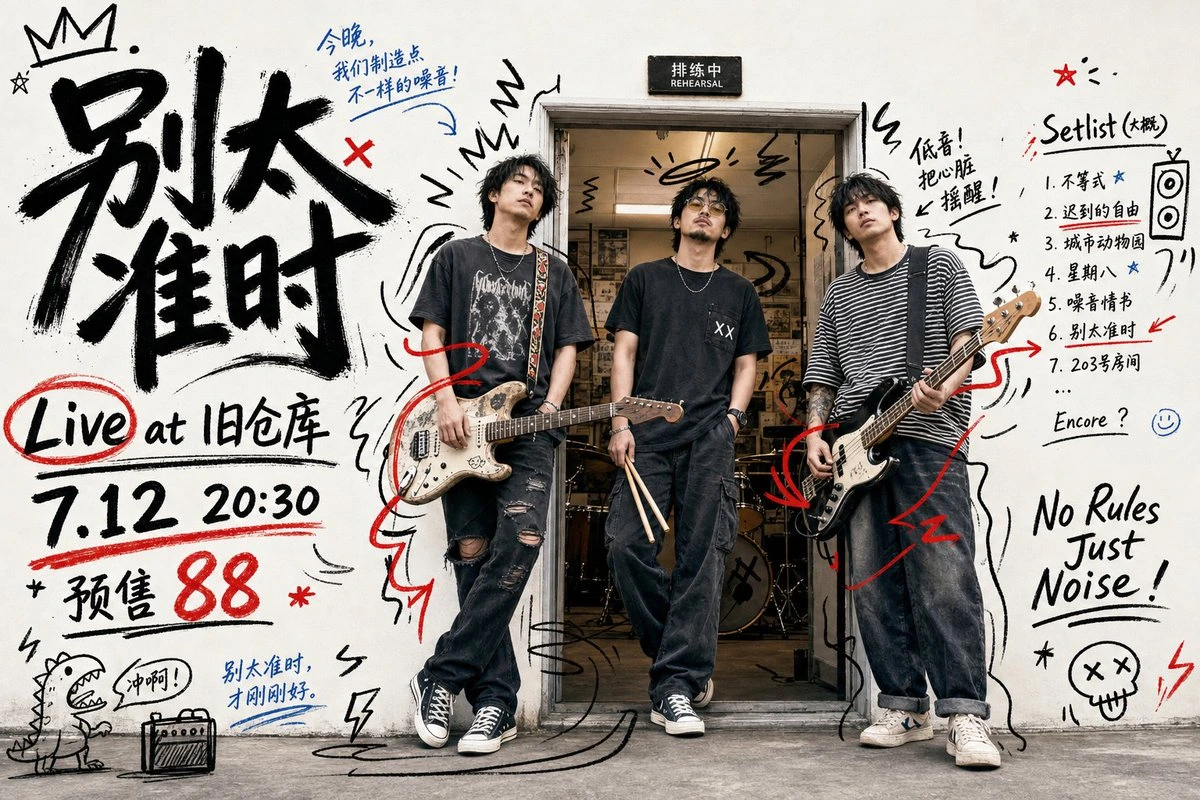
Complete AI image prompt
Build the first read from a tight collision between polished documentary photography and an all-over hand-drawn information layer. Give the theme’s most recognizable real-world carrier the dominant optical mass, with credible natural light, tactile materials, expressive action or emotion, and enough environmental context to feel observed rather than staged. Redraw its outer silhouette with thick, springy black marker strokes that cross photographic edges decisively, break in selected places, and rely on visual closure to make the subject feel manually cut out of reality. Counterweight it with an oversized headline written through mixed brush and broad-marker pressure: abrupt thick-to-thin changes, flung terminals, uneven glyph widths, shifting baselines, and valid, legible anatomy for the chosen writing system. Let one pivotal word accept a warm-colored double circle, underline, or long connecting stroke. The headline and photographic carrier must form dynamic asymmetrical balance across a generous pale field; their direction may reverse, but their unequal weights must visibly pull against each other. Establish a guided reading loop from headline to subject through warm arrows and arcs, onward through cool explanatory notes, black side comments, and small marginal icons, then into the decisive action information. Maintain a pronounced large-medium-small scale jump among subject, headline, annotations, and symbols; cluster dense notes beside the evidence they explain, preserve breathing room around the perimeter, and let only a few strokes violate the implied information grid. Derive every phrase, symbol, attachment, and narrative cue from the active theme and its information hierarchy: one concise main message remains highly readable, secondary lines behave like quick field notes, while circles, brackets, wavy rules, crosses, stars, lightning marks, motion ticks, and directional arrows express emphasis and causality. Reduce theme-born symbols to naive, instantly legible black contour doodles with minimal fill, sharing the same wrist speed as the lettering. Let the photograph supply the broad color world, then constrain drawing to structural black plus one cool and one warm high-chroma annotation color extracted from the theme: warm marks select and energize, cool marks explain and organize, while a broad light wall, sky, or paper-like open field carries the ink. A slightly tilted pale memo patch with a tape-like color tab may anchor one essential note. Keep marker ink flat and dense with slight pressure-led edge variation, preserve clear photographic detail and intact pale surfaces, and fuse the credibility of a candid moment with the participatory immediacy of a working notebook and the instant hierarchy of shareable editorial content.
Original style prompt
Build the first read from a tight collision between polished documentary photography and an all-over hand-drawn information layer. Give the theme’s most recognizable real-world carrier the dominant optical mass, with credible natural light, tactile materials, expressive action or emotion, and enough environmental context to feel observed rather than staged. Redraw its outer silhouette with thick, springy black marker strokes that cross photographic edges decisively, break in selected places, and rely on visual closure to make the subject feel manually cut out of reality. Counterweight it with an oversized headline written through mixed brush and broad-marker pressure: abrupt thick-to-thin changes, flung terminals, uneven glyph widths, shifting baselines, and valid, legible anatomy for the chosen writing system. Let one pivotal word accept a warm-colored double circle, underline, or long connecting stroke. The headline and photographic carrier must form dynamic asymmetrical balance across a generous pale field; their direction may reverse, but their unequal weights must visibly pull against each other. Establish a guided reading loop from headline to subject through warm arrows and arcs, onward through cool explanatory notes, black side comments, and small marginal icons, then into the decisive action information. Maintain a pronounced large-medium-small scale jump among subject, headline, annotations, and symbols; cluster dense notes beside the evidence they explain, preserve breathing room around the perimeter, and let only a few strokes violate the implied information grid. Derive every phrase, symbol, attachment, and narrative cue from the active theme and its information hierarchy: one concise main message remains highly readable, secondary lines behave like quick field notes, while circles, brackets, wavy rules, crosses, stars, lightning marks, motion ticks, and directional arrows express emphasis and causality. Reduce theme-born symbols to naive, instantly legible black contour doodles with minimal fill, sharing the same wrist speed as the lettering. Let the photograph supply the broad color world, then constrain drawing to structural black plus one cool and one warm high-chroma annotation color extracted from the theme: warm marks select and energize, cool marks explain and organize, while a broad light wall, sky, or paper-like open field carries the ink. A slightly tilted pale memo patch with a tape-like color tab may anchor one essential note. Keep marker ink flat and dense with slight pressure-led edge variation, preserve clear photographic detail and intact pale surfaces, and fuse the credibility of a candid moment with the participatory immediacy of a working notebook and the instant hierarchy of shareable editorial content.
More open images in the “Creator Covers & Editorial Images · Bright · 272” style