

Open prompts
sample 02 AI Image Prompt
sample 02, its complete AI image prompt, and the Photo Restyling · Paper Sculpture · Impasto · 197 style are free to view and copy.
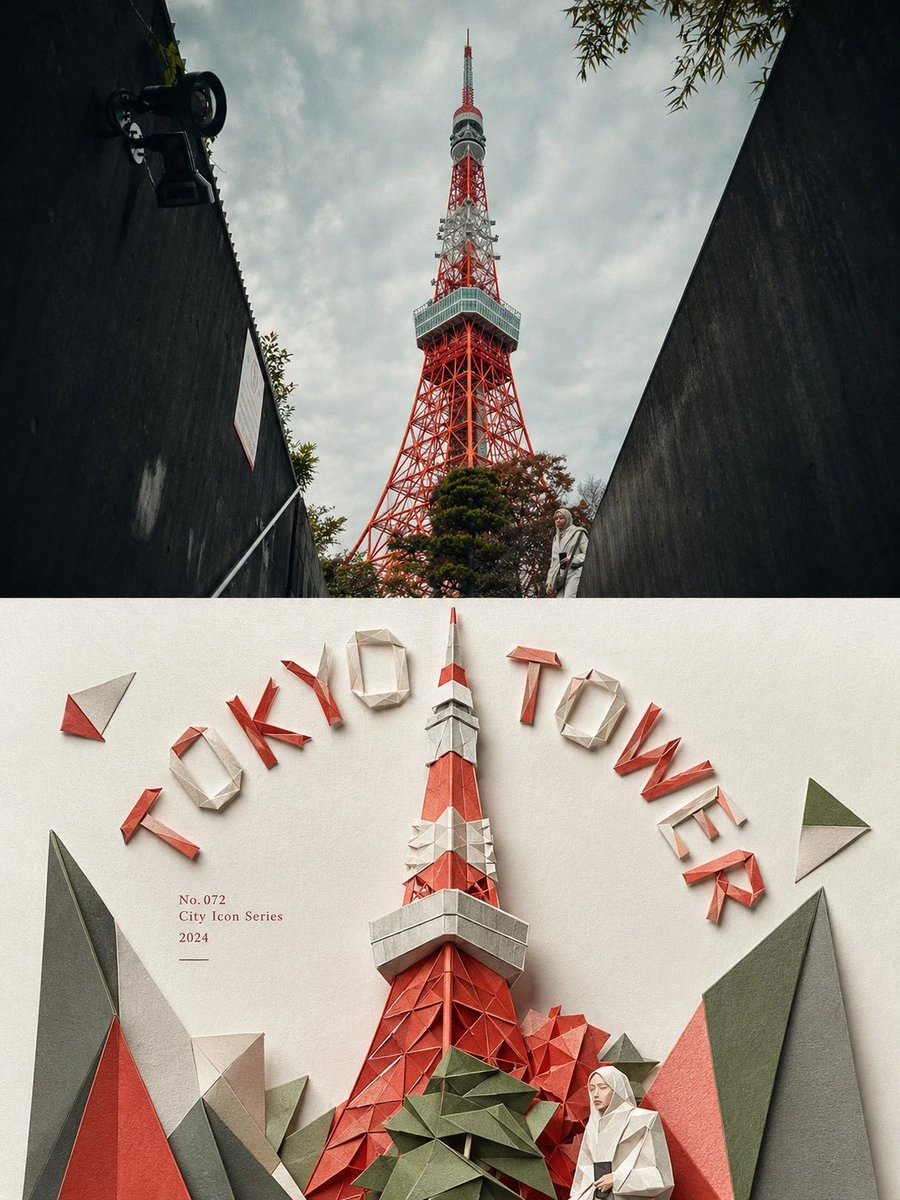
Complete AI image prompt
Build the image around a crisp horizontal division that turns one subject into a paired visual event: a credible real-world scene and its authored graphic recoding. The first field is specific, dimensional photography, preserving the subject’s most recognizable moment, the relationships among figures or objects, environmental scale, natural lighting, and legible depth. The second field extracts the same scene’s silhouette, perspective axis, repeated rhythm, hierarchy of masses, and decisive action, then reconstructs them on a warm ivory paper field as a distilled editorial image. The eye should encounter lived reality first and then recognize the same meaning compressed into a new visual syntax. Give the two fields comparable weight and bind them through a shared axis, echoed contour, or repeated gesture so continuity survives the division; in the graphic field, protect generous breathing room around one dominant thematic form, use sparse marginal information as a distant counterweight, and allow one controlled element to break the implied grid. Let the subject’s material associations select one principal making language from a bounded family: folded colored paper and shallow relief built with triangular facets, scored folds, layered edges, and soft contact shadows; flat illustration built from unoutlined color shapes, decisive silhouettes, few depth levels, and compressed perspective; or a localized impasto collage in which a miniature reconstruction is embedded inside one tactile swath of palette-knife pigment whose edges taper back into an otherwise even paper field. Use only one of these material logics as the lead treatment, while the photographic and recoded fields retain the same compositional skeleton, directional action, and relational palette. Derive color from the subject itself: one dominant family, one dark structural value, and one concentrated accent, distributed as broad restrained fields, stable dark anchors, and small high-chroma signals. Light creates atmosphere and depth in the photographic field, then reappears below as planar value separation, fold shadow, or physical pigment thickness. Treat lettering as editorial notation rather than promotional copy: one concise thematic title with a few numbers, place notes, observations, or chapter marks; create a strong scale jump between title and metadata, maintain valid anatomy for the chosen writing system, and use open tracking, fine rules, narrow text columns, and optical edge alignment to produce a quiet reading rhythm. When emphasis is needed, the title may be folded, cut, or given relief in the subject-derived material while remaining immediately readable. The finished system combines the order of a archival editorial plate with precise contemporary reduction: an evenly toned warm paper ground, solid flat ink, crisp contours, and physically credible thickness, folds, edges, and cast shadows. The photograph and abstraction must function as mutual evidence, retaining the subject’s emotional temperature while reducing its identity to an unmistakable symbolic system.
Original style prompt
Build the image around a crisp horizontal division that turns one subject into a paired visual event: a credible real-world scene and its authored graphic recoding. The first field is specific, dimensional photography, preserving the subject’s most recognizable moment, the relationships among figures or objects, environmental scale, natural lighting, and legible depth. The second field extracts the same scene’s silhouette, perspective axis, repeated rhythm, hierarchy of masses, and decisive action, then reconstructs them on a warm ivory paper field as a distilled editorial image. The eye should encounter lived reality first and then recognize the same meaning compressed into a new visual syntax. Give the two fields comparable weight and bind them through a shared axis, echoed contour, or repeated gesture so continuity survives the division; in the graphic field, protect generous breathing room around one dominant thematic form, use sparse marginal information as a distant counterweight, and allow one controlled element to break the implied grid. Let the subject’s material associations select one principal making language from a bounded family: folded colored paper and shallow relief built with triangular facets, scored folds, layered edges, and soft contact shadows; flat illustration built from unoutlined color shapes, decisive silhouettes, few depth levels, and compressed perspective; or a localized impasto collage in which a miniature reconstruction is embedded inside one tactile swath of palette-knife pigment whose edges taper back into an otherwise even paper field. Use only one of these material logics as the lead treatment, while the photographic and recoded fields retain the same compositional skeleton, directional action, and relational palette. Derive color from the subject itself: one dominant family, one dark structural value, and one concentrated accent, distributed as broad restrained fields, stable dark anchors, and small high-chroma signals. Light creates atmosphere and depth in the photographic field, then reappears below as planar value separation, fold shadow, or physical pigment thickness. Treat lettering as editorial notation rather than promotional copy: one concise thematic title with a few numbers, place notes, observations, or chapter marks; create a strong scale jump between title and metadata, maintain valid anatomy for the chosen writing system, and use open tracking, fine rules, narrow text columns, and optical edge alignment to produce a quiet reading rhythm. When emphasis is needed, the title may be folded, cut, or given relief in the subject-derived material while remaining immediately readable. The finished system combines the order of a archival editorial plate with precise contemporary reduction: an evenly toned warm paper ground, solid flat ink, crisp contours, and physically credible thickness, folds, edges, and cast shadows. The photograph and abstraction must function as mutual evidence, retaining the subject’s emotional temperature while reducing its identity to an unmistakable symbolic system.
More open images in the “Photo Restyling · Paper Sculpture · Impasto · 197” style