
Open prompts
sample 02 AI Image Prompt
sample 02, its complete AI image prompt, and the Portraits, Weddings & Photography · Line Art · Pixel Art · 104 style are free to view and copy.
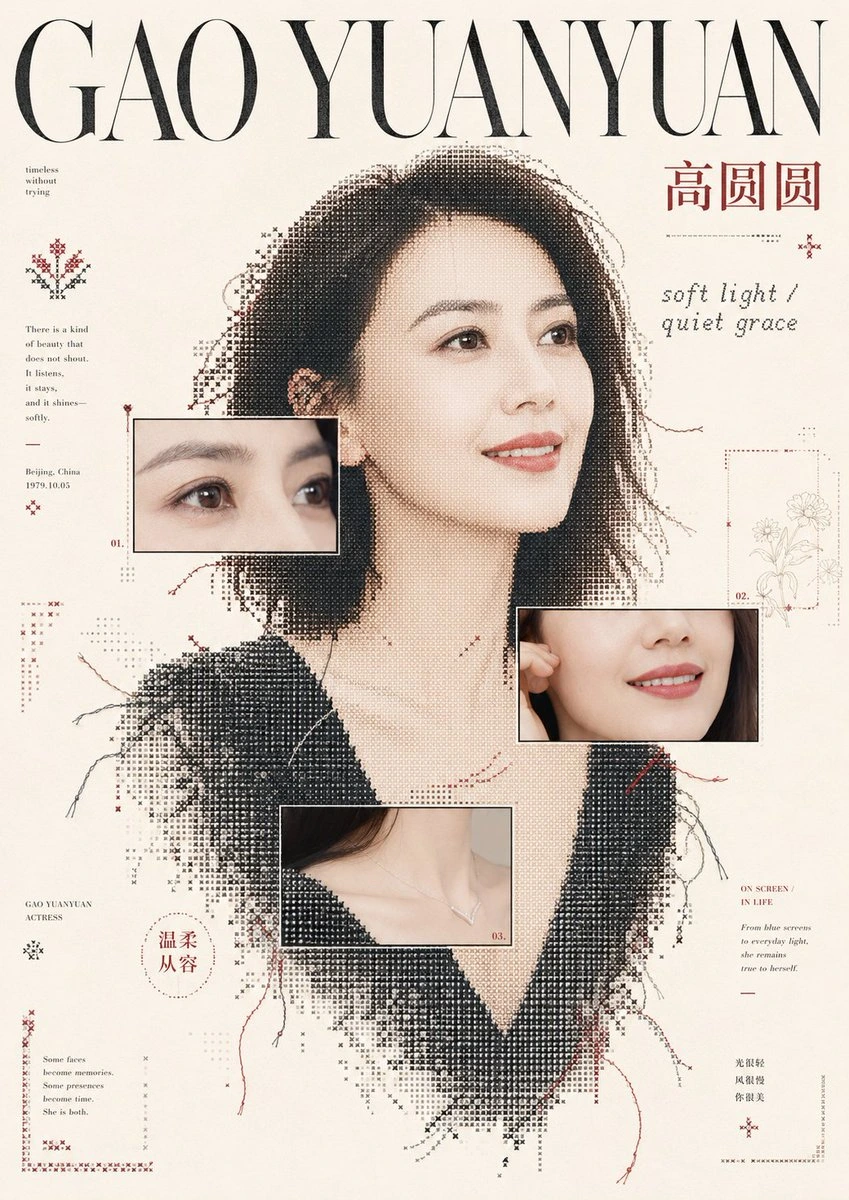
Complete AI image prompt
Build the image around one monumental, close-view subject carrier whose most recognizable form dominates the visual center and slightly exceeds the underlying editorial field. Reconstruct the continuous image as a disciplined matrix of cross-stitches and minute square halftone cells: dense, fully resolved stitching preserves the key recognition zone, while the outer contour progressively disperses into isolated X marks, interrupted strands, and fine trailing threads, making the subject appear to emerge from a woven image system. Lay roughly three sharply resolved rectangular detail windows across the main form at unequal scales and intervals. Let the theme choose the cropped evidence—signature features, material contact points, or symbolic details—rendered with photographic clarity, soft luster, and hairline dark borders; use their overlap to alternately conceal and reveal the stitched carrier and redirect attention between title, whole form, and intimate evidence. Span most of the upper field with an immense high-contrast serif display line, using hairline horizontals, forceful verticals, sharp wedge terminals, compact spacing, and a slight intersection with the subject edge. Generate all wording from the subject and intended writing system, preserving valid glyph topology and orthographic recognition. Set secondary naming in a poised cultural voice, then distribute captions, dates, indices, coordinates, and short archival notes in tiny type with open leading as narrow columns, corner labels, short vertical runs, hairline framed cards, and circular seals. Govern the space through a severe dominant-to-subordinate scale jump: a central image mass outweighs the peripheral information fragments, an implied editorial grid supplies calm order, and only the oversized carrier, floating windows, and escaping threads break that grid. Keep generous breathing room around the ensemble and balance small marginal modules asymmetrically; the eye enters through the display title, descends into the main form, pauses at the crisp windows, then follows thread paths toward micro-annotations. Use an even matte ivory paper field. Derive subject hues and local materials from the theme, compressing the broad value structure into ink black and warm neutrals, with restrained dark carmine and muted gold accents reserved for stitches, rules, indices, and emblematic marks. Light the resolved subject areas with high-key, enveloping softness and continuous tonal modeling while retaining separation inside the dark masses. Derive a sparse family of cross-stitched emblems, botanical-like contour traces, geometric needlework borders, and archival symbols from the theme, keeping them minute and placing them near information nodes and open margins. Preserve a bright, flat paper field and crisp window edges; confine the woven conversion to the dominant carrier and its thread trajectories so photographic intimacy, handmade stitch logic, and quiet editorial collectability remain causally joined.
Original style prompt
Build the image around one monumental, close-view subject carrier whose most recognizable form dominates the visual center and slightly exceeds the underlying editorial field. Reconstruct the continuous image as a disciplined matrix of cross-stitches and minute square halftone cells: dense, fully resolved stitching preserves the key recognition zone, while the outer contour progressively disperses into isolated X marks, interrupted strands, and fine trailing threads, making the subject appear to emerge from a woven image system. Lay roughly three sharply resolved rectangular detail windows across the main form at unequal scales and intervals. Let the theme choose the cropped evidence—signature features, material contact points, or symbolic details—rendered with photographic clarity, soft luster, and hairline dark borders; use their overlap to alternately conceal and reveal the stitched carrier and redirect attention between title, whole form, and intimate evidence. Span most of the upper field with an immense high-contrast serif display line, using hairline horizontals, forceful verticals, sharp wedge terminals, compact spacing, and a slight intersection with the subject edge. Generate all wording from the subject and intended writing system, preserving valid glyph topology and orthographic recognition. Set secondary naming in a poised cultural voice, then distribute captions, dates, indices, coordinates, and short archival notes in tiny type with open leading as narrow columns, corner labels, short vertical runs, hairline framed cards, and circular seals. Govern the space through a severe dominant-to-subordinate scale jump: a central image mass outweighs the peripheral information fragments, an implied editorial grid supplies calm order, and only the oversized carrier, floating windows, and escaping threads break that grid. Keep generous breathing room around the ensemble and balance small marginal modules asymmetrically; the eye enters through the display title, descends into the main form, pauses at the crisp windows, then follows thread paths toward micro-annotations. Use an even matte ivory paper field. Derive subject hues and local materials from the theme, compressing the broad value structure into ink black and warm neutrals, with restrained dark carmine and muted gold accents reserved for stitches, rules, indices, and emblematic marks. Light the resolved subject areas with high-key, enveloping softness and continuous tonal modeling while retaining separation inside the dark masses. Derive a sparse family of cross-stitched emblems, botanical-like contour traces, geometric needlework borders, and archival symbols from the theme, keeping them minute and placing them near information nodes and open margins. Preserve a bright, flat paper field and crisp window edges; confine the woven conversion to the dominant carrier and its thread trajectories so photographic intimacy, handmade stitch logic, and quiet editorial collectability remain causally joined.
More open images in the “Portraits, Weddings & Photography · Line Art · Pixel Art · 104” style