
Open prompts
sample 02 AI Image Prompt
sample 02, its complete AI image prompt, and the Good Morning & Daily Greetings · Good Morning · Bright · 176 style are free to view and copy.
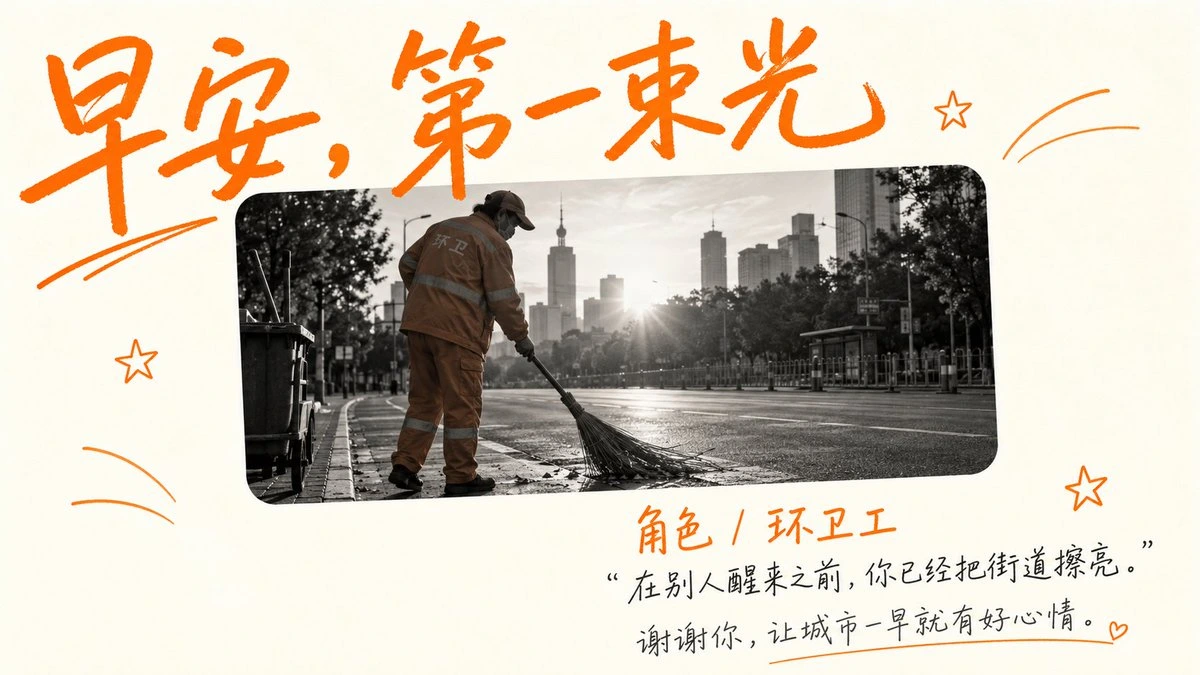
Complete AI image prompt
Build the first read around an emphatic scale jump between oversized freehand display lettering and one rounded-corner documentary image. Let the headline sweep across an edge, stack into an irregular second line, or interlock asymmetrically with the image; balance these unequal masses with generous warm paper space and a few distant marginal marks rather than fixing them to one position. Derive the scene entirely from the chosen subject: capture a restrained, humane moment of action with only the environmental clues needed to make it credible, rendered as black-and-white or near-monochrome photography with natural early light, lucid tonal separation, and selective depth. Crop according to gesture, object direction, or narrative gaze, then contain the photographic complexity inside a broad-radius rectangular frame. Construct the headline in the requested writing system as legible brush lettering with a heavy handmade skeleton, pressure-driven width changes, gently unsettled baselines, open finishing sweeps, and localized dry-brush openings along the stroke edges; vary spacing with the spoken cadence while preserving valid glyph anatomy and orthographic recognition. Set supporting copy in a much finer, lighter handwritten line. Maintain three information levels: a brief greeting or thematic declaration as the dominant lettering mass, a medium-sized identity or role line as the anchor, and one or two intimate sentences as the quiet response near an open margin; all wording, symbolism, identity, and narrative cues must come from the subject. Extract one vivid accent hue from the subject's emotional temperature and material associations. Confine it to the headline, selected words, underlines, and sparse drawn marks while the photograph remains neutral and the largest field stays warm ivory; if the headline is dark, reduce the hue to small sunlit annotations. Keep the area hierarchy paper first, image second, colored ink last. Draw a few subject-derived shorthand symbols, stars, short rays, arcs, or botanical-like strokes in the same accent ink, echoing the brush terminals and carrying the eye from headline to image, then to identity line and closing sentence. Use long thin underlines with occasional hooks, overlaps, and overrun ends as connective paths. Finish as an editorial morning note made on smooth matte card: crisp photographic boundaries, dense clear accent ink, visible hand-pressure variation, quiet outer space, and concentrated information where lettering meets image, creating a sincere, bright, buoyant rhythm with a sense of shared care.
Original style prompt
Build the first read around an emphatic scale jump between oversized freehand display lettering and one rounded-corner documentary image. Let the headline sweep across an edge, stack into an irregular second line, or interlock asymmetrically with the image; balance these unequal masses with generous warm paper space and a few distant marginal marks rather than fixing them to one position. Derive the scene entirely from the chosen subject: capture a restrained, humane moment of action with only the environmental clues needed to make it credible, rendered as black-and-white or near-monochrome photography with natural early light, lucid tonal separation, and selective depth. Crop according to gesture, object direction, or narrative gaze, then contain the photographic complexity inside a broad-radius rectangular frame. Construct the headline in the requested writing system as legible brush lettering with a heavy handmade skeleton, pressure-driven width changes, gently unsettled baselines, open finishing sweeps, and localized dry-brush openings along the stroke edges; vary spacing with the spoken cadence while preserving valid glyph anatomy and orthographic recognition. Set supporting copy in a much finer, lighter handwritten line. Maintain three information levels: a brief greeting or thematic declaration as the dominant lettering mass, a medium-sized identity or role line as the anchor, and one or two intimate sentences as the quiet response near an open margin; all wording, symbolism, identity, and narrative cues must come from the subject. Extract one vivid accent hue from the subject's emotional temperature and material associations. Confine it to the headline, selected words, underlines, and sparse drawn marks while the photograph remains neutral and the largest field stays warm ivory; if the headline is dark, reduce the hue to small sunlit annotations. Keep the area hierarchy paper first, image second, colored ink last. Draw a few subject-derived shorthand symbols, stars, short rays, arcs, or botanical-like strokes in the same accent ink, echoing the brush terminals and carrying the eye from headline to image, then to identity line and closing sentence. Use long thin underlines with occasional hooks, overlaps, and overrun ends as connective paths. Finish as an editorial morning note made on smooth matte card: crisp photographic boundaries, dense clear accent ink, visible hand-pressure variation, quiet outer space, and concentrated information where lettering meets image, creating a sincere, bright, buoyant rhythm with a sense of shared care.
More open images in the “Good Morning & Daily Greetings · Good Morning · Bright · 176” style