

Open prompts
sample 02 AI Image Prompt
sample 02, its complete AI image prompt, and the Good Morning & Daily Greetings · Good Morning · Line Art · 186 style are free to view and copy.
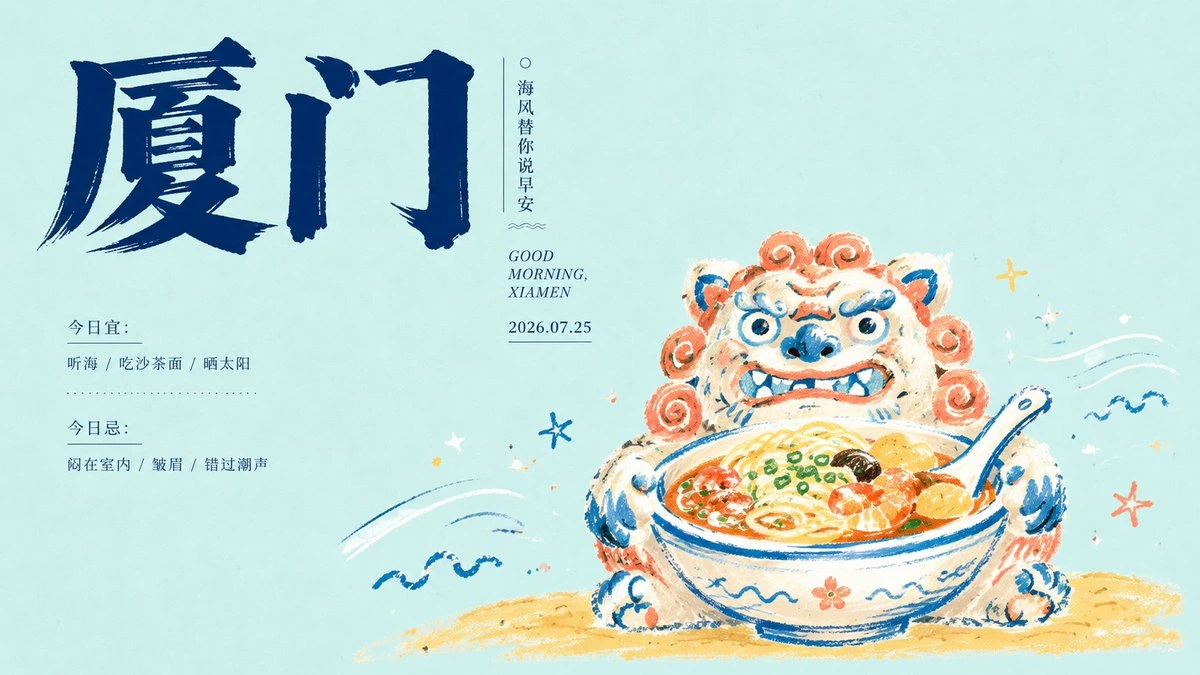
Complete AI image prompt
Build the first read around two unequal but balanced anchors: an exceptionally large theme-led headline and a recognizable thematic carrier reconstructed as an analog image. Separate them with a generous quiet field so the eye moves through a firm sequence of heavy lettering, pause, focal image, and marginal record data. Let the headline press an edge, run vertically or expand across a line, while the image occupies the counterweight, crosses an implied column, or emerges inside a narrow luminous opening; preserve the relational balance rather than fixed coordinates. Derive the carrier silhouette, symbolic attachments, small marks, narrative clues, and palette from the theme itself. For an open, buoyant emotional temperature, draw the carrier with wax crayon and colored pencil: directional strokes, incompletely filled shapes, lively contour offsets, layered pigment, and a sparse orbit of arcs, stars, and shorthand symbols that echo its shape. For a quieter, more monumental temperature, convert it into monochrome survey linework and a low-opacity image revealed through a deep light slit framed by dark masking edges. Keep these as two bounded expressions of one system: the light mode uses an even low-chroma paper field, deep-ink lettering, and three to five vivid theme-derived accents; the dark mode uses continuous near-black matte boundaries, a warm-white luminous paper core, and one identifying theme color, with brightness concentrated in the revealed center and peripheral data held back. Make typography function as information architecture. Set the main Chinese wording as valid, legible glyphs with either forceful brush-built strokes or high-contrast display construction, preserving authentic stroke order, tapered entries, weighted turns, open counters, and irregular hand-made edges. Pair it with narrow serif or typewriter-like Latin support text and orderly Song-derived or monospaced small Chinese text. Create at least three decisive scale levels through the giant title, date and index numbers, brief copy, fine ruled tables, circular seals, measurement callouts, and tiny symbols; generate all wording from the theme and maintain correct orthography. Restrict secondary marks to a few hand-drawn signs or technical annotations that repeat the carrier's contours and guide the reading path while leaving the quiet field spacious. Keep the focal image emotionally hand-rendered and locally overprinted, but make the information layer fine, straight, and restrained, using this precision mismatch to join everyday warmth with observational authority. Preserve the visible analog production logic: in the light mode, waxy pigment skips naturally across the paper and linework occasionally escapes the colored shapes while untouched paper stays evenly bright; in the dark mode, opaque masking material creates soft irregular inner borders around a clear luminous core, crisp line drawing, and dense continuous outer fields. Across any change of subject, retain the long-distance counterbalance between monumental type and thematic image, abundant breathing room, marginal archive data, the friction between handmade illustration and exact editorial setting, and the theme-controlled shift between a high-key pastel field and a low-key aperture field, yielding a serial visual language that feels simultaneously like a daily greeting and a numbered observation specimen.
Original style prompt
Build the first read around two unequal but balanced anchors: an exceptionally large theme-led headline and a recognizable thematic carrier reconstructed as an analog image. Separate them with a generous quiet field so the eye moves through a firm sequence of heavy lettering, pause, focal image, and marginal record data. Let the headline press an edge, run vertically or expand across a line, while the image occupies the counterweight, crosses an implied column, or emerges inside a narrow luminous opening; preserve the relational balance rather than fixed coordinates. Derive the carrier silhouette, symbolic attachments, small marks, narrative clues, and palette from the theme itself. For an open, buoyant emotional temperature, draw the carrier with wax crayon and colored pencil: directional strokes, incompletely filled shapes, lively contour offsets, layered pigment, and a sparse orbit of arcs, stars, and shorthand symbols that echo its shape. For a quieter, more monumental temperature, convert it into monochrome survey linework and a low-opacity image revealed through a deep light slit framed by dark masking edges. Keep these as two bounded expressions of one system: the light mode uses an even low-chroma paper field, deep-ink lettering, and three to five vivid theme-derived accents; the dark mode uses continuous near-black matte boundaries, a warm-white luminous paper core, and one identifying theme color, with brightness concentrated in the revealed center and peripheral data held back. Make typography function as information architecture. Set the main Chinese wording as valid, legible glyphs with either forceful brush-built strokes or high-contrast display construction, preserving authentic stroke order, tapered entries, weighted turns, open counters, and irregular hand-made edges. Pair it with narrow serif or typewriter-like Latin support text and orderly Song-derived or monospaced small Chinese text. Create at least three decisive scale levels through the giant title, date and index numbers, brief copy, fine ruled tables, circular seals, measurement callouts, and tiny symbols; generate all wording from the theme and maintain correct orthography. Restrict secondary marks to a few hand-drawn signs or technical annotations that repeat the carrier's contours and guide the reading path while leaving the quiet field spacious. Keep the focal image emotionally hand-rendered and locally overprinted, but make the information layer fine, straight, and restrained, using this precision mismatch to join everyday warmth with observational authority. Preserve the visible analog production logic: in the light mode, waxy pigment skips naturally across the paper and linework occasionally escapes the colored shapes while untouched paper stays evenly bright; in the dark mode, opaque masking material creates soft irregular inner borders around a clear luminous core, crisp line drawing, and dense continuous outer fields. Across any change of subject, retain the long-distance counterbalance between monumental type and thematic image, abundant breathing room, marginal archive data, the friction between handmade illustration and exact editorial setting, and the theme-controlled shift between a high-key pastel field and a low-key aperture field, yielding a serial visual language that feels simultaneously like a daily greeting and a numbered observation specimen.
More open images in the “Good Morning & Daily Greetings · Good Morning · Line Art · 186” style