

Open prompts
sample 02 AI Image Prompt
sample 02, its complete AI image prompt, and the Photo Restyling · Paper Cut · Impasto · 209 style are free to view and copy.
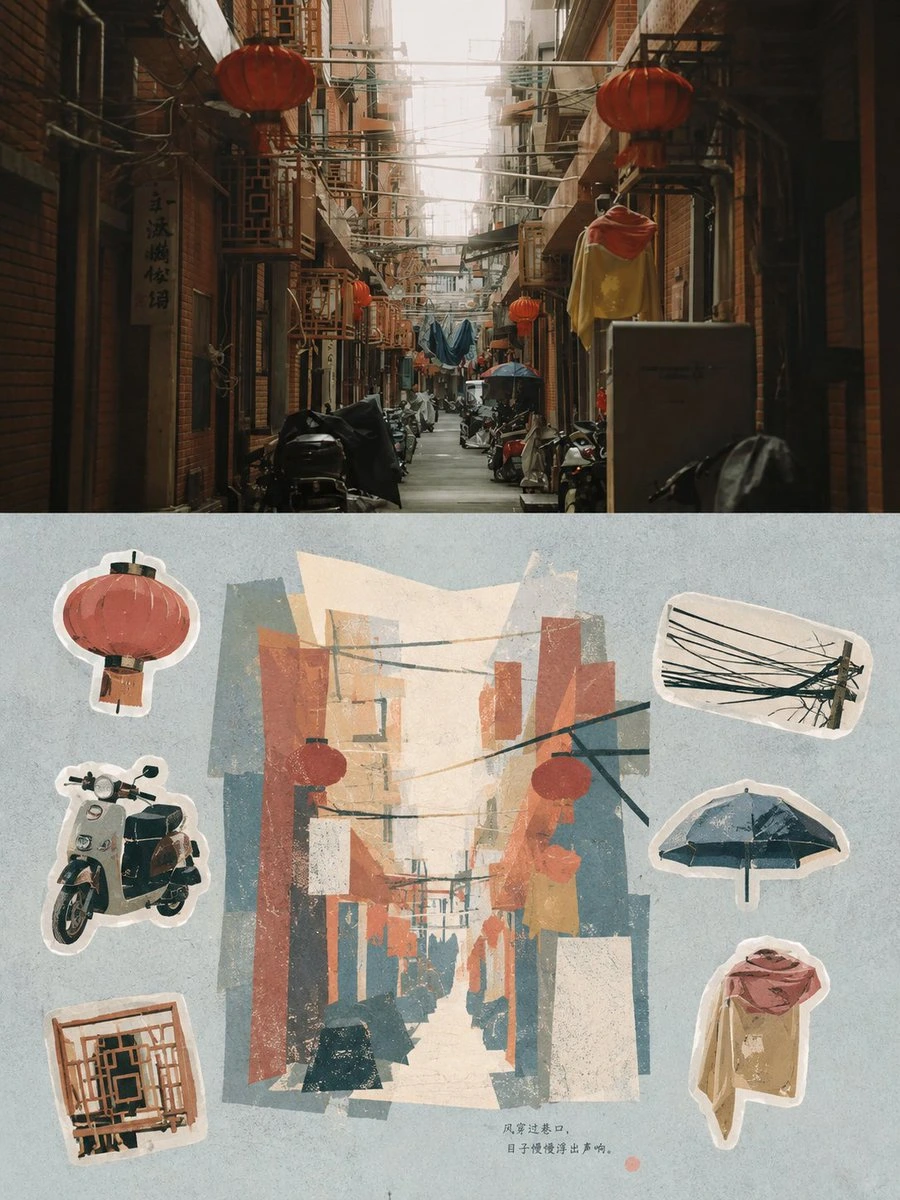
Complete AI image prompt
Build a two-part act of seeing around one subject, giving equal visual weight to a fully resolved photograph of the real encounter above and a remembered, hand-reconstructed version of that same encounter below. Join the fields with a calm, exact horizontal seam: the eye should first register factual light, scale, and place, then discover their emotional afterimage. In the photographic field, preserve credible perspective, a clearly recognizable primary form, foreground-to-distance separation, and an environment that naturally frames the subject through foliage, architecture, objects, or other theme-derived cues. Allow the lighting to range with the subject from warm dusk to lucid daylight or a dim enclosed passage, while retaining purposeful warm-cool depth, atmospheric separation, and one small, saturated color anchor. Rebuild the lower field on warm ivory or a pale paper tone derived from the subject's emotional climate. Carry over the photograph's visual center, directional flow, major silhouette, and spatial relationships without copying incidental detail. Describe the dominant form with broad matte opaque paint dragged by a palette knife, compact impasto strokes, and open edges that reveal the paper, or translate its perspective skeleton into overlapping, low-chroma, cut-paper-like geometric planes. Keep the theme-bearing form at the highest level of recognition; compress supporting surroundings into grouped color masses, interrupted contours, and softened distant shapes, with untouched paper acting as air and pause. Let the subject determine the central form, symbolism, material associations, narrative attachments, and native color sources; soften the photographic palette into powdery, low-saturation mixtures while carrying one vivid field color into the reconstruction as a mnemonic rivet between both views. When the subject contains useful fragments, arrange a restrained orbit of small photographic excerpts around the painted center, each with an irregular rounded paper edge and each isolating an attachment, texture, gesture, or distant clue. Link these fragments back to the reconstruction through repeated silhouettes and color echoes, creating a whole-to-fragment-to-whole reading loop. When a purely painterly interpretation serves the subject better, replace the excerpts with a generous side field of paper and brushwork entering from the edge, preserving the same asymmetrical counterweight and breathing rhythm. Set only a tiny, low-contrast reflective phrase in the available quiet space, using either a fine bookish serif structure or an airy handwritten line with wide spacing and loose leading; keep it decisively subordinate and finish it with a short rule or a small seal-like mark. Maintain a fine, even natural paper-fiber surface throughout the lower field, confine raised pigment and tactile buildup to the reconstructed forms and active brush marks, and keep the photographic field optically clear and precise. The photograph provides evidence; paint and collage perform selection, simplification, and tenderness. Make the media contrast unmistakable while binding both halves through the same compositional skeleton, color anchor, and emotional temperature.
Original style prompt
Build a two-part act of seeing around one subject, giving equal visual weight to a fully resolved photograph of the real encounter above and a remembered, hand-reconstructed version of that same encounter below. Join the fields with a calm, exact horizontal seam: the eye should first register factual light, scale, and place, then discover their emotional afterimage. In the photographic field, preserve credible perspective, a clearly recognizable primary form, foreground-to-distance separation, and an environment that naturally frames the subject through foliage, architecture, objects, or other theme-derived cues. Allow the lighting to range with the subject from warm dusk to lucid daylight or a dim enclosed passage, while retaining purposeful warm-cool depth, atmospheric separation, and one small, saturated color anchor. Rebuild the lower field on warm ivory or a pale paper tone derived from the subject's emotional climate. Carry over the photograph's visual center, directional flow, major silhouette, and spatial relationships without copying incidental detail. Describe the dominant form with broad matte opaque paint dragged by a palette knife, compact impasto strokes, and open edges that reveal the paper, or translate its perspective skeleton into overlapping, low-chroma, cut-paper-like geometric planes. Keep the theme-bearing form at the highest level of recognition; compress supporting surroundings into grouped color masses, interrupted contours, and softened distant shapes, with untouched paper acting as air and pause. Let the subject determine the central form, symbolism, material associations, narrative attachments, and native color sources; soften the photographic palette into powdery, low-saturation mixtures while carrying one vivid field color into the reconstruction as a mnemonic rivet between both views. When the subject contains useful fragments, arrange a restrained orbit of small photographic excerpts around the painted center, each with an irregular rounded paper edge and each isolating an attachment, texture, gesture, or distant clue. Link these fragments back to the reconstruction through repeated silhouettes and color echoes, creating a whole-to-fragment-to-whole reading loop. When a purely painterly interpretation serves the subject better, replace the excerpts with a generous side field of paper and brushwork entering from the edge, preserving the same asymmetrical counterweight and breathing rhythm. Set only a tiny, low-contrast reflective phrase in the available quiet space, using either a fine bookish serif structure or an airy handwritten line with wide spacing and loose leading; keep it decisively subordinate and finish it with a short rule or a small seal-like mark. Maintain a fine, even natural paper-fiber surface throughout the lower field, confine raised pigment and tactile buildup to the reconstructed forms and active brush marks, and keep the photographic field optically clear and precise. The photograph provides evidence; paint and collage perform selection, simplification, and tenderness. Make the media contrast unmistakable while binding both halves through the same compositional skeleton, color anchor, and emotional temperature.
More open images in the “Photo Restyling · Paper Cut · Impasto · 209” style