

Open prompts
sample 02 AI Image Prompt
sample 02, its complete AI image prompt, and the Solar Terms & Festivals · Solar Terms · Paper Texture · 049 style are free to view and copy.
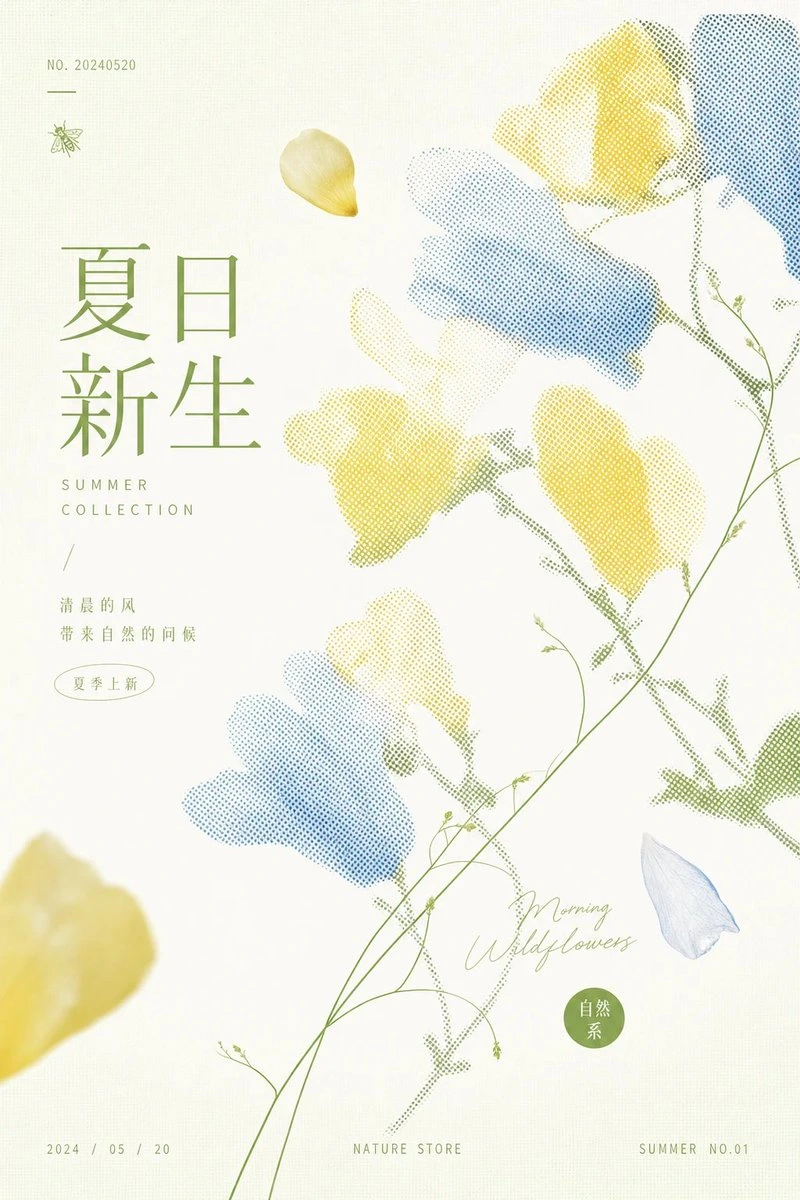
Complete AI image prompt
Reveal the theme's most recognizable forms through regular circular halftone screens: modulate dot size continuously with light, shade, and volume so dense passages resolve into legible silhouettes and visual anchors while sparse passages dissolve into open paper white, keeping the subject simultaneously descriptive and print-abstract. Enlarge one or two dominant masses until they continue beyond the frame, then counter their asymmetric weight with a broad, quiet field and remote micro-information. Let the theme supply the forms, symbolism, attachments, and narrative; translate its defining structure into screened contours, pale echoes, and a few sharply resolved miniature signs rather than a fixed object family or scene. Draw one hairline arc or restrained diagonal route across the emptiness, marked by only a few tiny circular nodes; it should guide the eye from display lettering through the dominant form and secondary sign toward marginal data, crossing, skimming, and briefly slipping behind shapes without losing continuity. Build an extreme typographic scale and density contrast: use very few tall, airy display glyphs with fine-to-moderate stroke contrast, crisp terminals, generous proportions, and valid anatomy for the chosen writing system; set supporting copy in extremely small narrow lettering with wide tracking, organized as short columns, dates, indices, bilingual tags, compact seals, or simple rules at the margins, carrying only theme-derived information. Derive color from the theme's emotional temperature and material associations: preserve warm paper white as the dominant field, assign one low-to-medium chroma structural hue to display type, hairlines, and the principal screens, and confine one or two lucid support hues to selected forms and pinpoint accents. Keep support-color area distinctly subordinate, overlaps pale and breathable, values high, and dark coverage low. Use an even warm-white matte paper ground with cleanly separated ink dots, regular spacing, and paper showing through every screen; reserve soft translucent-paper, watercolor-wash, or thin-cutout diffusion for a single lightweight thematic accent while all other graphics retain crisp flat-print edges. The reading order should begin with the tension between screened monumentality and emptiness, then disclose precision lettering and miniature narrative along the fine route, producing a lucid, restrained, exacting editorial character with an East Asian sense of space.
Original style prompt
Reveal the theme's most recognizable forms through regular circular halftone screens: modulate dot size continuously with light, shade, and volume so dense passages resolve into legible silhouettes and visual anchors while sparse passages dissolve into open paper white, keeping the subject simultaneously descriptive and print-abstract. Enlarge one or two dominant masses until they continue beyond the frame, then counter their asymmetric weight with a broad, quiet field and remote micro-information. Let the theme supply the forms, symbolism, attachments, and narrative; translate its defining structure into screened contours, pale echoes, and a few sharply resolved miniature signs rather than a fixed object family or scene. Draw one hairline arc or restrained diagonal route across the emptiness, marked by only a few tiny circular nodes; it should guide the eye from display lettering through the dominant form and secondary sign toward marginal data, crossing, skimming, and briefly slipping behind shapes without losing continuity. Build an extreme typographic scale and density contrast: use very few tall, airy display glyphs with fine-to-moderate stroke contrast, crisp terminals, generous proportions, and valid anatomy for the chosen writing system; set supporting copy in extremely small narrow lettering with wide tracking, organized as short columns, dates, indices, bilingual tags, compact seals, or simple rules at the margins, carrying only theme-derived information. Derive color from the theme's emotional temperature and material associations: preserve warm paper white as the dominant field, assign one low-to-medium chroma structural hue to display type, hairlines, and the principal screens, and confine one or two lucid support hues to selected forms and pinpoint accents. Keep support-color area distinctly subordinate, overlaps pale and breathable, values high, and dark coverage low. Use an even warm-white matte paper ground with cleanly separated ink dots, regular spacing, and paper showing through every screen; reserve soft translucent-paper, watercolor-wash, or thin-cutout diffusion for a single lightweight thematic accent while all other graphics retain crisp flat-print edges. The reading order should begin with the tension between screened monumentality and emptiness, then disclose precision lettering and miniature narrative along the fine route, producing a lucid, restrained, exacting editorial character with an East Asian sense of space.
More open images in the “Solar Terms & Festivals · Solar Terms · Paper Texture · 049” style